
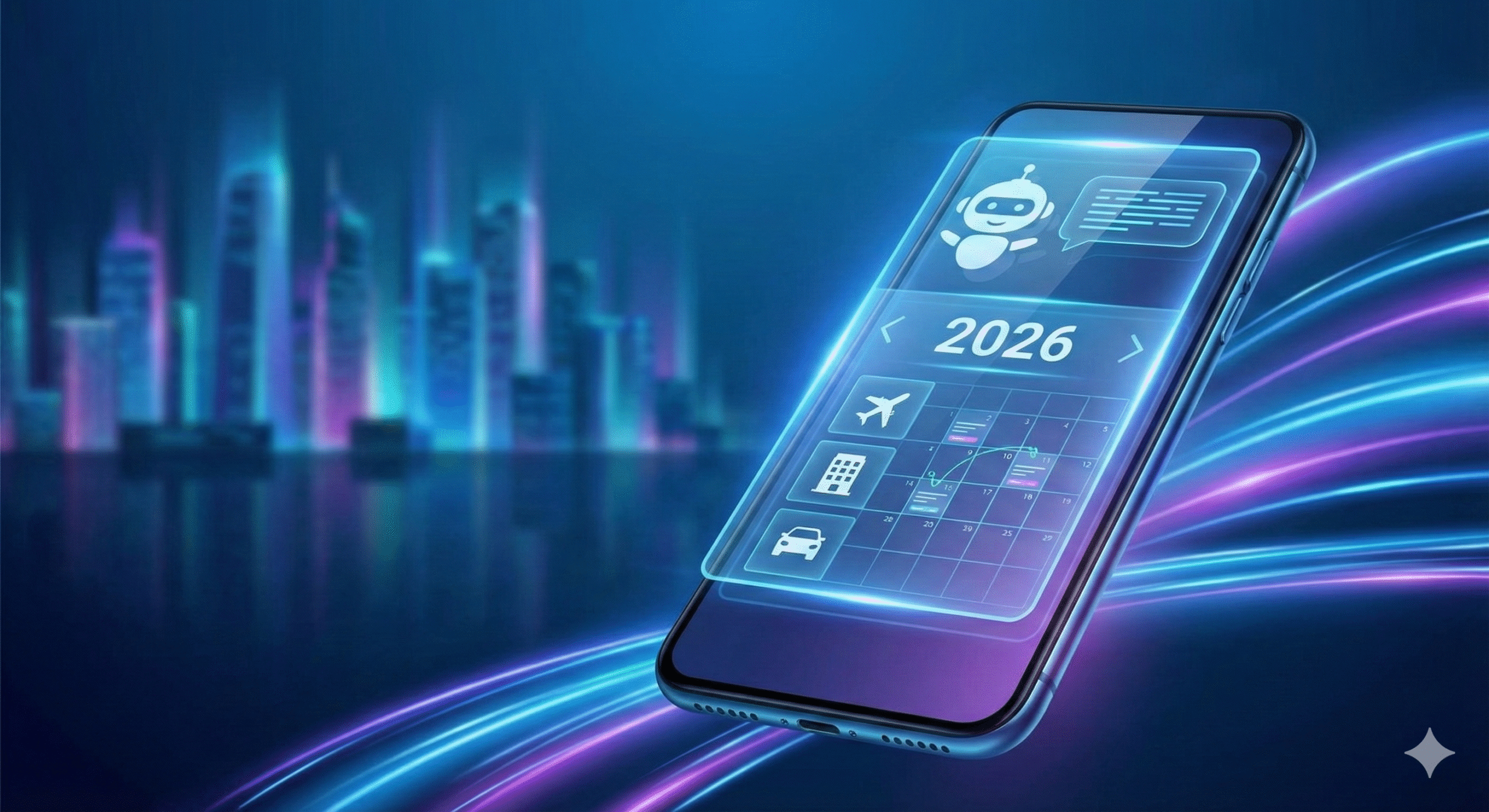
If the last two years were defined by the experimentation of Artificial Intelligence, the next two will be defined by its autonomy.
For business leaders, CTOs, and startup founders, the landscape of mobile app development is shifting beneath our feet. In 2024 and 2025, the focus was on integrating chatbots and basic personalization. But as we look toward 2026, the “nice-to-have” features of today are becoming the baseline requirements of tomorrow.
The apps of 2026 won’t just wait for user input; they will anticipate needs. They won’t just run in the cloud; they will think locally on the device. And they won’t just look the same for everyone; they will redesign themselves in real-time.
At The Softix, we believe that building software is not just about writing code for today it’s about engineering resilience for the future. Based on deep industry analysis and the trajectory of hardware capabilities (like the NPU chips in the latest smartphones), here is our comprehensive forecast of the Top 5 Mobile App Development Trends for 2026 that every enterprise needs to know.
1. From Chatbots to “Agentic AI”: The Era of Action
The buzzword of 2025 was “Generative AI” machines that could create text and images. The buzzword of 2026 will be Agentic AI.
What is Agentic AI?
Current AI assistants are passive. You ask a chatbot to “write a travel itinerary,” and it gives you text. You still have to open three different apps to book the flight, the hotel, and the dinner reservation.
Agentic AI changes this dynamic entirely. These are AI systems capable of taking action to achieve a goal. In 2026, users won’t interact with apps via buttons and menus; they will interact via intent.
The Business Impact
Imagine a Fintech app powered by Agentic AI. Instead of a user manually checking their balance and transferring funds, they simply say: “Move enough money to my savings to cover my tax bill, but leave enough for rent.”
The Agentic AI understands the context, checks the tax bill, checks the rent due date, calculates the surplus, executes the transfer, and sends a confirmation notification.
Why Startups Must Adapt:
- Reduced Friction: Every click you remove from a user journey increases conversion. Agentic AI removes all the clicks.
- Higher Retention: Users will stick to the one “Super Agent” app that does the work for them, uninstalling the single-purpose apps that require manual labor.
The Softix Insight: We are moving from “User Interface” (UI) to “Outcome Interface.” Your app’s success in 2026 will depend on how many tasks it can complete autonomously, not how pretty the buttons are.
2. On-Device AI: Intelligence Moves to the “Edge”
For the past decade, “Smart” meant “Connected to the Cloud.” To get an answer from Siri or ChatGPT, your data had to travel to a massive server farm, be processed, and sent back.
In 2026, the trend reverses. Intelligence is coming home to the device.
The Rise of the NPU
With the explosion of powerful Neural Processing Units (NPUs) in devices like the iPhone 17 and Pixel 10, mobile phones are becoming supercomputers. They can now run “Small Language Models” (SLMs) locally, without an internet connection.
Why Enterprises Are Pushing for Edge AI:
- Privacy & Compliance: For Healthcare and Fintech apps, data privacy is a nightmare. With Edge AI, sensitive patient data or banking credentials never leave the user’s phone. The AI processes the data locally, ensuring 100% HIPAA or GDPR compliance by design.
- Zero Latency: Cloud processing takes time. On-device AI is instant. This is critical for apps in manufacturing, logistics, or real-time trading where milliseconds cost millions.
- Cost Reduction: This is the big one for CFOs. Every time a user pings a cloud-based AI API, it costs the company money. By moving processing to the user’s device, businesses can slash their cloud computing bills by 40% to 60%.
Strategic Tip: If you are planning an AI-heavy app, ask your development partner about “Edge-first architecture.” At The Softix, we optimize models to run efficiently on mobile hardware to save you long-term operational costs.
3. Generative UI (GenUI): The End of Static Screens
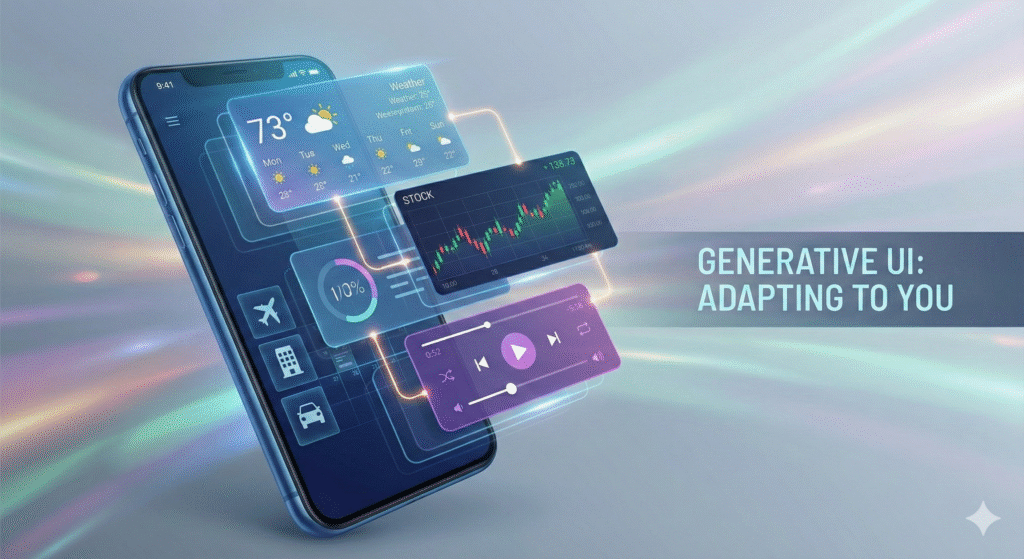
Open your favorite app. Now look at your friend’s phone. The app looks exactly the same, doesn’t it? By 2026, that uniformity will be considered a design flaw.
Generative UI (GenUI) is the concept where the app’s interface is not hard-coded by a designer but is generated in real-time by AI based on the user’s current needs, context, and history.
How It Works
- For the Power User: If the AI detects that you use the app for advanced trading, it might generate a dashboard dense with charts, data tables, and quick-action buttons.
- For the Casual User: If the AI detects you only check your balance once a week, it might generate a simplified, clean interface with just one big number and a “Logout” button.
- Context Awareness: If you open a retail app while standing inside a physical store (detected via geolocation), the UI might shift to show a “Barcode Scanner” and “Store Map” prominently, hiding the “Online Shipping” options.
The Development Challenge
This requires a fundamental shift in how we build apps. Developers can no longer just “paint screens.” We must build Design Systems sets of rules and components that the AI can assemble on the fly.
The Softix Insight: This level of personalization creates a “stickiness” that competitors can’t copy. Once an interface molds itself to a user’s brain, they find it impossible to switch to a competitor’s rigid, static app.
4. The “Super App” Consolidation Comes West
In Asia, apps like WeChat and Grab are “Super Apps” ecosystems where you can message friends, pay bills, book a taxi, and order food without ever leaving the app. The Western market (US/Europe) has historically been fragmented, with different apps for different tasks.
Market data suggests 2026 will be the tipping point for App Consolidation in the US.
Why Now?
- App Fatigue: Users are tired of downloading, updating, and managing accounts for 50 different apps.
- The “X” Effect: Major tech players (like Elon Musk’s X vision and Uber’s expansion into travel) are training US consumers to expect all-in-one utility.
What This Means for Startups
If you are building a niche service say, a “Dog Walking App” you face a high risk of being uninstalled. The winning strategy for 2026 is Integration.
- Build a Platform: If you can, aggregate multiple related services (e.g., Pet Store + Vet Telehealth + Dog Walking).
- Be API-First: If you can’t be the Super App, ensure your service can easily integrate into one. Your “Dog Walking” service should be bookable directly inside a larger “Neighborhood” or “Property Management” Super App.
5. Green Coding & Sustainable Development
Sustainability is no longer just for energy companies; it is becoming a software requirement. With the massive energy consumption of AI models, there is a growing backlash against “bloated” software that drains battery life and burns server energy.
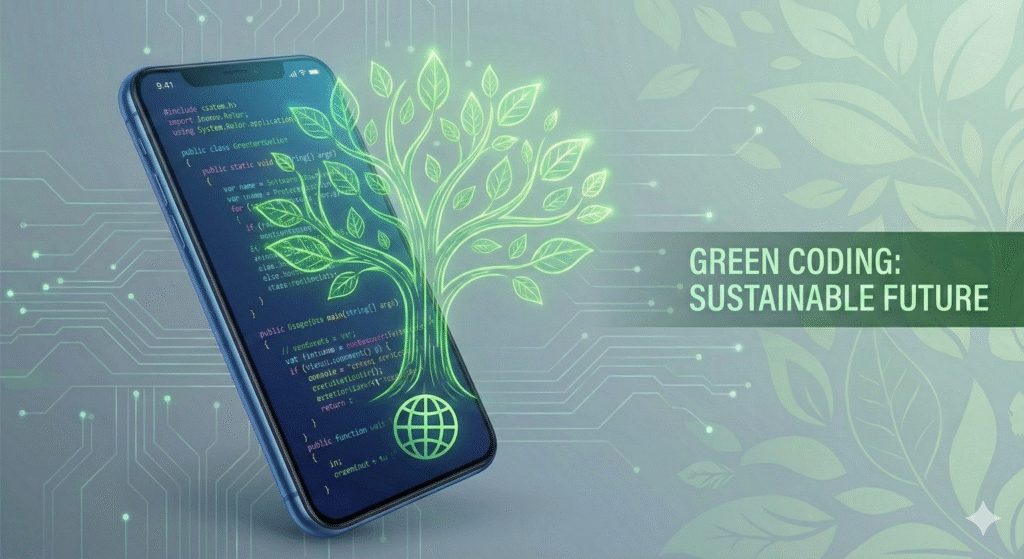
Green Coding Practices for 2026:
- Energy-Efficient Algorithms: Writing code that achieves the result with the fewest CPU cycles possible.
- Dark Mode Optimization: Apps designed to leverage OLED screens to reduce battery drain.
- Carbon-Aware Computing: Scheduling heavy background tasks (like data syncing) only when the energy grid is using renewable sources or when the device is plugged in.
Why It Matters: Enterprises often have ESG (Environmental, Social, and Governance) goals. A corporate app that drains employee batteries or increases the company’s digital carbon footprint will fail procurement audits.
The Softix Promise: Our US-based engineering team prioritizes “clean code.” We don’t just optimize for speed; we optimize for efficiency, ensuring your app is a good citizen on your user’s device.
The Softix Advantage: Engineering for 2026, Today
Reading about these trends is exciting, but implementing them requires a level of engineering rigor that low-cost, offshore “body shops” often cannot provide.
Agentic AI requires complex logic mapping. Edge AI requires deep knowledge of hardware constraints. Generative UI requires a mastery of flexible frontend frameworks like Flutter and React Native.
At The Softix, we don’t just build apps for the current app store; we build digital assets ready for the future.
- US-Based Excellence: Our architects are here, in your time zone, understanding your market.
- Scalable Architecture: We build backends that can handle the transition from Cloud to Edge without a total rewrite.
- Security First: In an era of AI agents, we implement Zero Trust security architectures to ensure that autonomy never compromises safety.
The technology of 2026 is coming fast. Is your business ready to lead it, or will you be playing catch-up?
Ready to Future-Proof Your Mobile Strategy?
Don’t build a legacy app. Let’s build the future. Let’s Talk Business – Schedule a free discovery call with our Senior Solutions Architect today.
Frequently Asked Questions (FAQ)
1. How will AI change mobile app development in 2026? AI will move from being a “feature” (like a chatbot) to the “core” of the app. In 2026, Agentic AI will allow apps to perform complex tasks autonomously, while Generative UI will allow apps to redesign their own interfaces in real-time to suit user preferences.
2. What is the difference between Cloud AI and Edge AI? Cloud AI processes data on remote servers (requiring internet), while Edge AI processes data directly on your smartphone (using the device’s NPU). Edge AI is a major trend for 2026 because it is faster, works offline, and keeps sensitive data private.
3. Is Flutter still a good choice for app development in 2026? Yes, absolutely. Cross-platform frameworks like Flutter and React Native are essential for the “Generative UI” trend, allowing developers to build flexible, component-based interfaces that work seamlessly across iOS, Android, and even spatial computing devices.
4. Why is “Green Coding” becoming important? As apps become more powerful, they consume more energy. “Green Coding” ensures apps are optimized to save battery life and reduce carbon emissions. For enterprises with sustainability goals, this is becoming a mandatory requirement for their software vendors.
5. How much does it cost to build an AI-powered mobile app? The cost varies based on complexity. A simple app might start at $20k–$40k, while an enterprise-grade app with Agentic AI and Edge capabilities can range from $100k to $300k+. At The Softix, we offer transparent pricing models to help you maximize ROI. Contact us for a quote.
Share