In the high-stakes world of startups, cash flow is oxygen. As we approach 2026, the software market has become saturated with tools for every niche imaginable. This competition means that simply having a “good idea” is no longer enough. The primary reason startups fail today isn’t a lack of creativity it’s running out of money before they can find a product-market fit. This makes the SaaS MVP development cost the single most critical variable in your early-stage strategy.
At The Softix, we have partnered with dozens of founders who come to us with grand visions. However, our expertise in Web App Development has taught us that the most successful founders are the ones who can say “no.” They understand that an MVP (Minimum Viable Product) is not a stripped-down, buggy version of their final vision. It is a sharp, focused tool designed to solve one specific problem exceptionally well.
If you are a founder or CTO researching how to reduce software development costs for startups, you are likely bombarded with conflicting advice. Some say “build fast and break things, while others warn about “technical debt.” This guide cuts through the noise. We are providing a definitive, transparent Minimum Viable Product budget breakdown and a feature checklist to help you launch leaner, faster, and smarter in 2026.
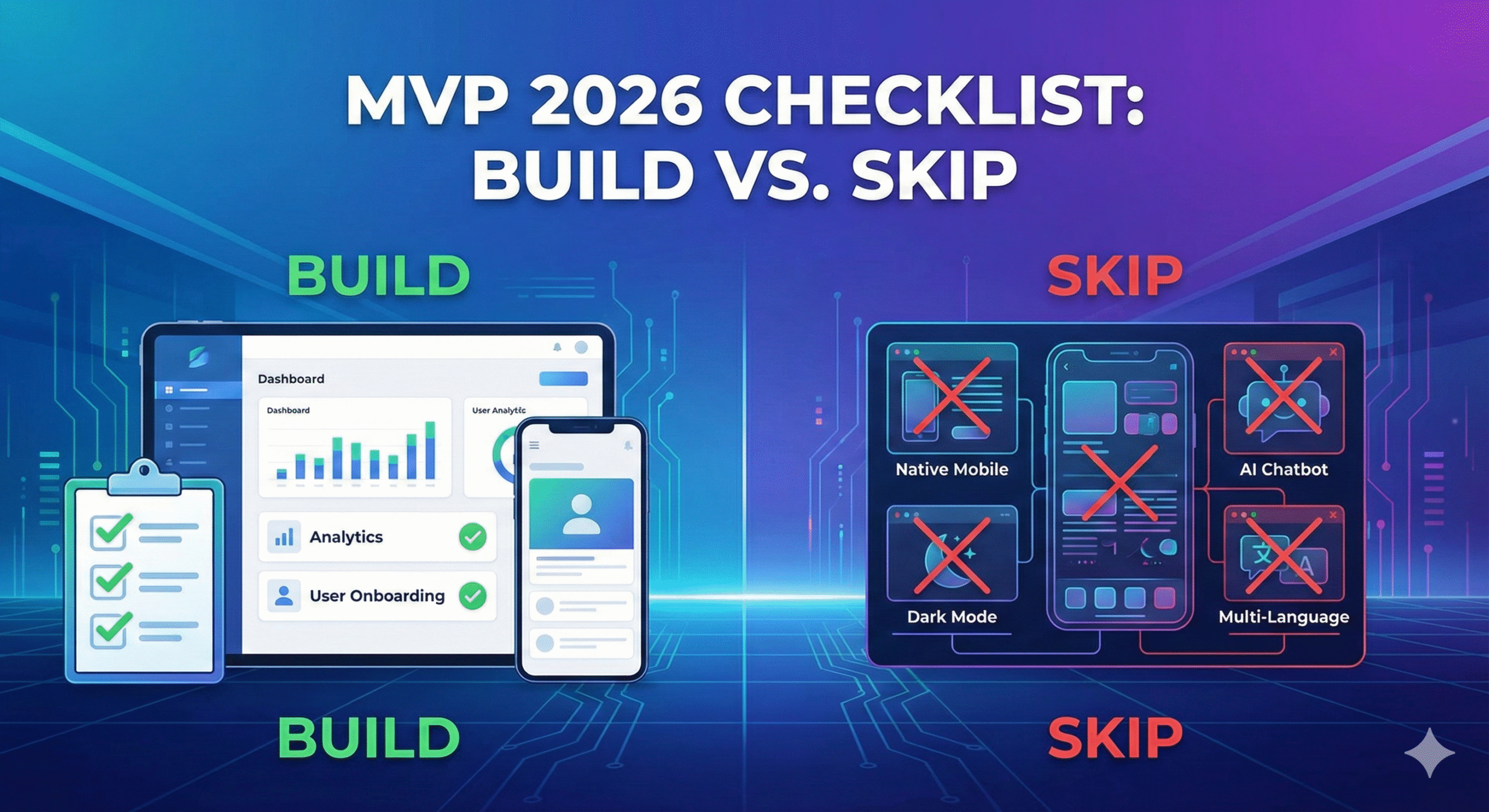
Part 1: The “Must-Build” Core (The Foundation)
These are the non-negotiables. If you cut features from this list, you aren’t building a “Lean” product; you are building a fragile prototype that will fail to retain users. In 2026, the bar for “Minimum” has been raised. Users will forgive a lack of features, but they will not forgive a lack of quality or security.
1. Robust User Onboarding Flow
First impressions are mathematical. In 2026, user attention spans are shorter than ever. If a user signs up for your SaaS and cannot figure out how to achieve “value” within the first 60 seconds, they will churn. A common mistake is assuming your UI is intuitive enough to explain itself. It rarely is.
- The Softix Strategy: Instead of building complex video tutorials (which are expensive to update), we recommend building interactive product tours using libraries like Intro.js or Shepherd.js.
- Why it’s Essential: A solid user onboarding flow for MVP reduces your customer support costs. If your app teaches the user how to use it, you don’t need to hire a support agent on Day 1.
2. MVP Security Checklist 2026 (Zero Trust)
You can skip fancy design, but you cannot skip security. In an era of rampant data breaches and AI-driven cyber attacks, even early adopters are security-conscious. A single data leak in your first month is a company-killer.
- Authentication: Do not build your own auth system from scratch. Use established providers (like Auth0, Clerk, or Firebase Auth) that handle MFA (Multi-Factor Authentication) out of the box.
- Data Protection: Ensure SSL encryption (HTTPS) is standard, and implement secure password hashing (bcrypt or Argon2).
- Role-Based Access Control (RBAC): If you are building B2B software, RBAC is mandatory. Companies need to know that their “Manager” users see different data than their “Employee” users.
- Keyword Focus: This is a critical part of the MVP security checklist 2026.
3. Mobile-Responsive Web App Design
Notice we didn’t say “Native Mobile App.” We said “Responsive Web App.” In 2026, users expect to access your SaaS from their phone browser (Safari/Chrome) and have it function perfectly.
- The Technical Reality: Using modern CSS frameworks like Tailwind CSS, we ensure your application is fully responsive.
- The Benefit: This allows you to capture mobile traffic without the massive expense of building separate iOS and Android apps. Mobile-responsive web app design is the bridge between desktop power and mobile accessibility.
4. The “Core Loop” Feature
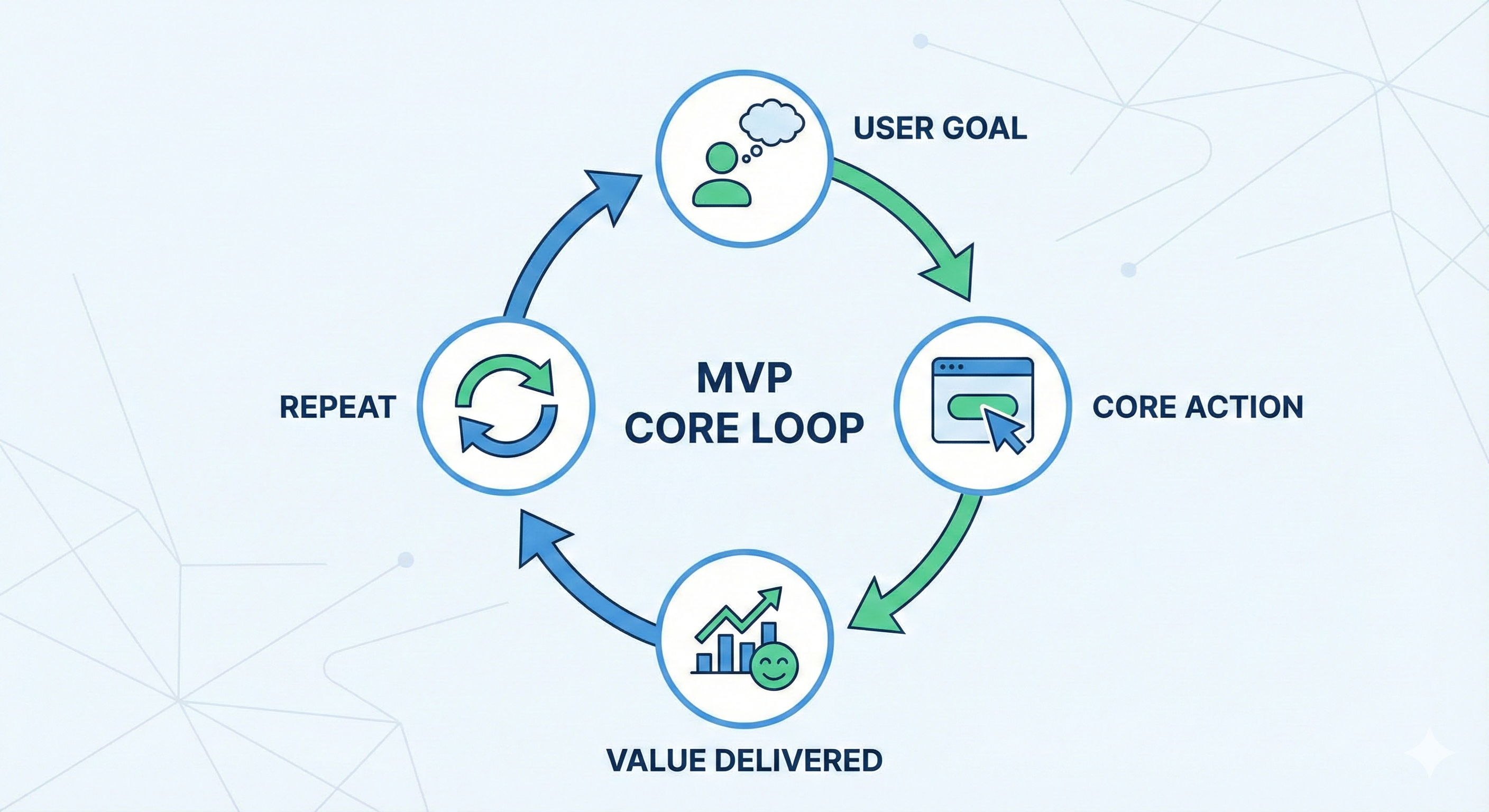
Every successful product has a “Core Loop” the single action that provides the most value.
- For Instagram, it’s posting a photo.
- For Uber, it’s booking a ride.
- For your MVP, identify this one feature and polish it until it shines. If your Core Loop is buggy, no amount of extra features will save you. Spend 80% of your development budget here.
5. Basic SaaS Analytics & Feedback Loops
You cannot iterate if you are flying blind. You need to know what users are doing inside your app.
- Analytics: Implement basic tracking (PostHog or Google Analytics 4) to see which features are being used.
- Feedback: Include a simple “Feedback” button in the header.
- Why: These user feedback loops are the only way to validate your Product-Market Fit (PMF).
Part 2: The “Must-Skip” List (The Money Savers)
This is where The Softix proves its value as a consultant. Most agencies will happily build whatever you ask for because it increases their billable hours. We prefer to save you money now so you can survive long enough to hire us for the big scale-up later. Here are the MVP features to cut to keep your budget safe.
1. Native Mobile Apps (iOS & Android)
“Do I need a mobile app for my MVP?”
The honest answer for 95% of B2B and SaaS startups in 2026 is No.
- The Cost Reality: Building native apps requires three codebases: Web (React), iOS (Swift), and Android (Kotlin). This effectively triples your development and maintenance costs.
- The Solution: Build a Progressive Web App (PWA). PWAs run in the browser but look and feel like apps. They can send push notifications, work offline, and be installed on the home screen.
- Impact: This decision alone can reduce your SaaS MVP development cost by 60%.
2. Automated Billing & Complex Invoicing
This is a controversial piece of advice, but it is valid for early-stage startups.
Building a fully automated billing system that handles pro-rating, upgrades, downgrades, taxes (VAT/GST), and PDF invoice generation is incredibly complex.
- The Lean Alternative: Use Stripe Checkout or a simple payment link. When a customer pays, receive the notification and manually send them an invoice using free accounting software.
- The Threshold: Do this manually until you have 50-100 customers. Once the manual work becomes too much, then you automate it. Don’t spend $5,000 automating a process for 3 customers.
- Keyword Context: Avoid complex Stripe Connect integration for platforms in phase one unless you are a marketplace.
3. Dark Mode
Developers and designers love Dark Mode. It looks cool. But does it prove your business model? No.
- The Hidden Cost: Supporting Dark Mode requires testing every single screen, button, and icon in two color palettes. It increases QA time by 30-40%.
- Decision: Stick to a clean, professional Light Mode. Dark mode vs. light mode for MVP is a distraction from your core value.
4. Multi-Language Support (Localization)
Unless you are specifically launching in a non-English speaking market, keep your app in one language.
- The Tech Debt: implementing
i18n(internationalization) frameworks adds complexity to every string of text in your code. - Strategy: Launch in your primary market first. Validate the product. Add languages when you have customers in those regions paying you to do so.
5. AI Integration (Unless it’s the Core Product)
“AI” is the buzzword of 2026. Founders feel pressured to add “AI Chatbots” or “AI Recommendations” to everything.
- The Reality: AI APIs (like OpenAI) are expensive to run and complex to fine-tune.
- The Advice: If you are building a Project Management tool, you don’t need AI to summarize tasks for the MVP. A simple rule-based system is often faster, cheaper, and more reliable.
Part 3: Architecture & Tech Stack Decisions
Choosing the right technology is the foundation of a cost-effective MVP strategy. The wrong choice can lead to massive technical debt that forces you to rewrite the whole app a year later.
Monolith vs. Microservices
In the enterprise world, “Microservices” are popular. For an MVP, they are a disaster.
- Microservices: involve breaking your app into tiny, independent pieces. It requires complex DevOps and orchestration.
- Monolith: One codebase, one server.
- The Softix Recommendation: Build a Modular Monolith. It is easy to deploy, easy to debug, and fast to build. You can break it into microservices later if you hit massive scale (1M+ users).
No-Code vs. Custom Code for MVP 2026
- No-Code (Bubble/Webflow): Great for validating an idea before you have any budget. However, you will hit a ceiling. You don’t own the code, and you are limited by the platform’s constraints.
- Custom Code (The Softix Approach): Essential if your product is your main asset. We use a MVP tech stack for speed that balances performance with development speed:
- Frontend: React.js or Next.js (Excellent SEO and speed).
- Backend: Node.js (JavaScript everywhere makes development faster).
- Database: PostgreSQL (Reliable, scalable SQL database).
- Hosting: Vercel or AWS Amplify (Serverless hosting reduces DevOps costs).
Part 4: The Budget Breakdown (2026 Estimates)
One of the most common questions we get is: “How much does it cost to build a SaaS MVP in 2026?”
While every project is different, here is a realistic range for a high-quality, custom MVP developed by a professional agency like The Softix.
| Project Size | Features | Estimated Timeline | Estimated Cost |
| Simple MVP | 1 Core feature, simple auth, standard UI. | 4-6 Weeks | $10k – $20k |
| Standard SaaS | Dashboard, payments, admin panel, RBAC. | 2-3 Months | $25k – $45k |
| Complex Platform | Real-time data, heavy algorithms, 3rd party APIs. | 4-5 Months | $50k – $90k+ |
Note: If you are seeing quotes for $5,000 for a full SaaS, be wary. You are likely paying for a template that cannot be customized or scaled.
Part 5: The “Softix” Development Process
We don’t just take your requirements and disappear for three months. That is the “Waterfall” method, and it leads to failure. We use an Agile/Scrum methodology designed for startups.
- Discovery Workshop: We sit down (virtually or physically) to ruthlessly cut your feature list down to the essentials.
- Design Sprint: We create wireframes and high-fidelity designs. You see exactly what the app looks like before we write a line of code.
- Development Sprints: We build in 2-week cycles. Every two weeks, you get a clickable, working version of your app to test.
- Launch & iterate: We help you deploy to the cloud and set up your analytics.
This iterative process ensures that we catch MVP scope creep examples early and keep the project on budget.
FAQ: Common Founder Questions
Q: How do I prioritize features for my startup MVP?
A: Use the “MoSCoW” method. Categorize features into Must have, Should have, Could have, and Won’t have. Be strict. If the product works without it, it’s not a “Must.”
Q: Scalability vs. Speed in MVP which is more important?
A: Speed. In the early days, you don’t need to scale to a million users. You need to get to 100 users fast. Don’t over-engineer your backend for hypothetical traffic that doesn’t exist yet.
Q: What is Technical Debt?
A: Technical debt is the “cost” of choosing an easy solution now instead of a better approach that would take longer. Some debt is okay for an MVP, but too much (like bad security or messy code structure) will bankrupt you later.
Q: How does The Softix handle IP (Intellectual Property)?
A: Unlike some low-cost offshore agencies, with The Softix, you own 100% of the code. We build it, and we hand over the keys. It is your asset.
Conclusion: Start Small, Dream Big
The road to a billion-dollar exit starts with a single, well-executed MVP. The goal of 2026 is validation phase efficiency. By focusing on the essential SaaS features and cutting the fluff, you extend your runway and give your startup a fighting chance.
Building software is expensive, but building the wrong software is fatal. At The Softix, we don’t just write code; we act as your technical partners. We challenge your assumptions, we protect your budget, and we build products that are ready to grow.
Are you ready to validate your idea without burning your budget?
Contact The Softix Today for a free consultation. Let’s review your feature list together and turn your vision into a lean, scalable reality.
Before you commit runway, pressure-test Build vs Buy vs Customize with Softix’s SMB software TCO calculator.
Share