
In the rapidly evolving landscape of software development, the complexity of modern web applications continues to grow exponentially. As businesses demand more sophisticated features, real-time interactions, and seamless user experiences, developers face an increasingly difficult challenge: maintaining code quality while scaling functionality. This is where Clean Code Architecture emerges as a game-changing approach that transforms how we build and maintain web applications.
Clean Code Architecture isn’t just another buzzword in the development community; it’s a fundamental shift in how we think about software design. It represents a systematic approach to organizing code that prioritizes maintainability, testability, and flexibility over quick fixes and tightly coupled implementations. By establishing clear boundaries between different layers of an application and enforcing strict dependency rules, Clean Code Architecture enables development teams to build systems that can evolve gracefully with changing business requirements.
Understanding Clean Code Architecture Fundamentals
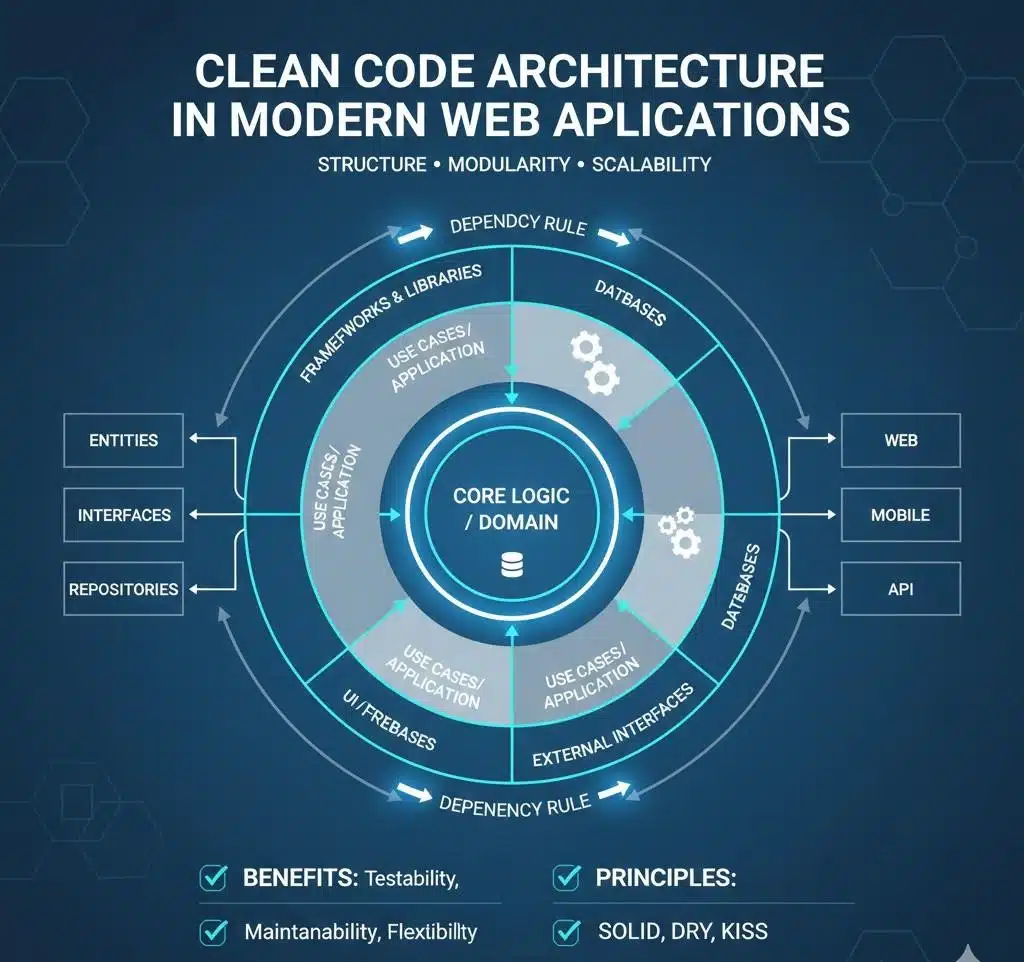
At its core, Clean Code Architecture is built on the principle of separation of concerns, where different aspects of an application are isolated into distinct layers with well-defined responsibilities. Web App Development professionals who embrace this architectural pattern discover that their applications become significantly easier to understand, test, and modify over time. The architecture operates on the dependency rule: source code dependencies must point inward, toward higher-level policies, ensuring that business logic remains independent of external frameworks, databases, and user interfaces.
The fundamental structure consists of concentric circles, each representing different areas of the software. The innermost circles contain business logic and entities, which are the most stable and least likely to change. As we move outward, we encounter layers that are more prone to change, such as frameworks, databases, and user interfaces. This arrangement ensures that changes in external dependencies don’t ripple through the entire application, dramatically reducing the cost and risk of modifications.
One of the most powerful aspects of this architecture is its framework independence. Your business rules don’t need to know whether you’re using React, Angular, or Vue.js on the frontend, or whether your data is stored in PostgreSQL, MongoDB, or a cloud-based solution. This independence means that technological choices become implementation details rather than architectural constraints, giving teams the flexibility to adapt to new technologies without rewriting core business logic.
The Four Essential Layers
Clean Code Architecture typically organizes applications into four distinct layers, each with specific responsibilities and constraints. Understanding these layers is crucial for implementing the architecture effectively in your web applications.
Entities Layer: The innermost layer contains enterprise business rules and entities. These are the fundamental objects that represent core business concepts and contain methods that embody critical business rules. In an e-commerce application, for example, entities might include Product, Customer, Order, and Payment. These entities are pure business objects, free from any concerns about how they’re stored, displayed, or transmitted. They change only when fundamental business requirements change, which typically happens infrequently.
Use Cases Layer: Surrounding the entities layer, the use cases layer contains application-specific business rules. Use cases orchestrate the flow of data to and from entities and direct those entities to use their business rules to achieve the goals of the use case. For instance, a “PlaceOrder” use case would coordinate the validation of customer information, verification of product availability, calculation of totals, and creation of an order entity. Use cases are independent of UI considerations, database implementations, or external services, making them highly testable and reusable.
Interface Adapters Layer: This layer converts data from the format most convenient for use cases and entities to the format most convenient for external agencies like databases and web frameworks. It contains controllers, presenters, gateways, and view models. Controllers handle incoming requests and convert them into a format that use cases can understand, while presenters format data from use cases into a structure suitable for the UI. This layer serves as a translator, ensuring that the inner layers remain pure and uncontaminated by external concerns.
Frameworks and Drivers Layer: The outermost layer consists of frameworks, tools, and external interfaces such as databases, web frameworks, and third-party APIs. This layer is where all the details live. The web framework you choose, the database technology you select, and the external services you integrate all reside here. Because of the dependency rule, code in this layer can depend on inner layers, but inner layers know nothing about what happens out here, providing maximum flexibility and minimal coupling.
Implementing Clean Code Architecture in Practice
Translating theoretical concepts into practical implementation requires careful planning and disciplined execution. When beginning a new web application project, start by identifying your core business entities and the rules that govern them. These should be defined independently of any framework or database considerations. Create plain classes or objects that represent these entities with methods that enforce business invariants.
Next, define your use cases as classes that depend on abstractions rather than concrete implementations. For example, instead of having a use case directly instantiate a database connection, it should depend on an interface or abstract class that defines the operations it needs. This approach, known as dependency inversion, allows you to swap implementations without changing use case code. A use case might depend on a UserRepository interface, which can be implemented using PostgreSQL in production, an in-memory implementation for testing, or a different database entirely if requirements change.
The interface adapters layer requires careful attention to ensure proper separation. Controllers should be thin, handling only the conversion of HTTP requests into use case inputs and converting use case outputs into HTTP responses. Avoid the temptation to place business logic in controllers, as this creates tight coupling and makes testing difficult. Similarly, view models should contain only presentation logic, transforming domain data into formats optimized for display.
When implementing the frameworks layer, treat external dependencies as plugins that can be swapped out. If you’re using a specific ORM or web framework, contain its usage within this layer. Create adapters that implement the interfaces defined by inner layers, translating between the framework’s expectations and your application’s needs. This containment strategy ensures that if you need to migrate from one framework to another, the impact is localized to this outer layer.
Benefits of Clean Code Architecture
The advantages of adopting Clean Code Architecture extend far beyond code organization. Development teams experience significant improvements in productivity, code quality, and system maintainability when this architectural pattern is properly implemented.
Testability improves dramatically because business logic is isolated from external dependencies. Unit tests can focus on core business rules without needing to mock databases, HTTP requests, or UI components. This isolation leads to faster test execution, more reliable tests, and better code coverage. Integration tests become clearer in scope, focusing specifically on the interactions between layers rather than testing everything simultaneously.
Maintenance becomes substantially easier as the system grows. When business requirements change, modifications are localized to specific layers. Adding a new feature typically means creating new use cases and potentially new entities, without disturbing existing functionality. Bugs are easier to locate and fix because each layer has clear responsibilities, reducing the search space when investigating issues.
The architecture facilitates parallel development by allowing different team members to work on different layers simultaneously. Frontend developers can work on the presentation layer while backend developers focus on use cases and data access, with minimal conflicts. This separation becomes especially valuable in larger teams where coordination overhead can significantly impact productivity.
Technology flexibility represents another crucial benefit. When new frameworks emerge or existing technologies become obsolete, the architecture allows for gradual migration. You can replace your web framework, database, or external services without rewriting business logic. This flexibility reduces technical debt and extends the useful life of your codebase, providing better return on development investment.
Common Challenges and Solutions
Implementing Clean Code Architecture isn’t without challenges. Development teams often encounter obstacles that can derail adoption if not addressed thoughtfully.
The learning curve represents the first significant challenge. Developers accustomed to framework-centric development or simple layered architectures need time to understand and internalize the principles. The solution involves investing in education through workshops, code reviews, and pair programming sessions. Start with a small project or module to build confidence before applying the architecture system-wide.
Over-engineering is another common pitfall. Enthusiastic teams sometimes create excessive abstractions, multiple layers where fewer would suffice, or overly complex interfaces that obscure rather than clarify intent. The key is finding the right balance for your application’s complexity. Small applications might not need full Clean Code Architecture, while large enterprise systems benefit greatly from the structure. Apply the architecture where it adds value, not uniformly everywhere.
Performance concerns occasionally arise, particularly regarding the overhead of multiple layers and abstractions. While it’s true that Clean Code Architecture introduces some indirection, the performance impact is typically negligible compared to database queries, network calls, and complex business logic. Modern compilers and runtime environments optimize effectively, and the maintainability benefits far outweigh any minor performance considerations.
Team resistance can occur when introducing significant architectural changes. Some developers prefer familiar patterns and resist new approaches. Address this by clearly communicating the benefits, involving the team in architectural decisions, and demonstrating success through pilot projects. Show how Clean Code Architecture reduces the pain points they experience in current projects, making the value proposition concrete rather than abstract.
Real-World Application Scenarios
Clean Code Architecture shines particularly bright in certain types of web applications. E-commerce platforms benefit immensely from the clear separation of concerns. Product catalog management, order processing, payment handling, and inventory management each become discrete use cases with well-defined boundaries. When payment providers change or new shipping methods are added, modifications remain localized without affecting core business logic.
Content management systems represent another ideal use case. The architecture naturally separates content modeling, workflow management, and presentation concerns. Editorial teams can work with content through one interface, administrators manage system configuration through another, and end-users consume content through various channels, all backed by the same core business logic.
Financial applications, with their complex business rules and strict audit requirements, particularly benefit from Clean Code Architecture. Transaction processing, account management, and regulatory compliance are clearly separated, making it easier to maintain audit trails, implement controls, and demonstrate compliance. The testability of business rules becomes crucial in these regulated environments.
Multi-tenant SaaS applications leverage Clean Code Architecture to manage complexity across tenant configurations. Core business logic remains consistent while tenant-specific customizations are implemented as adapters or configuration data, avoiding the maintenance nightmare of forked codebases.
Conclusion
Clean Code Architecture represents a mature, proven approach to building modern web applications that can evolve gracefully over time. By organizing code into layers with clear responsibilities and enforcing strict dependency rules, development teams create systems that are easier to understand, test, and modify. The initial investment in learning and implementing this architecture pays dividends throughout the application’s lifetime through reduced maintenance costs, faster feature development, and improved system reliability.
As web applications continue growing in complexity and importance, the need for solid architectural foundations becomes increasingly critical. Clean Code Architecture provides that foundation, enabling teams to build software that serves business needs today while remaining flexible enough to adapt to tomorrow’s requirements. Whether you’re building a startup MVP or an enterprise system, the principles of Clean Code Architecture offer valuable guidance for creating maintainable, testable, and scalable applications.
The journey to implementing Clean Code Architecture begins with a single step: separating one concern from another, creating one boundary where none existed before. Start small, learn continuously, and gradually apply these principles across your projects. The result will be code that not only works today but continues to work efficiently and reliably as your application grows and evolves over the years ahead.
Share