
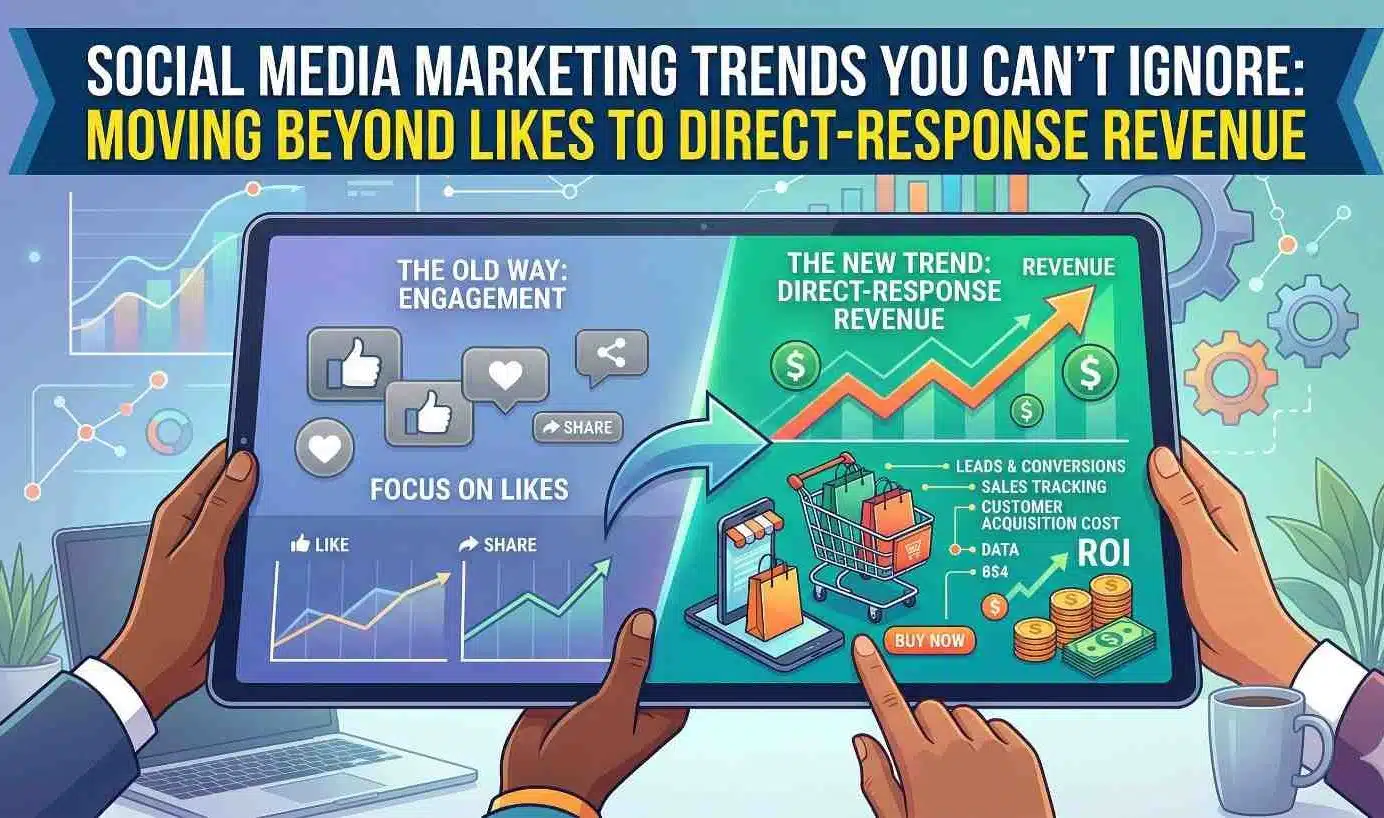
The global social media landscape in 2026 represents a departure from the experimental digital environments of the previous decade, maturing into a unified infrastructure for global commerce and information discovery. With approximately 5.66 billion active social media user identities comprising nearly 69% of the world’s population social platforms have transcended their roles as mere communication tools to become the primary engines of the global economy. This saturation has fundamentally altered the value proposition of digital presence; where “vanity metrics” such as likes, follows, and impressions once served as the primary KPIs for brand health, the contemporary mandate is the generation of direct-response revenue. The sheer volume of engagement with average daily time spent per user reaching 2 hours and 39 minutes has created a hyper-competitive attention economy where only those organizations capable of converting a “scroll” into a “sale” can sustain visibility.
Total global social media advertising expenditure is projected to reach $317.33 billion in 2026, a figure that accounts for approximately $3 of every $10 spent on digital advertising. This massive infusion of capital is driven by a profound shift in consumer behavior, particularly among younger cohorts. Social media platforms like TikTok, Instagram, and YouTube now collectively drive over 60% of product discovery, while traditional search engines like Google have seen their search share retreat to 34.5%. This migration of intent from the traditional web to social feeds has necessitated a complete reimagining of the marketing funnel. The linear progression from awareness to consideration to purchase has collapsed into a circular, multi-modal discovery loop where transaction occurs at the point of inspiration.
| Metric | 2026 Statistic/Projection | Year-over-Year Growth/Context |
| Global Social Media User Identities | 5.66 Billion | +259 Million identities (+4.8% YoY) |
| Total Social Media Ad Spend | $317.33 Billion | 10.9% CAGR projected through 2030 |
| Social Media Search Share | 60% of Discovery | Surpasses Google’s 34.5% share |
| Average Weekly Time per User | 18 Hours 36 Minutes | Average 6.75 networks visited monthly |
| Mobile-Generated Ad Spend | 82.9% by 2030 | Reflects near-total mobile dominance |
This environment rewards “social-first” brands those that integrate commerce objectives and creator-led strategies into their overarching business plans. Research indicates that these socially mature organizations achieve an average revenue increase of 10.2% as a direct result of their social strategies and are eight times more likely to exceed their revenue goals by 25% or more. The following analysis explores the technological, cultural, and operational shifts that define this era, providing a blueprint for moving beyond engagement toward a performance-centric revenue model.
The Decentralization of Intent and the Social Search Revolution
The historical dominance of traditional search engines has been disrupted by a fundamental shift in how users seek and validate information. In the current market, online marketing services have restructured their strategies around the reality that social platforms now function as high-intent search engines where keyword-rich captions, voice-overs, and visual signals dictate discoverability. TikTok, in particular, has emerged as a primary search destination for 41% of U.S. consumers, with 52% of Gen Z users expressing higher trust in product information found on social media than in Google search results. This transition is not merely a change in platform but a paradigm shift from “navigational search” to “validation search.” Users are no longer looking for a list of links; they are looking for user-generated content, personal experiences, and video-first evidence that reduces the psychological risk of a purchase.
| Search Engine/Platform | Search Intent Share (2026) | Primary Value Driver for Users |
| Social Media (TikTok/IG/YT) | 60.0% | Authenticity, UGC, Video Proof |
| Traditional Search (Google) | 34.5% | High-level info, navigational queries |
| AI-Powered Chatbots | 5.5% (Estimated) | Synthesized answers, convenience |
The mechanism of this “Social SEO” involves optimizing content for platform algorithms that prioritize watch time, saves, and shares over hashtag density. Visibility in 2026 hinges on understanding searcher intent at the semantic level. Captions must mirror the natural-language phrases customers type, while video structures must include a strong hook followed by a clear payoff. Furthermore, search engines like Google are now indexing public Instagram business profiles and TikTok content directly, meaning that social content has become a long-term SEO asset that extends beyond the initial viral moment. This interconnectedness requires a unified approach to discoverability where social media and traditional web search are treated as a single, multi-modal system.
The implications for direct-response revenue are profound. When a user searches for a product on a social platform, the distance to checkout is measured in seconds rather than clicks. The integration of native commerce features means that discovery leads directly to the “in-app” shopping aisle. For marketers, this necessitates the use of “Answer Engine Optimization” (AEO) structuring content to provide concise, authoritative answers to specific user queries, thereby securing placement in both social search results and AI-generated summaries.
AI-Native Infrastructure and the Meta Andromeda Paradigm
Artificial intelligence has evolved from a supplementary tool for content creation into the foundational architecture of the social advertising ecosystem. Meta’s introduction of the Andromeda infrastructure represents a significant leap in ads retrieval technology, utilizing deep neural networks and specialized hardware like NVIDIA Grace Hopper Superchips to process massive volumes of data at sublinear inference costs. This system allows for a 10,000x increase in model capacity, enabling the real-time reconstruction of latent user-ad interaction signals to match creative assets with high-intent users with unprecedented precision. The result of this technological sophistication is a measurable increase in performance: early implementations of Andromeda have delivered an 8% boost in relevance scores and a 22% increase in Return on Ad Spend (ROAS).
| AI Component/Feature | Technical Specification/Innovation | Performance Impact |
| Meta Andromeda | Personalized retrieval engine; GPU-GPU interconnect | 22% ROAS increase; 8% relevance boost |
| Advantage+ Sales | Fully automated targeting, budget, and creative | 15% lower CPA; 12% higher ROAS |
| Llama 3/GenAI Tools | Automated image variation and text overlay | 75% faster campaign launch times |
| Predictive Analytics | Churn risk and intent forecasting | 202% conversion rate improvement |
The Meta Advantage+ suite further democratizes these advanced capabilities, allowing small and medium-sized enterprises (SMEs) to leverage automated audience expansion and creative testing with minimal manual intervention. Advantage+ Shopping Campaigns (ASC) have seen a 70% year-over-year increase in usage, as they effectively manage the complexity of creative combinations to identify high-performing assets autonomously. For instance, a single product photo can be transformed into multiple AI-generated versions with different backgrounds and copy variations, which the system tests across Reels, Stories, and Feeds to optimize engagement in real-time.
However, the rapid adoption of generative AI has created a tension between efficiency and brand integrity. The market is currently saturated with “AI slop”—low-quality, synthetic content that may initially drive high engagement due to its oddity but eventually leads to consumer fatigue. Successful brands in 2026 use AI as a “back-end” collaborator for data intelligence, campaign planning, and rapid experimentation, while maintaining human oversight to ensure that the “front-end” content remains authentic and emotionally resonant.
The Creator Performance Ecosystem and the Professionalization of Influence
In 2026, the creator economy has matured into a performance-driven ecosystem where ROI is the primary metric of success. The focus has shifted from one-off sponsored posts to long-term partnerships and in-house creator programs that prioritize storytelling quality and audience alignment. Statistics demonstrate the superior efficacy of creator-led strategies: creator-made ads outperform traditional studio-produced brand creative by 2.1x on click-through rate (CTR) and achieve engagement rates 20-30% higher when run through whitelisted accounts.
| Campaign Type | CTR Relative to Brand Creative | Engagement Rate Lift |
| Creator-Made Paid Content | 2.1x | 20-30% |
| Traditional Brand Ads | Baseline | Baseline |
| TikTok Spark Ads | High Performance | Driven by organic-feel |
| Employee Advocacy | Enhanced Trust | 31% Brand Trust Lift |
Brands are increasingly adopting a “creator mindset,” humanizing their presence by having social teams step in front of the camera to build personal connections with their audience. This strategy is reinforced by employee advocacy programs, which extend reach while bolstering authenticity; audiences frequently trust employees more than CEOs or external influencers. The shift toward “fastvertising” where brands respond to cultural moments almost instantly through creator-style content disrupts traditional content calendars in favor of algorithmic agility.
Furthermore, the emergence of AI-generated virtual influencers has provided a new avenue for hyper-targeted, high-ROI campaigns. For example, virtual influencers like Kenza Layli have demonstrated a 20x ROI while managing thousands of concurrent chatbot conversations, signaling a future where influence is both scalable and programmable. Nevertheless, for most brands, the strongest drivers of sales remain “expert influencers” niche authorities whose small but highly engaged audiences offer superior conversion rates compared to macro-influencers with millions of passive followers.
The Industrialization of Social Commerce and Direct-to-Consumer Logistics
Social commerce has evolved into a sophisticated retail environment that rivals traditional e-commerce in both capability and scale. The digital marketing agency of 2026 must now operate as a hybrid of a creative shop and a logistics firm, managing seamless in-app checkouts and real-time inventory synchronization. Global social commerce sales are projected to exceed $2 trillion by 2026, with TikTok Shop alone accounting for $23.41 billion in the U.S. market. This growth is driven by the total integration of shopping functionality into Reels, Stories, and live broadcasts, creating multiple touchpoints for product discovery within a single user session.
| Social Commerce Channel | 2026 Forecast/Data | Key Conversion Driver |
| Global Market Size | ~$2 Trillion | In-app checkout integration |
| TikTok Shop (U.S.) | $23.41 Billion | Affiliate program & native feeds |
| Livestream Shopping | 20% of Social Sales | 9-30% conversion rates |
| Instagram Shopping | High Weekly Interaction | Product tagging in Reels |
One of the most critical shifts in 2026 is the recognition that fulfillment is a core component of social marketing strategy. On platforms like TikTok Shop, the “Shop Performance Score” (SPS) is directly tied to fulfillment speed and accuracy; a low SPS can limit brand awareness and account growth by signaling unreliability to the algorithm. Consequently, marketing leaders are integrating logistics solutions, such as Amazon Multi-Channel Fulfillment (MCF), to ensure that viral demand does not result in shipping delays or stockouts.
Livestream shopping has reached maturity in Western markets, accounting for a predicted 20% of all social commerce sales by 2026. These events combine entertainment with real-time analytics, allowing brands to adjust pricing and promotion mid-stream based on viewer behavior. The successful implementation of these “shoppertainment” strategies requires a unified commerce framework that treats social storefronts as standalone business units with dedicated inventory and performance optimization workflows.
Authenticity as a Performance Lever in a Post-Synthetic Landscape
The proliferation of AI-generated content has created an environment where “human-made authenticity” is the ultimate differentiator. As feeds become saturated with overly polished, synthetic imagery, users are increasingly gravitating toward unedited, behind-the-scenes content that feels relatable and real. This shift has led to the resurgence of long-form video, as audiences seek deeper contextual details and emotional connections that short-form “AI slop” fails to provide. Short-form video remains the primary “front door” to discovery, but long-form content is increasingly used for the validation and justification stages of the buyer journey.
| Content Format | Primary Engagement Driver | Role in Funnel |
| Short-Form Vertical (Reels/TikTok) | High Hook Rate, Pattern Interrupt | Discovery & Awareness |
| Long-Form Video (YouTube) | Depth, Storytelling, Education | Validation & Confidence |
| Carousels/PDF Docs | Information Density, Saves | Consideration & Retention |
| Live Video (IG/FB Live) | Real-time interaction, urgency | Conversion & Loyalty |
In this “messy-real” era, imperfections such as an occasional stutter or a low-production aesthetic are viewed as signals of credibility. Brands that adopt a “cozy aesthetic” or embrace “slow living” narratives are finding success with overstimulated audiences. The strategy for 2026 is one of “Fast and Slow”: use AI-driven workflows to support efficient content production and rapid experimentation, but prioritize a human touch in the final output to build genuine connections. This balance ensures that brands can keep pace with the algorithm while maintaining the trust required for direct-response revenue.
Community-Led Growth and the Monetization of the Private Social Web
As traditional social feeds become more crowded and expensive, brands are migrating their loyalty and retention efforts to private community spaces. Community-Led Growth (CLG) has emerged as a dominant strategy, with 78% of brands identifying it as essential to their 2026 growth plans. These private ecosystems hosted on Discord, Slack, Reddit, or private Facebook Groups offer a “flywheel” effect where active advocates drive organic reach, provide product feedback, and lower customer acquisition costs (CAC) by an average of 32%.
| Community Platform | Engagement/Retention Metric | Unique Value Proposition |
| Discord | 2.3x higher real-time engagement | Synchronous chat, high technicality |
| Facebook Groups | Used by 63% of brands | Private, focused discussions |
| Highest discussion depth (2.9 comments) | Niche authority, search visibility | |
| WhatsApp Communities | 78% open rate on announcements | Direct, urgent communication |
Community members represent a higher value segment than passive followers, spending 24% more per purchase and showing a 46% higher Customer Lifetime Value (CLV). The shift toward “community-first” marketing requires brands to transition from broadcasting messages to facilitating conversations. This involves member spotlights, user-generated series, and “office hours” where brand representatives interact directly with customers. By treating the community as a co-creator in the brand narrative, companies build resilience and emotional equity that traditional advertising cannot replicate.
B2B Social Revenue: LinkedIn and the Narrative-Driven Pipeline
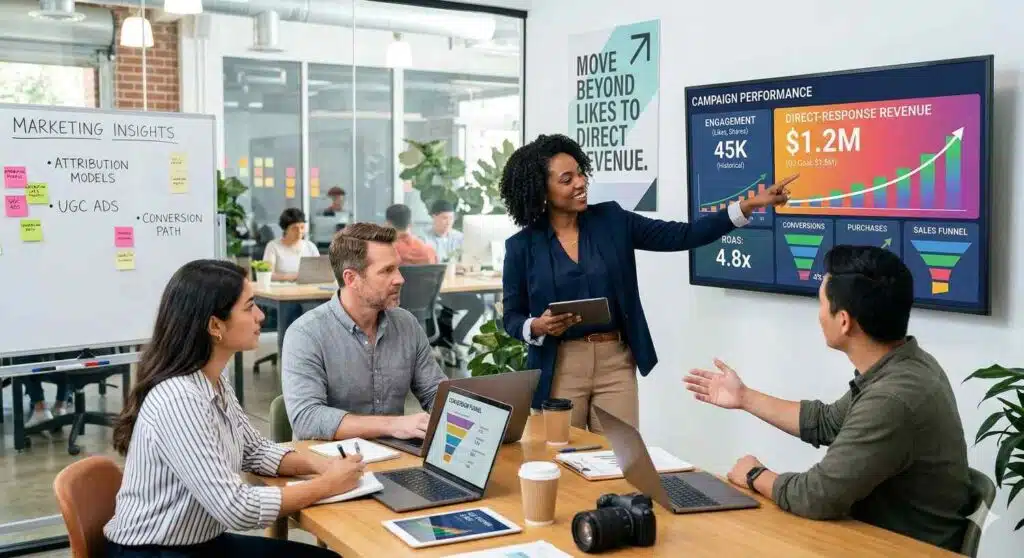
For the B2B sector, social media has transformed from a networking utility into a predictable revenue engine. LinkedIn continues to dominate this space, hosting over 1 billion members and offering unmatched precision in targeting by job title, industry, and seniority. However, the approach has moved away from high-volume outbound prospecting which currently sees a 79% rejection rate for cold direct messages toward a “content-to-conversion” framework. Profiles are now treated as landing pages, optimized with rich media and value-driven headlines to build instant credibility.
| LinkedIn Direct-Response Tool | Funnel Stage | Effectiveness Insight |
| Document Ads (PDF) | Top/Middle Funnel | 5x more views than text |
| Lead Gen Forms | Middle Funnel | Frictionless conversion |
| Narrative Posts | All Stages | ROI Replace Outbound |
| LinkedIn Newsletters | Retention | Thought leadership |
Direct-response success on LinkedIn in 2026 relies on “Universal Alpha” content narrative-driven posts that solve specific industry pain points rather than just sharing corporate updates. This content appeals to both human buyers and AI algorithms that scan for relevance and authority. Marketers are focusing on metrics that tie directly to the pipeline, such as Cost per SQL (Sales Qualified Lead) and Closed-Won Revenue, rather than just lead volume. By integrating LinkedIn campaign data with CRM systems, demand generation leaders can prove the revenue impact of their social spend to the CFO.
Hyper-Personalization and the Science of Micro-Moments
The 2026 consumer journey is defined by “micro-moments” immediate needs to know, go, do, or buy. AI-driven hyper-personalization allows brands to respond to these moments with 1-to-1 scale, providing tailored experiences that feel like “mind-reading” to the customer. This level of customization is no longer a luxury but a core requirement for customer engagement; 91% of consumers are more likely to shop with brands that provide personalized experiences, and AI-powered systems can boost conversion rates by 202%.
| Personalization Technique | Implementation Mechanism | Expected Outcome |
| Predictive Engagement | AI forecasts next-step needs | Higher loyalty and retention |
| Dynamic Ad Creative | Real-time image/copy variation | Optimized engagement |
| Context-Aware Suggestions | Integrated location/device signals | Immediate relevance |
| Journey-Based Automation | Funnel-optimized content journeys | Compressed consideration phase |
This strategy requires a shift from static segmentation to real-time, behavior-based orchestration across all touchpoints. AI tools analyze past interactions, content consumption patterns, and device usage to deliver messages at the optimal time and frequency. For example, a user who has viewed multiple pages on a website might be triggered a personalized discount via a social DM or a chatbot, a tactic that can increase conversion rates by 20%.
Multi-Touch Attribution and the New Standard for Measurement
The complexity of the social-first buyer journey often involving 8-10 touchpoints across various platforms has rendered single-touch attribution models obsolete. Marketers in 2026 are increasingly adopting multi-touch attribution (MTA) to gain a holistic view of performance. These models distribute conversion credit across all marketing interactions, allowing teams to identify which channels create demand (top-of-funnel) and which ones capture it (bottom-of-funnel).
| Attribution Model | Credit Distribution | Best Use Case |
| First-Touch | 100% to initial discovery | Awareness & new brand growth |
| Last-Touch | 100% to final interaction | Short cycles, direct response |
| Linear | Equal share to all touches | Long journeys, trust building |
| Time-Decay | Weighted toward recent touches | High-intent conversion phases |
| Data-Driven (MTA) | Machine learning weighted | Omnichannel, full-funnel strategy |
To maintain data accuracy in a privacy-first, cookieless world, brands are implementing server-side tracking and Meta’s Conversions API (CAPI). These tools allow organizations to feed first-party signals directly back into ad platforms, closing the loop on lost attribution and improving the performance of AI bidding models. By moving beyond “blended ROAS” to granular incrementality testing, marketers can determine the true value of their social activities and reallocate budget to the touchpoints that drive the most significant downstream revenue.
Conclusion: Synthesizing the Social Performance Framework
The transition beyond “likes” to direct-response revenue represents the final maturation of social media as a business platform. In 2026, success is defined by the ability to orchestrate a complex ecosystem of AI-native infrastructure, community-led growth, and authentic creator partnerships. The “social-first” paradigm dictates that discovery is the new top-of-funnel, intent is the new anchor, and interaction is the new conversion engine.
To thrive in this environment, organizations must commit to:
- Algorithmic Mastery: Leveraging infrastructures like Meta Andromeda to achieve hyper-relevant ad delivery and higher ROAS.
- Social SEO Dominance: Optimizing for multi-modal search patterns where video, voice, and keyword-rich captions define visibility.
- Community-First Retention: Building private ecosystems that foster trust and drive 2.1x faster revenue growth.
- Logistics-Integrated Commerce: Treating fulfillment as a marketing lever to maintain high platform performance scores and repeat sales.
- Scientific Measurement: Utilizing multi-touch attribution to justify spend across the 8-10 touchpoints of the modern consumer journey.
The brands that navigate these trends with both technological precision and a human touch will not only survive the noise of the 2026 landscape but will capture the $2 trillion opportunity within the social commerce industrial complex. Authenticity, speed, and data intelligence are the currencies of the future; those who spend them wisely will see their social efforts transformed into sustainable, predictable revenue.
Share