
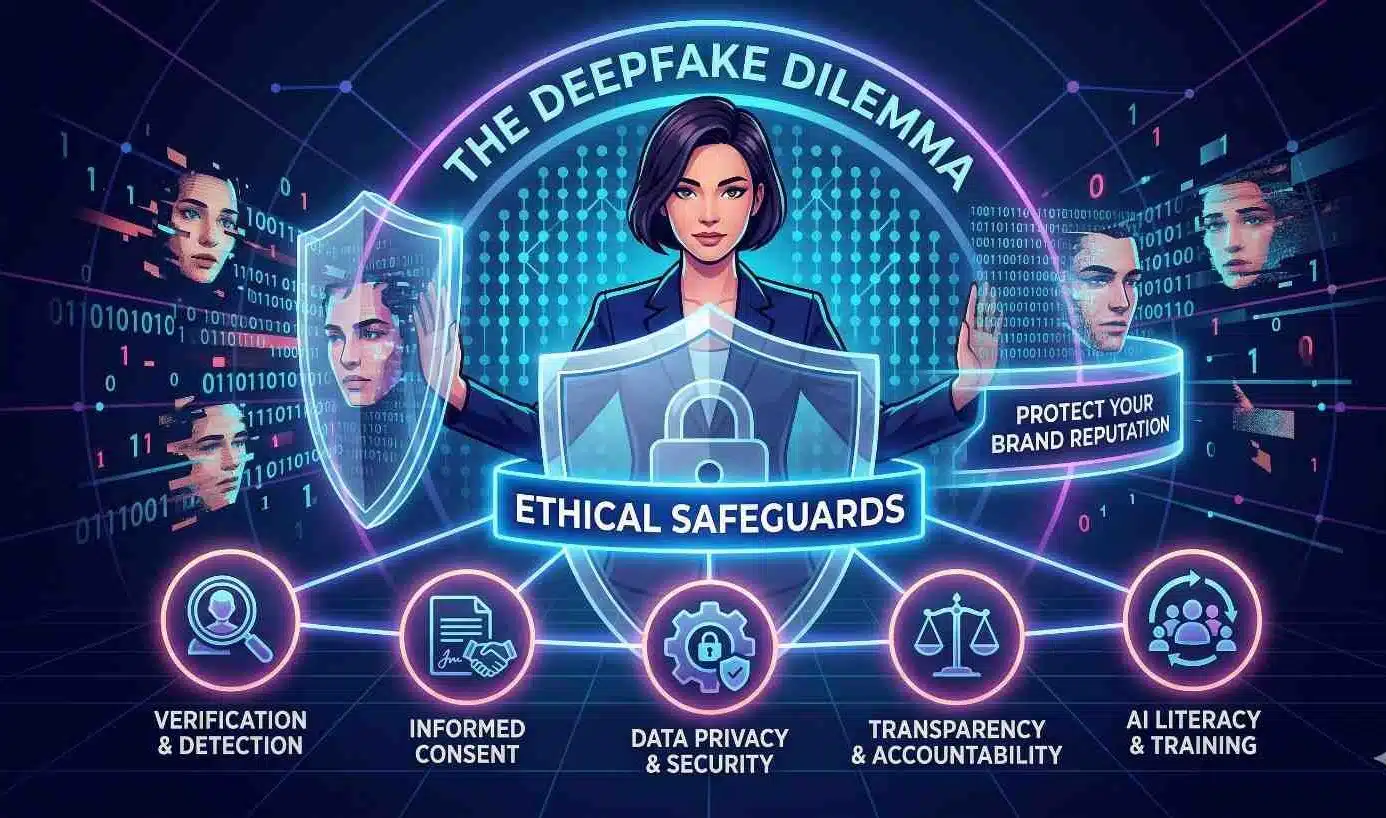
The emergence of hyper-realistic synthetic media, colloquially known as deepfakes, has inaugurated a transformative and precarious epoch for global commerce. This phenomenon is characterized by what experts identify as a “synthetic reality threshold” a critical juncture where the human ability to distinguish between authentic and fabricated media without technological assistance essentially collapses. As the Generative AI market is projected to expand by an unprecedented 560% between 2025 and 2031, reaching a market valuation of approximately $442 billion, the industrialization of deception has become a primary concern for executive leadership across all sectors. The erosion of digital trust is no longer a peripheral technical issue; it is a systemic risk that threatens the epistemic foundations of brand-consumer relationships. For the modern agency, navigating this landscape requires more than just defensive posture it demands a foundational re-architecting of ethical standards and operational protocols.
Mandatory Disclosure and Algorithmic Transparency
The first and perhaps most critical safeguard against the corrosive effects of synthetic media is the implementation of a comprehensive transparency framework. In the contemporary digital ecosystem, agencies providing online marketing services must adopt a policy of radical honesty regarding the origins of their content. This is not merely an ethical preference but a burgeoning legal mandate. The European Union’s AI Act (AIA), which entered into force in August 2024, specifically addresses the deepfake threat through Article 50, requiring providers and creators to ensure that AI-generated or manipulated content is clearly labeled as such. The regulatory environment is shifting from a “buyer beware” model to one of “creator responsibility,” where the failure to disclose synthetic origins can result in significant financial penalties and irreparable reputational damage.
| Regulation/Standard | Jurisdiction | Disclosure Requirement | Specific Mandate |
| EU AI Act (AIA) | European Union | Mandatory | Article 50(2) requires tagging AI-generated content. |
| AB-3211 | California, USA | Mandatory | Identification through watermarks in metadata of photos/audio. |
| FTC Section 5 | USA | Enforced | Prohibits deceptive practices, including undisclosed AI content. |
| BIPA | Illinois, USA | Consent-based | Requires written consent for biometric data use in deepfakes. |
| ISO 2025 (Expected) | Global | Standardized | Implementation of Content Credentials at the browser level. |
The psychological impact of undisclosed synthetic media is profound. Research into Cognitive Appraisal Theory (CAT) demonstrates that the timing and presence of disclosure significantly dictate consumer reactions. When high-quality deepfake advertisements are disclosed prior to exposure, they can suppress the elicitation of negative emotions, even if the overall appraisal remains skeptical. Conversely, if consumers realize they have been deceived after the fact, the resulting “chilling effect” often leads to immediate disengagement and a permanent loss of perceived brand authenticity. Therefore, transparency should not be a footnote; it must be an integrated component of the creative process. Agencies must also consider the “uncanny valley” effect, where subtle visual distortions or poor synchronization in low-quality deepfakes trigger an instinctive aversion in viewers, further underscoring the need for high-quality production combined with honest disclosure.
The Ethics of Emotional Resonance in Synthetic Advertising
A central ethical tension in modern advertising is whether brands should leverage deepfake technology to create artificial emotional connections with their audience. Legitimate uses, such as “digital twins” of influencers or interactive avatars, can significantly reduce operating costs and extend a seller’s reach to 24/7 cycles. For instance, deepfake technology has been used to create marketing videos on platforms like Taobao, where AI influencers provide a sense of presence and social interaction at a fraction of the cost of human talent. However, this efficiency comes with a moral weight. The ethical agency must ask: is it permissible to simulate a human relationship for commercial gain when the host is entirely artificial?
To mitigate these concerns, agencies are encouraged to adopt “agentic diplomacy” a governed approach to AI coordination where models are trained on proprietary data to ensure the brand voice remains authentic and non-intrusive. This involves rigorous “red-teaming” protocols, which are now considered best practices for identifying potentially harmful effects and biases before a campaign reaches the public. Effective red-teaming involves diverse groups, including social scientists and cybersecurity experts, who simulate attacks and document potential harms. This proactive ethical vetting ensures that synthetic media serves to enhance, rather than exploit, the consumer experience.
Cryptographic Content Provenance and the C2PA Standard
The second safeguard involves the adoption of technical standards that provide a verifiable audit trail for digital media. The Coalition for Content Provenance and Authenticity (C2PA) has developed an open technical standard, known as Content Credentials, which acts as a “digital birth certificate” for images, videos, and audio. Unlike traditional metadata like EXIF or XMP, which can be easily stripped or modified, Content Credentials are cryptographically bound to the asset, making them tamper-evident. This technical infrastructure allows users to verify the origin and history of a piece of content, including whether it was captured by a camera, edited in software, or generated by an AI model.
The implementation of C2PA standards is rapidly gaining momentum among technology leaders. LinkedIn, Meta, and Google have all announced or implemented support for these credentials, often represented to the user by a “Cr” icon. When a consumer clicks this icon, they can view a detailed manifest that outlines the asset’s journey, including signatures from verified creators and software. This shift from “blind trust” to “verifiable provenance” is essential for maintaining brand integrity in an era where voice-cloning AI can mimic a loved one’s voice with only seconds of audio.
| Technical Feature | Mechanism | Benefit to Brand Reputation |
| Cryptographic Signatures | SHA-256 Hashing | Ensures the file has not been tampered with since creation. |
| JUMBF Manifest Store | Metadata Embedding | Persistently carries the history of edits and AI involvement. |
| Hard Binding | Byte-range hashes | Prevents collision-based attacks and unauthorized insertions. |
| Soft Binding | Verification API | Allows retrieval of credentials even if metadata is stripped. |
| Forensic Watermarking | Pixel-level signals | Provides a fallback for social media platforms that compress files. |
For agencies, integrating Content Credentials into their workflow is a proactive defense against brand hijacking. By signing official corporate videos and executive announcements, an agency provides the public with a reliable way to distinguish authentic messages from malicious forgeries. This is particularly vital given the rise in “liar’s dividend” attacks, where a genuine but embarrassing video is dismissed as a deepfake, or a fabricated video is used to manipulate stock prices or corporate strategy. The ability to point to a cryptographic manifest provides a definitive counter-narrative to such disinformation campaigns.
Persistent Authenticity Across the Content Lifecycle
One of the significant challenges in provenance is the “metadata stripping” that occurs when content is uploaded to social media platforms. These platforms often resize or re-encode media to optimize performance, which can inadvertently remove the C2PA manifest. To counter this, agencies should use a layered security approach that combines Content Credentials with invisible, forensic-grade watermarking. Companies like Steg.AI provide watermarks that persist through compression and re-encoding, allowing the original C2PA data to be retrieved via a “soft binding” API.
This layered defense ensures that the authenticity signal survives the “social media churn.” It allows news organizations, publishers, and government agencies to maintain a chain of custody for sensitive content, ensuring that the public can always trace an official image back to its source. Furthermore, the C2PA standard is expected to be adopted as an ISO international standard by 2025, marking a significant milestone in global media integrity. Agencies that adopt these standards early not only protect their clients but also position themselves as leaders in the ethical use of digital technology.
Zero Trust Media Architecture and Human-Layer Security
The third safeguard represents a fundamental shift in cybersecurity strategy: the move toward a Zero Trust Media Architecture (ZTMA). Traditional security models focus on perimeter defense once a user is inside the network, they are trusted. However, deepfake technology has rendered this model obsolete. Fraudsters can now use real-time deepfake video and audio to impersonate CEOs and CFOs during high-stakes video calls, as seen in the $25 million heist targeting a Hong Kong-based multinational in early 2024. In this environment, the new paradigm is “Never trust, always verify authenticity”.
ZTMA extends zero-trust principles to the “human layer” of interaction. This involves verifying not just the credentials of a user, but the physical and behavioral authenticity of the individual on the other side of the screen. Digital Trust and Authenticity Platforms (DTAPs) achieve this by using multimodal detection systems that scan for pixel-level inconsistencies, GAN-related compression artifacts, and environmental anomalies that do not match the real world. By combining content analysis with real-time biometric and behavioral signals, these platforms can expose imposters as they interact, stopping fraud before damage is done.
| ZTMA Component | Focus Area | Detection Mechanism |
| Behavioral Biometrics | Human Interaction | Analyzes keystroke dynamics and navigation patterns. |
| Semantic Analysis | Contextual Coherence | Identifies inconsistencies in tone, style, and logic. |
| Physical Analysis | Real-world Lighting | Scans for unnatural shadows or environmental glitches. |
| Out-of-Band (OOB) | High-Risk Actions | Requires a second channel for transaction confirmation. |
| Threat Intelligence | Pattern Mapping | Uses “Identity Threat Graphs” to link disparate attacks. |
For an agency, implementing ZTMA means establishing rigorous verification protocols for all high-risk communications. This includes “multi-channel verification,” where any request for sensitive information or financial transfers initiated via video or audio call must be confirmed through a separate, trusted channel such as a voice call to a registered number or a face-to-face interaction. This “defense-in-depth” approach ensures that even if an attacker manages to create a perfect deepfake likeness, the secondary verification hurdle will prevent the attack’s success.
Behavioral Biometrics: The Unfakeable Signature
As deepfake technology improves, static biometric signals like facial recognition are becoming increasingly vulnerable to spoofing. The next frontier in ZTMA is the use of behavioral biometrics, which monitor how a person interacts with their device. Unique patterns in typing rhythm, mouse movement trajectories, and touchscreen pressure are significantly harder for AI to replicate than visual or auditory likenesses. By establishing a “behavioral baseline” during enrollment, systems can continuously verify a user’s identity throughout a session.
This continuous authentication is vital for preventing “account takeover” attacks, where a session is hijacked after the initial login. If the interaction patterns deviate from the established baseline, the system can trigger “step-up” authentication challenges or terminate the session entirely. This level of security is increasingly mandated by regulatory frameworks like PCI DSS 4.0 for sensitive data access, and it represents the future of identity assurance in a world of synthetic identities.
Strategic Resilience and Identity Insurance
The fourth safeguard is the integration of deepfake risks into a brand’s broader resilience and insurance strategy. Deepfakes are no longer a theoretical threat; they are a direct monetization vector for bad actors. In 2026, the threat landscape is expected to shift from reputational damage to industrialized fraud, with global identity fraud losses already exceeding $50 billion annually. To counter this, organizations must move beyond simple “phishing tests” toward realistic “deepfake simulations” that build response readiness across the enterprise.
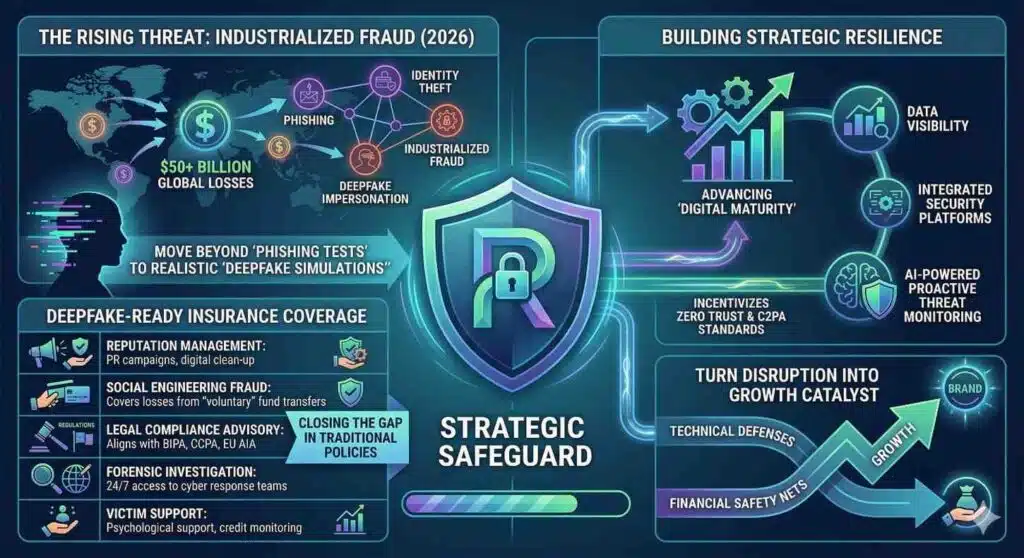
A critical component of this strategy is the emergence of cyber insurance policies that specifically cover deepfake-related incidents. Traditional policies often excluded losses due to the “voluntary transfer of funds” even if the employee was tricked by a sophisticated AI impersonation. However, new “deepfake-ready” policies are entering the market, covering costs such as forensic analysis, legal support for takedowns, and crisis communication services to repair brand reputation post-breach. These policies incentivize organizations to adopt Zero Trust frameworks and C2PA standards, creating a partnership between insurance risk management and cybersecurity technology.
| Insurance Feature | Coverage Detail | Strategic Benefit |
| Reputation Management | Funds PR campaigns and digital clean-up | Restores consumer trust after a deepfake attack. |
| Social Engineering Fraud | Covers losses from “voluntary” fund transfers | Closes the gap in traditional cyber policies. |
| Legal Compliance Advisory | Aligns with BIPA, CCPA, and EU AIA | Reduces exposure to regulatory penalties. |
| Forensic Investigation | 24/7 access to cyber response teams | Rapidly identifies the source and scope of a breach. |
| Victim Support | Psychological support and credit monitoring | Mitigates the long-term impact on affected individuals. |
Strategic resilience also requires a focus on “digital maturity.” Organizations that prioritize data visibility and integrated security platforms are better positioned to absorb shocks without losing momentum. By advancing their digital maturity, leaders can turn disruption into a catalyst for growth, using AI not only for content generation but for proactive threat monitoring and risk-adjusted decision-making. This holistic approach ensures that brand reputation is protected by both technical defenses and financial safety nets.
The Role of Susceptibility Assessments
To build true resilience, agencies must undertake ongoing “susceptibility assessments” of their processes. This involves identifying any business function that relies on the ingestion of media for authorization such as automated insurance claims, remote hiring, or executive approvals and determining the potential impact of a deepfake attack on those nodes. For instance, HR teams are increasingly integrating deepfake detection tools into their interview processes to combat synthetic identity scams, particularly those linked to North Korean IT worker schemes.
By understanding where the organization is most exposed, agencies can design targeted mitigation strategies. This might involve working with specialized deepfake research providers who monitor for fraudulent content on social media and the dark web. Regular audits of digital assets, similar to the monitoring of trademarks and patents, can help spot misuse before it escalates into a full-blown crisis. This proactive stance is essential for maintaining the “epistemic agency” of the brand the ability to act and communicate effectively in a world of contested truth.
Crisis Governance and Incident Response Protocols
The fifth and final safeguard is the establishment of a robust crisis governance framework. When a deepfake attack occurs, speed and transparency are the most effective counters to misinformation. Agencies providing result-driven online marketing services must have a predefined “Deepfake Response Plan” that outlines exactly who responds, how the falsehood is addressed, and the fastest way to set the record straight. As deepfake incidents can move through networks at machine speed, a manual, uncoordinated response is almost certain to fail.
An effective response plan begins with “executive exposure audits,” where an agency reviews all publicly available recordings of its leadership. These recordings from YouTube presentations to podcast appearances are the primary training data for voice clones and face swaps. By creating “controlled baseline samples” verified recordings of executives in consistent lighting and backgrounds security teams have a standard against which to compare suspicious content. If a suspicious video surfaces, it can be quickly analyzed using technical detection tools like Microsoft’s Video Authenticator or Deepware Scanner.
| Phase of Response | Critical Action | Responsible Department |
| Pre-Incident | Executive exposure audit and baseline creation | Cybersecurity / PR. |
| Detection | Anomaly detection via social listening tools | Marketing Analytics. |
| Verification | Comparison against baseline and forensic scan | Multimedia Forensics. |
| Containment | Platform coordination and takedown requests | Legal / Social Media. |
| Communication | Rapid, transparent public statement | Corporate Communications. |
| Recovery | Post-incident analysis and system audit | IT / Executive Leadership. |
The goal of modern brand protection is not necessarily to stop every single attack which is nearly impossible given the low cost of AI automation—but to make abuse “economically unattractive”. By responding with such velocity and clarity that the deception fails to gain traction, a brand becomes a “hard target,” leading bad actors to seek out softer, less prepared victims. This requires a connected system where marketplaces, social media platforms, and internal security teams operate as a unified defensive front.
Leveraging Social Listening for Early Warning
A proactive anti-deepfake strategy requires a deep understanding of information flow and audience behavior. Organizations must use social listening and data analysis to monitor for the exploitation of their brand or executives. This allows them to identify the “inflection point” where a deepfake begins to gain traction within specific communities. By tracking these patterns, comms teams can intervene early, providing accredited voices and authentic counter-messages before the falsehood reaches the mainstream.
Successful crisis management in the AI age also requires the integration of tech, cybersecurity, and communication teams. Historically, these departments have operated in silos, with the comms team often brought in as an “afterthought” after a technical breach has already caused reputational harm. In the context of deepfakes, the harm is primarily reputational. Therefore, the comms team must be integrated into the risk management strategy from the beginning, ensuring that the brand’s response is as sophisticated as the technology used to attack it.
Quantifying the ROI of Ethical AI Adoption
While the implementation of these safeguards represents a significant investment, the returns are measurable in both tangible and intangible terms. Organizations that take a strategic, outcome-driven approach to AI are seeing sales ROI improve by 10-20% on average. This is achieved by focusing on specific business goals such as revenue growth through personalization, improved customer retention, and lower customer acquisition costs. The “result-driven” agency uses AI not just to create content, but to optimize the entire customer journey, from initial awareness to long-term loyalty.
| ROI Metric | Definition | AI Performance Indicator |
| CAC | Customer Acquisition Cost | Reduction in spend through better targeting. |
| CLV | Customer Lifetime Value | Increase in total worth via personalization. |
| Retention Rate | Customer Loyalty | Lower churn through predictive analytics. |
| Campaign ROI | Direct Return on Spend | 20-30% lift compared to traditional methods. |
| Productivity Uplift | Time Saved / Capacity | 60% reduction in research/operational time. |
To accurately measure success, agencies should establish a performance baseline before launching any AI project, allowing them to directly attribute improvements to their AI efforts. This includes tracking “squishy ROI” such as employee sentiment and trust, which are critical for the long-term adoption and effectiveness of AI tools. By using a comprehensive “AI ROI Performance Index” that combines financial return, revenue growth, and operational cost savings, agencies can demonstrate the real value of their ethical AI strategies to their clients and stakeholders.
The Future of Brand Reputation in a Synthetic World
As we move toward 2030, the “Deepfake Dilemma” will only intensify. Fraudsters are already developing “autonomous AI fraud agents” that can execute identity theft end-to-end with minimal human involvement, probe defenses, and scale successful tactics across thousands of targets simultaneously. This “industrialization of brand abuse” means that manual enforcement will soon become completely obsolete. To survive, brands must adopt “always-on enforcement” systems that use AI to fight AI, integrating directly with marketplace systems to remove high-risk threats instantly.
The distinction between real and synthetic identities is also blurring through the rise of “synthetic identity fraud,” where attackers combine real and fabricated data to create entirely new personas. These “invisible fraudsters” can build fake credit histories and online footprints over time, making them nearly impossible for traditional verification systems to detect. For agencies, the challenge will be to help their clients navigate a world of “commerce without clicks,” where purchasing decisions are increasingly made inside AI-generated summaries and social commerce feeds that brands do not directly control.
In this future landscape, the five safeguards—transparency, provenance, zero trust, resilience, and crisis governance are not just options; they are the bedrock of survival. The agencies that thrive will be those that view AI as an opportunity to fundamentally rethink their business models, positioning themselves as guardians of trust in an increasingly uncertain digital world. By building a culture that supports acceptance, collaboration, and mandatory AI fluency, organizations can ensure that their human strategy remains the driving force behind their technological advancements.
The deepfake era is a test of character for the advertising and marketing industry. It challenges the sector to move beyond short-term gains toward a sustainable, ethical framework that respects the consumer and protects the integrity of digital discourse. Until the legal and technical landscapes fully stabilize, the guiding principle for every agency should be simple: respect the audience, protect the brand, and never monetize what was never consented to. Through the diligent application of these safeguards, agencies can turn the deepfake dilemma into a catalyst for a more authentic and resilient future.
Legal and Compliance Roadmaps for Agencies
For agencies to remain compliant in this rapidly shifting legal terrain, they must establish clear internal governance policies. This includes staying aligned with emerging state laws in the U.S., such as California’s and Utah’s mandates for robust verification processes. Agencies should proactively update their contracts to clarify how AI and deepfakes may be used internally, ensuring that they have explicit, written consent for any use of employee or influencer likenesses. This not only avoids legal liability but also builds internal trust, ensuring that the agency’s own staff are the first line of defense against synthetic threats.
Furthermore, agencies must be aware of the “Postmortem Publicity Laws” that are increasingly being applied to artificial intelligence digital replicas. As deepfakes are used to “bring back” deceased celebrities for marketing campaigns, the lack of uniform national regulation creates significant risk. Most states now recognize a postmortem right of publicity that is inheritable, meaning that using a deceased person’s likeness to suggest approval of a product can be actionable under both state law and federal false endorsement statutes. Ethical agencies should follow a principle of respecting the dignity of the deceased, avoiding the “commercialization of grief” by ensuring that all digital replicas have the proper legal and ethical clearances.
| Legal Strategy | Practical Implementation | Desired Outcome |
| Contractual Guardrails | Explicit AI usage clauses in talent/staff contracts | Prevents unauthorized likeness exploitation. |
| Disclosure Audit | Verification of “clearly visible” labels on all ads | Ensures compliance with EU AI Act Art. 50. |
| NIL Rights Review | Legal clearance for all “digital replicas” | Mitigates risk of Right of Publicity lawsuits. |
| Data Minimization | Collecting only essential biometric patterns | Aligns with GDPR and CCPA privacy standards. |
| Incident Reporting | Establishing 48-hour takedown response times | Complies with TAKE IT DOWN Act mandates. |
By adopting these legal and strategic roadmaps, agencies can protect themselves from the “legal jeopardy” that synthetic media inherently carries. This foundation of compliance allows the agency to focus on innovation, using AI to drive results for their clients while maintaining the highest standards of professional integrity. The deepfake dilemma is indeed a formidable challenge, but for the agency equipped with the right safeguards, it is also an opportunity to define the new standard for trust in the digital age.
The trajectory of synthetic media indicates that the “post-truth” era is not a temporary phase but a permanent change in the digital environment. As tools to create tailored, personalized scams become inexpensive and easy to deploy at scale, the barrier to entry for bad actors has effectively disappeared. In this context, the role of the agency as a trusted intermediary has never been more vital. By championing transparency and technical provenance, agencies can lead the way in restoring a sense of shared reality to the digital marketplace. This commitment to truth is the ultimate ethical safeguard, and it is the only way to ensure that brand reputation remains a valuable and enduring asset in the years to come.
As a final consideration, the ROI of ethical AI adoption must be viewed through a long-term lens. While short-term payback periods for technology investments are typically seven to twelve months, many organizations report that achieving satisfactory ROI on AI use cases takes two to four years. This highlights the importance of “intentional and strategic” adoption. Firms that give their professionals the room to improve, the depth of organizational understanding, and personal goal setting will find themselves at the forefront of skill development and increased productivity. In the end, the most successful agencies will be those that understand that while AI can make work faster, it is the human strategy and ethical foundation that drive real, sustainable results.
Share