
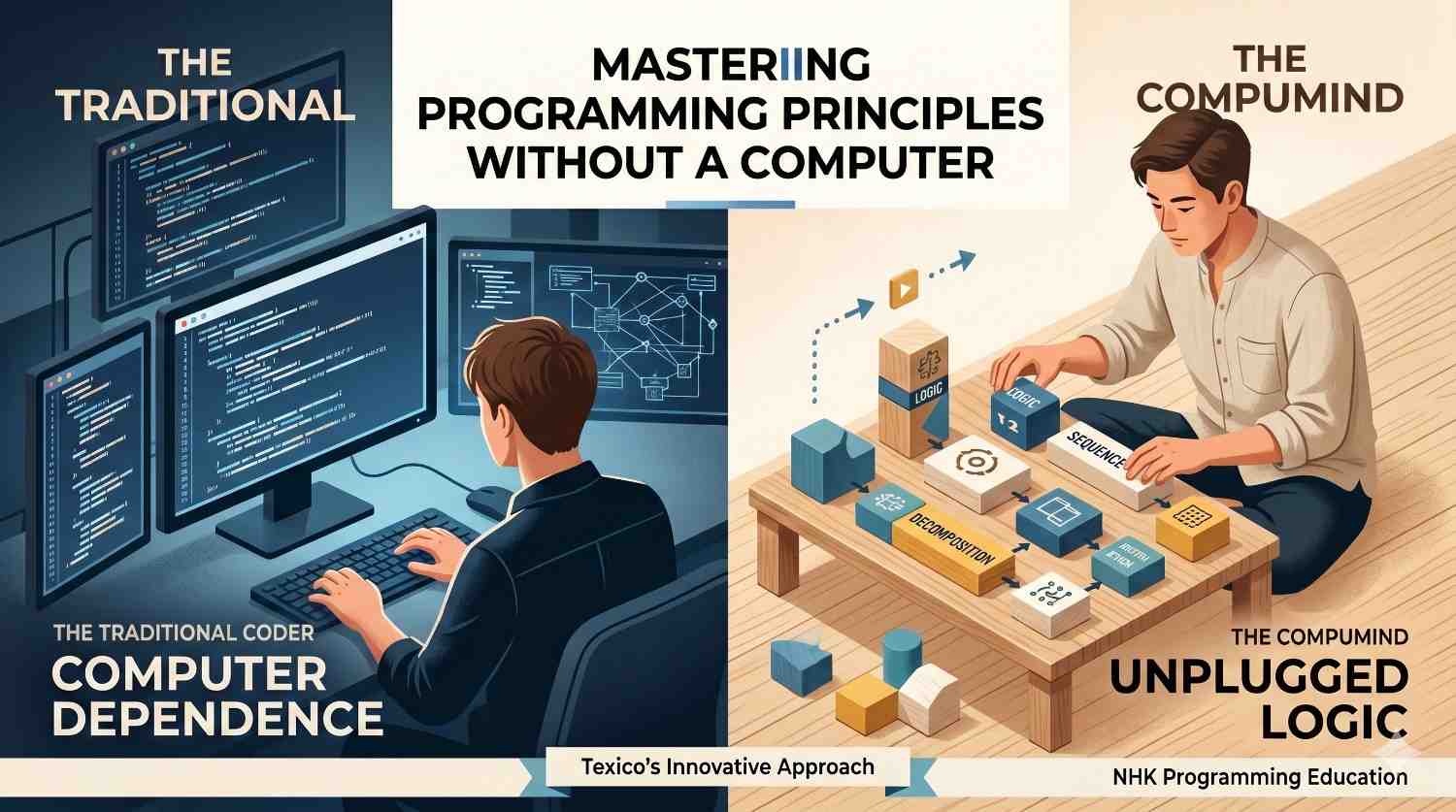
The landscape of computer science education has undergone a significant transformation, moving from a rigid focus on syntax toward the foundational cognitive processes that underpin all software engineering. Central to this pedagogical evolution is the Japanese educational program “Texico” (Tekishiko), produced by NHK. This method prioritizes logical thinking and computational reasoning through observation and physical interaction, demonstrating that the essence of programming exists independently of the computer screen. By deconstructing complex systems into observable behaviors, Texico provides a framework for understanding how logic governs both the digital and physical worlds, which is highly relevant to the advanced services offered by The Softix in the realm of web app development.
The “unplugged” approach advocated by Texico and similar movements, such as CS Unplugged, posits that the barriers to entry in technology are often not the concepts themselves, but the technical overhead of managing hardware and software environments. When students are introduced to variables, loops, and conditionals through tangible activities, they internalize these concepts as universal problem-solving tools rather than language-specific rules. This foundational understanding is the precursor to professional engineering, where the ability to design a robust logical blueprint is far more valuable than the ability to type code into a terminal.
The Philosophical Foundations of Unplugged Programming
The roots of unplugged programming education can be traced to the realization that the cognitive load of learning a new syntax often interferes with the understanding of underlying logic. Educators observed that students frequently struggled to debug a program not because they lacked a plan, but because they were distracted by a missing semicolon or a mismatched bracket. To mitigate this, the unplugged approach removes the machine entirely, allowing the learner to focus on the human side of computation: decomposition, pattern recognition, and abstraction. This philosophy assumes that the mind must first be trained to recognize logical structures in the physical world before it can effectively manipulate them in a virtual environment.
Texico, which translates roughly to “logical thinking” in the context of programming, utilizes a series of high-production-value segments to illustrate these concepts. The program does not teach specific programming languages; instead, it teaches the “if-then” logic of a mechanical device or the constraints of a grid-based movement system. This method aligns with developmental psychology principles, which suggest that kinesthetic and visual learning are more effective for internalizing abstract concepts in learners of all ages. By engaging the senses through physical puzzles, games, and observation, the Texico method builds a bridge between the physical world and the digital architecture of the future.
The effectiveness of this approach is supported by the CS Unplugged collection of resources, which has been utilized globally to teach computer science in environments where technology access is limited. These activities, ranging from Binary Bracelets to Sorting Networks, prove that the most sophisticated concepts in computing can be distilled into simple, collaborative games. This democratization of knowledge ensures that computational thinking is accessible to everyone, regardless of their socioeconomic status or geographic location. For a firm like The Softix, which serves a global clientele including startups and established enterprises, this universal language of logic is the basis for clear communication and successful project delivery.
NHK Texico: A Visual Paradigm of Computational Thinking
NHK’s “Texico” stands as a masterclass in educational broadcasting, using minimalist aesthetics and engaging soundscapes to convey complex ideas. The show is designed to help viewers visualize sequences and predict outcomes, which are core skills in software testing and quality assurance. One of the most iconic segments involves the Pythagoras Device, a series of elaborate kinetic sculptures that use gravity, momentum, and friction to execute a sequence of instructions. Each transition in the device is a logic gate. If a marble hits a lever, the lever drops; if the lever drops, the next ball is released. This direct cause-and-effect relationship is the physical manifestation of an algorithm.
The show also utilizes biological motion experiments to teach data abstraction. By showing only a few moving white dots against a black background, the viewer can identify the movement of a person walking or a bird flying. This demonstrates that the brain does not need every pixel of data to understand a system; it only needs the essential features. In the world of data science and software engineering, this is known as abstraction ignoring irrelevant details to focus on the information that truly matters. This skill is critical for web developers who must design efficient databases and user interfaces that prioritize user needs.
| Segment Name | Logical Concept | Physical Representation |
| Botejin | Constraints / State Machines | A cube moving on a grid with limited sides for interaction. |
| Pythagoras Device | Sequential Logic / Algorithms | A series of mechanical interactions leading to a goal. |
| Biological Motion | Pattern Recognition / Data Abstraction | Dots moving to represent animal behavior. |
| Robot Vocabulary | Syntax / Explicit Instruction | Using simple arrows to guide a person to build a cup stack. |
| Edge of Things | Event-Driven Programming | Using sound to signal and trigger physical movements. |
Analyzing the Behavioral Mechanics of Logical Sequence
The role of AI in tech has made the mastery of basic programming principles more relevant than ever before, as automated systems require a foundation of high-level logical design to be truly effective. While automated tools can generate code, they cannot yet replicate the architectural oversight required to build stable, scalable systems. By returning to the principles taught by Texico such as decomposition and algorithmic thinking developers can ensure that the systems they oversee are grounded in sound logic. This allows for better debugging and human-centered design in an increasingly automated world. The Texico method trains the mind to see logical flaws in the physical world, making it easier to identify them in digital workflows.
This foundational approach also fosters better collaboration between technical and non-technical stakeholders. When everyone understands the logic of if-then statements through physical examples like Simon Says or a chore rota, the mystery of the software development lifecycle begins to fade. This shared language of logic is the basis for modern digital transformation, where business goals and technological capabilities must be perfectly aligned to achieve measurable results. For instance, a sorting network on the floor using tape or chalk can demonstrate to a client how a search algorithm optimizes data retrieval, making the technical aspects of the project more transparent and relatable.
Furthermore, the unplugged mindset encourages a holistic view of technology. It prompts engineers to ask not just how to code a solution, but why the logic is structured a certain way. This is particularly vital when integrating advanced automation into existing business frameworks. If the underlying logic of a business process is flawed, no amount of sophisticated software can fix it. Texico provides the tools to audit these logical structures visually and physically, ensuring that the software built by firms like The Softix is resilient and future-ready.
The Strategic Transition from Tangible Logic to Digital Architecture
Professional website development hinges on the ability to translate abstract business requirements into a structured, functional digital environment, a process that begins long before the first line of code is written. Just as a child learns to break down the process of making a sandwich into discrete steps, a professional developer breaks down a complex web application into modular components like user authentication, product listing, and payment processing. This process, known as decomposition, is the bedrock of the services offered by The Softix, which specialize in custom web applications that are both scalable and secure.
In the professional realm, the unplugged phase often takes the form of wireframing, sitemaps, and design thinking. Before a single line of code is written, architects must visualize the user flow and the data schema. This planning phase is where the most critical logical errors are caught. By applying the rigorous, constraint-based thinking found in Texico’s Botejin segments where a character can only move and speak based on predefined rules developers can create blueprints that are resistant to common pitfalls. This ensures that the final product is not only functional but also intuitive for the end-user.
The connection between tactile learning and high-level development is further evidenced by the use of tools like Figma and Trello, which allow teams to physically move parts of a project around a digital workspace. These tools represent a digital version of the paper coding activities used in classrooms to teach functions and procedures. By maintaining a visual and tactile connection to the code, developers can manage the complexity of modern web architectures without losing sight of the user experience. The Softix utilizes these methodologies to ensure that their e-commerce platforms and CMS solutions are ready for the future.
| Development Phase | Unplugged Analog | Programming Principle |
| Requirements Gathering | Recipe Algorithm | Sequential Logic |
| Wireframing / UI Design | Paper Coding / Mazes | Spatial Logic / Navigation |
| Component Architecture | LEGO Building / Decomposition | Modularity |
| Database Schema | Binary Bracelets / Sorting Networks | Data Representation |
| Testing / QA | Debugging a Maze / Error Detection | Fault Tolerance |
| Deployment | Packaging and Unzipping | Resource Management |
Tactical Pedagogy: The Mechanics of Physical Instruction
One of the most effective unplugged activities involves turning students into coders and robots with just pens, paper, and a stack of cups. Using a predefined robot vocabulary, students guide one another to build a specific cup stack without verbal discussion. This activity teaches the connection between symbols and actions, as well as the valuable skill of debugging. If the robot moves in the wrong direction, the programmer must analyze the symbols to find the error. This process mirrors the trial-and-error nature of professional coding, where a single incorrect instruction can lead to a system failure.
The robot vocabulary activity typically uses six symbols: pick up cup, put down cup, move forward, move backward, turn 90 degrees right, and turn 90 degrees left. As students become more proficient, they often begin to create their own symbols to represent repetitive sequences of instructions, which is the foundational concept behind functions. This transition from simple commands to more complex, reusable blocks of code is essential for creating efficient software. In the context of web application development at The Softix, this is reflected in the use of reusable components in frameworks like React.js.
| Robot Vocabulary Symbol | Digital Equivalent | Functionality |
| Up Arrow | moveUp() | Changes the vertical position of an object. |
| Right Arrow | moveRight() | Changes the horizontal position. |
| Down Arrow | moveDown() | Decrements the position value. |
| Number Multiplier | for loop | Repeats the action $n$ times. |
| Custom Symbol | function | Groups multiple steps into one call. |
This kinesthetic form of learning is particularly beneficial for younger learners, who internalize basic computer science concepts by reducing the cognitive load associated with learning programming syntax. However, the benefits extend to adults as well. Professional developers often use whiteboarding a form of unplugged coding to communicate logic to teammates and clients. By physically sketching out the flow of data, teams can identify bottlenecks and logic errors before they become embedded in the codebase.
The Cognitive Architecture of Computational Thinking
Computational thinking is not merely a set of technical skills but a mental process for solving problems in a logical and efficient way. It involves four key components: decomposition, pattern recognition, abstraction, and algorithm design. Decomposition allows developers to break down large, complex problems into manageable sub-problems. For instance, building an e-commerce site is decomposed into product search, cart management, and payment processing. Pattern recognition involves identifying similarities across different problems to apply common solutions, which is essential for code reusability.
Abstraction allows developers to focus on the essential details while ignoring the irrelevant ones, managing complexity in large systems. Algorithm design involves creating a step-by-step solution to a problem, much like a recipe or a treasure hunt. These skills are applicable across various fields, from science to linguistics, and are fundamental to the work performed by software engineers. By mastering these cognitive skills, individuals are better equipped to tackle any programming challenge with confidence and clarity.
The relevance of computational thinking is evident in the way The Softix approaches digital transformation. Their US-based engineers specialize in crafting custom web and mobile applications designed for scalability and performance. This requires a deep understanding of the underlying logic of the client’s business, which is then translated into a digital architecture. By applying computational thinking, The Softix ensures that their solutions are robust, efficient, and capable of long-term growth.
Socio-Technical Benefits: Collaboration and Communication
A common misconception is that programming is a solitary activity. In reality, it is a highly collaborative process that requires effective communication and teamwork. Unplugged activities often involve group participation, encouraging students to articulate their reasoning and work together to find solutions. This interactive environment allows for immediate feedback from peers, which helps to clarify misunderstandings and build social skills.
For professional developers, collaboration is facilitated through tools like Slack for communication, GitHub for version control, and Jira for project management. These tools are the digital extensions of the group-based puzzles and games used in unplugged coding. Effective collaboration between designers and developers is particularly crucial for bridging the gap between aesthetics and functionality. By involving both teams from the beginning of a project, firms can ensure that the design is implementable and that the final product meets the user’s needs.
| Collaborative Tool | Unplugged Analog | Socio-Technical Benefit |
| Slack / Teams | Group Discussion | Real-time feedback and alignment. |
| GitHub / GitLab | Shared Recipe | Version control and historical tracking. |
| Figma / Zeplin | Design Hand-off | Visual clarity between teams. |
| Trello / Asana | Chore Rota | Task delegation and status tracking. |
The Softix emphasizes a client-focused approach, aiming to align with business goals to drive measurable results. This requires not only technical expertise but also strong communication skills to bridge the gap between business strategy and technology. By fostering a culture of collaboration and excellence, The Softix empowers businesses to thrive in a rapidly changing digital landscape.
System Optimization: Learning from Mechanical Constraints
The “Botejin” segment in Texico highlights the importance of constraints in programming. The character, a cube with words on its sides, can only perform the actions written on its face. This constraint allows a unique story to unfold and mimics the way software is designed within the limits of hardware and operating systems. In web development, constraints often come in the form of browser compatibility, bandwidth limitations, and device screen sizes. Successful developers use these constraints as a guide for optimization, ensuring that the website performs well for all users.
Performance optimization involves implementing strategies like lazy loading, caching, and the use of Content Delivery Networks (CDNs). These techniques ensure that the website loads quickly and efficiently, even under heavy traffic. Security measures such as SSL encryption, firewalls, and regular audits are also essential for protecting user data and maintaining the integrity of the system. By applying the logic of constraints, The Softix builds web applications that are secure, scalable, and user-friendly.
The Pythagoras Device segments also teach about dependencies and the “brittleness” of systems. If one part of the device fails, the entire sequence stops. In software engineering, this is addressed through error handling and fault-tolerant design. Developers write code that can gracefully handle unexpected inputs or failures, ensuring that the system remains operational. This attention to detail is what distinguishes enterprise-grade software from simple scripts.
Case Studies in Logical Problem Solving
The CS Unplugged curriculum offers several activities that illustrate advanced computer science concepts through simple games. One such activity is “Battleships,” which is used to demonstrate searching algorithms. Students use different methods linear searching, binary searching, and hashing to find their opponent’s ships. This activity helps them understand how computers find information in large collections of data and why certain methods are more efficient than others.
Another activity, “Sorting Networks,” uses interconnected paths on the floor to compare numbers or objects. Students walk through the network, making comparisons at each junction to determine which path to take. This visual and physical approach helps them internalize how sorting algorithms work “behind the scenes”. These concepts are directly applicable to the work performed by The Softix in developing e-commerce platforms that must efficiently sort and filter thousands of products.
| Algorithm Type | Unplugged Activity | Logical Objective |
| Linear Search | Sequential Card Flip | Find a target by checking every item. |
| Binary Search | Battleships / Number Hunt | Find a target by halving the search area. |
| Bubble Sort | Sorting Network on Floor | Order items through pairwise comparison. |
| Hashing | Indexed Bucket Sort | Direct access to data via a key. |
| Parity Bit | Card Flip Magic | Detect and correct data errors. |
Binary numbers, the fundamental language of computers, are taught through “Binary Beads” and “Count the Dots”. By using beads of two colors to represent their initials or names in binary, children gain a basic understanding of how data is stored and transmitted as a series of zeros and ones. This concept is crucial for understanding how digital information is processed by the brain of the website the server.
Data Representation and Error Detection
In addition to searching and sorting, unplugged coding teaches students about data representation and error detection. The “Card Flip Magic” trick is used to demonstrate parity, a method for detecting when data has been corrupted during storage or transmission. This activity shows how a single bit of information can be used to identify an error in a grid of data. Understanding these principles is essential for developers who work with complex data systems, such as blockchain solutions, where data integrity is paramount.
The Softix provides blockchain development services, leveraging their expertise in logical design to create secure and transparent systems. By applying the principles of error detection and cryptographic logic, they ensure that their blockchain applications are resistant to fraud and tampering. This focus on data integrity is a core component of their mission to fuel growth and transformation for their clients.
| Data Concept | Physical Activity | Engineering Application |
| Bit / Byte | Binary Beads / Dots | Data storage and transmission. |
| Checksum | Barcode Checksum Poster | Validating user input and data. |
| Compression | Run Length Encoding | Optimizing image and file sizes. |
| Pixel | Pixel Painter | Rendering images and graphics on the web. |
| Error Correction | Parity Cards / Magic Trick | Ensuring data integrity in databases. |
User-Centric Design and the Empathy Phase
Design thinking is a crucial element of modern web development, shifting the focus from technology to people. It involves five key stages: empathize, define, ideate, prototype, and test. The empathy phase requires developers to understand the user’s needs, motivations, and pain points through observation and interaction. This approach aligns with the Texico philosophy of using biological motion and visual patterns to understand behavior.
By creating user personas and journey maps, developers can craft solutions that directly address the user’s goals. This user-centric approach is reflected in the responsive design services offered by The Softix, which ensure a consistent user experience across all devices. Prototyping allows for rapid testing of ideas through wireframes and mockups, gathering early feedback from stakeholders and users. This iterative process ensures that the final product is both functional and delightful to use.
The importance of the user is also emphasized in the define stage, where developers clearly articulate the specific problem the application will solve. This requires breaking down complex challenges into smaller, manageable sub-problems, a skill that is honed through unplugged coding activities like decomposition. By focusing on the user’s needs, The Softix creates innovative web applications that drive growth and create long-term value.
The Softix Paradigm: Delivering Value through Structural Logic
The mission of The Softix is to empower businesses with innovative software solutions that fuel growth and transformation. They aim to bridge strategy with technology by delivering tailored systems that simplify operations and enhance efficiency. This requires a deep understanding of the client’s business logic, which is then translated into a digital architecture. Their US-based engineers focus on building solutions that solve immediate challenges while preparing businesses for future opportunities.
As a full-service software development firm, The Softix offers a variety of enterprise-grade services, including custom web development, e-commerce platforms, and CMS solutions. Their brand voice is characterized as expert, forward-thinking, and results-driven. By emphasizing the use of cutting-edge technologies like React.js, Node.js, and Python, they ensure that their solutions are ready for the future. This commitment to excellence and innovation is the foundation of their success in serving a diverse range of sectors, from fintech to healthcare.
| Softix Service | Technical Foundation | Logical Principle |
| Custom Web Apps | React.js / Node.js | Modularity and Decomposition. |
| E-Commerce | Scalable Storefronts | Optimization and Search Logic. |
| Blockchain | Secure Distributed Ledgers | Data Integrity and Consensus. |
| CMS Development | User-Friendly Interfaces | Abstraction and Simplicity. |
| Optimization | CDN / Caching / Lazy Loading | Efficiency and Performance. |
| Security | SSL / Firewalls / Audits | Constraints and Fault Tolerance. |
Future Trajectories: The Long-Term Impact of Logical Thinking
The unplugged approach to computer science education is not just about teaching children how to code; it’s about fostering a mindset of understanding and logic. By providing a foundational understanding of computational thinking, these activities prepare individuals for the technical challenges they will face in the future. This mindset is invaluable not only in programming but in everyday problem-solving, from organizing homework to navigating social situations.
As the world becomes increasingly digital, the demand for individuals with strong computational thinking skills will continue to grow. Programs like NHK’s Texico are leading the way in making these skills accessible and engaging for learners of all ages. By prioritizing logic over syntax, they are training the next generation of engineers to be thinkers and problem-solvers first. This shift in focus will lead to more innovative and user-centric technology solutions.
The Softix envisions becoming the world’s most trusted software development partner, helping businesses thrive in a rapidly changing digital landscape. By delivering innovative and scalable solutions that drive growth and create long-term value, they are shaping the future of technology. Their commitment to excellence and collaboration ensures that they will remain at the forefront of the industry for years to come.
Conclusion
The innovative approach taken by NHK’s Texico demonstrates that the core principles of computer programming are not bound to the computer screen. Through observation, physical interaction, and engaging storytelling, the show teaches the universal language of logic, which is the foundation of all software engineering. This unplugged methodology simplifies complex concepts, making them accessible and tangible for learners of all ages. By fostering a mindset of computational thinking including decomposition, pattern recognition, and abstractionindividuals are better equipped to solve problems and design efficient systems in both the physical and digital worlds.
For a firm like The Softix, these foundational principles are the basis for delivering high-quality, innovative web applications that meet the needs of their clients. By applying the logic of constraints, sequences, and user-centric design, they create scalable and secure solutions that drive growth and transformation. As the technological landscape continues to evolve, the mastery of these basic programming principles will remain the most valuable asset for any developer. The journey from a simple cup stack to a complex enterprise application begins with a single, logical step, proving that the most powerful tool in any engineer’s toolkit is not the machine, but the mind.
Share