
For organizations providing premium IT services and software development, the challenge is not merely to build functional applications but to ensure that the data those applications generate remains accessible, secure, and meaningful across decades. Within this context, the United States Library of Congress (LOC) serves as a global authority on Digital Preservation, establishing rigorous benchmarks for file formats that can withstand the test of time. One of the most significant developments in the field of data stewardship is the official recommendation of SQLite as a preferred storage format for datasets. This endorsement places SQLite in an elite category alongside established standards like XML, JSON, and CSV, highlighting its exceptional durability and structural integrity.
As a Strategic Technology Partner, The Softix specializes in Custom Software Development and Agile Methodologies, where the choice of a storage format is a foundational decision that influences the scalability and future-readiness of every solution. Whether developing Mobile App Development for startups or modernizing mission-critical legacy systems for large enterprises, understanding the preservation-grade qualities of SQLite is essential for delivering Innovation Delivered with Precision. The Library of Congress’s decision to include SQLite in its Recommended Formats Statement (RFS) is rooted in a comprehensive evaluation of sustainability factors, ranging from transparency and documentation to adoption and technical protection mechanisms.
The Library of Congress Sustainability Framework for Datasets
The Library of Congress does not issue recommendations based on popularity alone; instead, it employs a rigorous framework of sustainability factors designed to maximize the chance of survival and continued accessibility of digital content. These criteria are particularly relevant for businesses aiming for Digital Growth and high-performance applications. The analysis of a format’s suitability for preservation involves seven core dimensions: disclosure, adoption, transparency, self-documentation, external dependencies, impact of patents, and technical protection mechanisms.
Disclosure and Documentation as a Foundation for Trust
Disclosure refers to the degree to which complete specifications and tools for validating technical integrity exist and are accessible to those creating and sustaining digital content. SQLite excels in this regard because its file format is openly and meticulously documented, and the source code itself is in the public domain. This transparency ensures that even if the original development team were to vanish, the technical community would possess the necessary information to build new tools for reading and interpreting the data. The existence of complete documentation is prioritized over approval by a recognized standards body, as the actual utility of the format depends on the clarity of its specification.
For agencies focused on Custom Engineering and Enterprise Portals, such as the projects within The Softix’s portfolio, this level of disclosure translates to local reliability and reduced risk of vendor lock-in. In an environment where “one-size-fits-all” approaches often fail, the ability to rely on a format with 100% public disclosure allows for more precise and creative technology solutions.
Global Adoption and the Network Effect
Adoption is the degree to which the format is used by primary creators, disseminators, or users of information resources. SQLite is widely recognized as the most deployed database engine in the world. It is integrated into almost every smartphone, including billions of Android and iOS devices, as well as major web browsers like Chrome, Firefox, and Safari. This massive install base creates a “gravity” that ensures the format will remain supported by a vast ecosystem of third-party tools, libraries, and expertise for the foreseeable future.
| Metric of Adoption | SQLite Statistics |
| Total Deployments | Multiple billions of devices |
| Mobile Integration | Default storage for Android and iOS |
| Browser Support | Integrated into Chrome, Firefox, and Safari |
| Operating Systems | Included in Windows 10, macOS, and Linux |
| Application Use | Adobe Lightroom, Apple Mail, iTunes, and Dropbox |
This high level of adoption is a critical component of the “platform effect” in Data Archiving planning. When a format is this pervasive, the cost of maintaining access to it decreases because the global market for its maintenance is so large. Leveraging such a widely adopted format in SaaS Development and CRM Development ensures that clients are building on a globally recognized standard that facilitates data exchange and long-term storage.
Transparency and Self-Documentation
Transparency involves the degree to which a digital representation is open to direct analysis with basic tools, such as human readability using a text editor. While SQLite is a binary format, it maintains a level of transparency through its well-structured B-tree architecture and the inclusion of the SQL CREATE TABLE commands directly within the file. A preservationist can use a simple hexadecimal viewer or the standard SQLite library to inspect the structure and contents of the database without needing external schema files or proprietary software.
Self-documenting digital objects contain basic descriptive, technical, and other administrative metadata within themselves. SQLite files are inherently self-documenting because the database schema the definitions of tables, columns, and relations is stored in a dedicated table called sqlite_schema. This ensures that the data and its structural context are inseparable, which is a prerequisite for authentic Digital Preservation. Within the framework of Custom Software Development, this feature allows for the creation of Scalable, Secure, and Future-Ready Solutions where the data remains meaningful even as the application evolves.
Technical Architecture: Precision Engineering for Longevity
The technical design of SQLite is a study in Innovation Delivered with Precision. Unlike client-server database systems like PostgreSQL or Oracle, SQLite is an embedded, serverless engine. This means the entire database is contained within a single cross-platform file, making it exceptionally easy to manage for archival purposes.
The Unitary File Structure
The fact that a complete SQL database, including tables, indices, triggers, and views, is contained in a single disk file is one of its most attractive features for Data Archiving. This unitary nature simplifies the packaging of archival materials, as there are no external dependencies or multiple files to keep in sync. The Library of Congress notes that SQLite’s file format is transferable between 32-bit and 64-bit systems and between big-endian and little-endian architectures, making it truly platform-independent.
The B-Tree and Page-Based Storage
At its core, an SQLite database is composed of one or more pages, all of which are the same size. This size is typically a power of two between 512 and 65,536 bytes. SQLite uses B-trees to organize these pages, providing a highly efficient mechanism for searching and navigating large datasets.
| Page Type | Function | Significance for Preservation |
| Table B-Tree Page | Stores the actual data records | Ensures efficient access to large datasets without full scans. |
| Index B-Tree Page | Stores keys for rapid lookup | Accelerates query performance even in multi-terabyte files. |
| Overflow Page | Stores data that is too large for a single page | Allows for the storage of large BLOBs (images, documents). |
| Lock-Byte Page | Historically used for file locking | Maintained for backwards compatibility with older OS. |
The theoretical maximum size of an SQLite database is approximately 140 terabytes, which is more than sufficient for the vast majority of research datasets and enterprise archives. For organizations that deal with “high touch” data curation and Digital Growth, this capacity ensures that solutions can scale alongside business models.
The 100-Byte Header: The Key to Identification
Every well-formed SQLite 3 database file begins with a 100-byte header that provides the critical metadata needed to interpret the file. The first 16 bytes contain the UTF-8 encoding of the string “SQLite format 3” followed by a null terminator. This “magic number” is the most reliable way to identify SQLite files, which is a key requirement for automated digital repository workflows.
| Offset | Size | Field Description |
| 0 | 16 | Header string: “SQLite format 3\000” |
| 16 | 2 | Database page size in bytes |
| 18 | 1 | File format write version (1 for rollback, 2 for WAL) |
| 19 | 1 | File format read version (1 for rollback, 2 for WAL) |
| 20 | 1 | Bytes of unused “reserved” space at the end of each page |
| 24 | 4 | File change counter |
| 32 | 4 | Size of the database file in pages |
| 48 | 4 | User version number |
| 68 | 4 | Text encoding (1=UTF-8, 2=UTF-16le, 3=UTF-16be) |
The header also specifies the text encoding used within the database, which the Library of Congress notes as a critical factor in its preference for UTF-8 and UTF-16. By embedding these technical details directly into the file, SQLite reduces the risk of data corruption due to misinterpretation of character sets or page structures.
Stability and the 2050 Commitment: Serious Engineering for the Long Term
One of the most remarkable aspects of the SQLite project is its explicitly stated long-term support policy. The developers intend to support SQLite through the year 2050. This is not merely an aspirational goal; it is a commitment that influences every design decision made today. In an industry characterized by “move fast and break things,” SQLite stands apart for its Digital Resilience.
Planning for the Unborn Developer
The source code for SQLite is carefully commented, with the specific goal of helping future developers understand the logic and rationale behind the implementation. The project leaders write code with the assumption that it will one day be read by people not yet born. This level of foresight is invaluable for Digital Preservation, which is ultimately a human endeavor requiring cultural awareness and the ability to interpret materials across generations.
As a Strategic Technology Partner, The Softix aligns its long-term outlook with this philosophy. By building Enterprise Portals and SaaS Development solutions on a platform that guarantees support for another quarter-century, clients are provided with a level of security and reliability that is rare in the software industry.
Aviation-Grade Reliability and Testing
The reliability of SQLite is further underscored by its use in flight-critical software for the Airbus A350 XWB family of aircraft. Meeting the DO-178B certification standards for aviation requires a level of testing that is unprecedented for most commercial software. The SQLite library consists of approximately 156,000 lines of source code, but it is supported by over 90 million lines of test code a ratio of nearly 600 to 1.
| Testing Metric | SQLite Performance |
| Lines of Production Code | ~156,000 |
| Lines of Test Code | ~92,000,000 |
| Branch Test Coverage | 100% |
| Pre-release Test Count | ~2.5 million cases |
| Release Frequency | 5-6 times per year |
The automated test suite simulates power losses, I/O errors, memory allocation failures, and maliciously designed database files to ensure that SQLite remains resilient under any circumstances. This focus on reliability is a primary reason why it is used in mission-critical systems and why it is a trusted choice for organizations that cannot afford data loss.
Comparative Analysis: SQLite vs. Traditional Data Formats
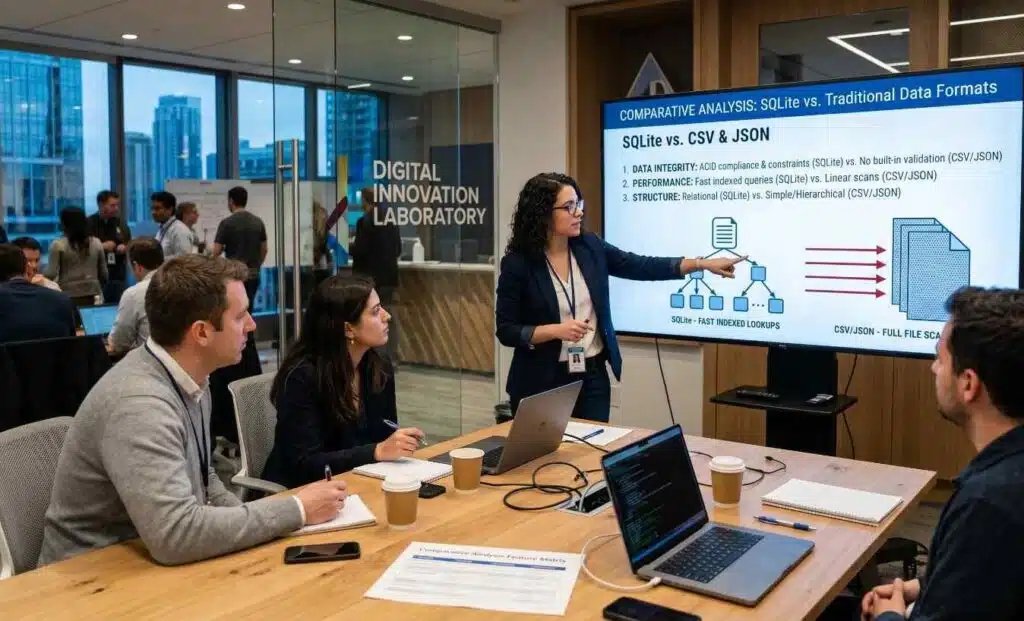
When selecting a storage format for long-term preservation, institutions often compare SQLite to simpler text-based formats like CSV and JSON. While these formats have their merits, they often fall short when dealing with complex or large-scale datasets.
The Limitations of CSV and JSON
CSV is widely used due to its simplicity and the ability to be opened by spreadsheet programs like Excel. However, CSV lacks a formal standard, leading to ambiguity regarding character encodings and delimiters. More importantly, CSV does not store data types or schema constraints, which can lead to data integrity issues over time.
JSON is the de facto standard for data interchange on the web, but it is often inefficient for large-scale storage. Parsing a large JSON file can become a significant performance bottleneck, as most parsers must load the entire file into memory to create a Document Object Model (DOM). Furthermore, JSON does not natively support indexing, making it slow for complex queries.
The SQLite Advantage in Structure and Performance
In contrast, SQLite provides a structured relational environment that enforces data integrity through the use of primary keys, foreign keys, and CHECK constraints. Because it uses an indexed B-tree structure, SQLite can query a specific portion of a multi-gigabyte file in milliseconds, whereas a CSV or JSON file would require a linear scan of the entire dataset.
| Feature | CSV | JSON | SQLite |
| Data Integrity | No built-in validation | Limited schema support | ACID transactions and constraints |
| Querying | Requires full file read | Slow for large files | Fast with indexed lookups |
| Metadata | External or absent | External | Embedded in the file |
| Concurrent Access | Generally read-only | Single process write | Multi-process read/write with locking |
| Complexity | Simple tables only | Hierarchical | Relational and complex joins |
For projects focused on high-performance applications and strategic Digital Growth, the performance advantages of SQLite allow for Scalable, Secure, and Future-Ready Solutions that grow with the client’s needs.
Digital Preservation in the Age of AI and Platforms
The context of Digital Preservation is shifting toward “platformization,” where research data infrastructure is increasingly moved to corporate-owned platforms. This trend underscores the importance of open-source solutions like SQLite that are independent of proprietary silos. New federal research policies, such as those from the National Science Foundation (NSF), now require robust data management plans that prioritize long-term open access to scientific data.
Integrating Metadata and Schema.org
Modern digital archiving also involves the use of standardized metadata frameworks to enhance searchability. For example, the use of Schema.org metadata (often expressed in JSON-LD) helps search engines index datasets more effectively. While SQLite is a binary format, its contents can be easily transformed into these linked-data formats, ensuring that the archived information remains part of the broader “knowledge graph”.
The Role of Artificial Intelligence (AI)
Artificial Intelligence is increasingly being used to support preservation work, assisting with metadata generation and large-scale analysis. However, the rise of AI also introduces new challenges regarding authenticity and provenance. SQLite’s ability to store both the data and the documentation of how that data was processed is crucial for maintaining trust in the historical record.
The expertise in AI and software development at The Softix, particularly in building innovative solutions like Karpathy-style Wikis or AI-assisted cognition tools, demonstrates the importance of structured data in the AI era. By using a preservation-grade format like SQLite, Development teams ensure that the training data and logs for AI systems remain accessible for future auditing.
Digital Forensics and Data Recovery: A Test of Transparency
The transparency and robustness of the SQLite format are perhaps most evident in the field of digital forensics. Because SQLite is used for local storage in so many mobile applications, it has become a primary target for investigators seeking to recover artifacts.
Recovering the “Deleted”
In forensics, the “unallocated area” of an SQLite database is a goldmine for information. When a record is deleted, it is not immediately scrubbed from the disk; instead, the space it occupied is marked as available for reuse. Forensic tools can “carve” these records from the database file, providing critical evidence in legal investigations.
- iPhone Artifacts: Researchers acquire logical data from locked iPhones by identifying the SQLite tables where messages are stored within backup files.
- Instagram Forensics: Artifacts stored in SQLite on mobile devices provide a wide range of information, from user data to time and location indicators.
- Reverse Engineering: The simplicity of the SQLite format allows for tools like DB Browser for SQLite to analyze user behavior with relatively little effort.
This high degree of forensic recoverability is a direct result of SQLite’s transparent and well-documented structure the same qualities that make it an ideal format for Digital Preservation.
Licensing and the Public Domain: Ensuring Legal Sustainability
A significant risk to long-term Digital Preservation is the issue of intellectual property. If a file format is proprietary or encumbered by patents, future archives may be legally or technically barred from accessing the content. SQLite avoids this risk entirely by being in the public domain.
The Hwaci Affidavits
All of the code and documentation in SQLite have been dedicated to the public domain by its authors. To ensure this status is legally beyond reproach, the principal developers have signed affidavits dedicating their contributions to the public domain, and the original copies of these documents are stored in a fire-safe at the offices of Hwaci.
As a US-based premium IT services agency, The Softix views this legal clarity as a major selling point for its clients. It allows for the Development of Scalable, Secure, and Future-Ready Solutions without the fear of future litigation or licensing fees. For international clients, SQLite also offers the Creative Commons Zero (CC0) license as an alternative in jurisdictions that do not recognize the concept of the public domain.
Strategic Implementation: How The Softix Leverages SQLite for Success
The use of SQLite within Custom Software Development projects is a reflection of a commitment to Innovation Delivered with Precision. By following an agile five-step iterative process Requirement Gathering, UI/UX Design, Development, QA & Testing, and Deployment The Softix ensures that every solution is optimized for both current performance and long-term storage.
Building MVPs for Startups
For startups looking to validate a MVP (Minimum Viable Product), speed and cost-effectiveness are paramount. SQLite’s zero-configuration nature makes it an ideal choice for rapid development. There is no server to install, no user permissions to manage, and no network protocols to configure. This allows developers to focus on the core features and user experience while still building on a database engine that can support significant growth.
Modernizing Legacy Systems for Enterprises
When enterprises need to modernize legacy software or build mission-critical systems, they require a storage solution that is both stable and high-performing. SQLite’s ability to act as an “application file format” is a key strategy here. Instead of creating a proprietary binary format for a specific application, developers can use a standard SQLite database. This ensures that the enterprise’s data remains accessible to other tools and can be easily migrated to larger database systems if necessary.
The results seen in case studies such as the +500% increase in monthly sessions for Gunnar or the +300% increase in organic search for Whisps are a testament to the power of combining expert Development with the right technology stack. While SEO and marketing are critical for visibility, the underlying data architecture must be robust enough to handle the resulting traffic.
Conclusion: The Strategic Imperative of Preservation-Grade Storage
The recognition of SQLite as a recommended storage format by the Library of Congress is more than a technical trivia point; it is a signal to the entire IT industry that durability, transparency, and simplicity are the hallmarks of great engineering. As the world becomes increasingly data-driven, the ability to ensure the long-term accessibility and integrity of that data is a core competitive advantage.
For a Strategic Technology Partner, SQLite represents the ideal blend of innovation and reliability. Its pervasive adoption ensures a large pool of support; its public domain status removes legal barriers; and its rigorous testing regime guarantees the highest levels of data integrity. By integrating SQLite into Custom Software Development, Mobile App Development, and enterprise solutions, The Softix ensures that its clients are not just building for today, but are creating lasting digital assets that will remain accessible for generations to come.
In an age where digital transformation is accelerating, the choice of a storage format like SQLite is a commitment to Think IT Think Softix a commitment to delivering precision-engineered solutions that are truly future-ready. The Library of Congress recommendation is a validation of this approach, confirming that SQLite is indeed a world-class standard for the preservation of our digital heritage.
Share