If the technology landscape of the early 2020s was defined by rapid adaptation, the landscape of 2026 is defined by intelligent integration and unprecedented speed. We have moved past the initial hype cycles of artificial intelligence and decentralized concepts into an era of practical, powerful application. For developers, CTOs, and digital product owners, “business as usual” is a roadmap to obsolescence.
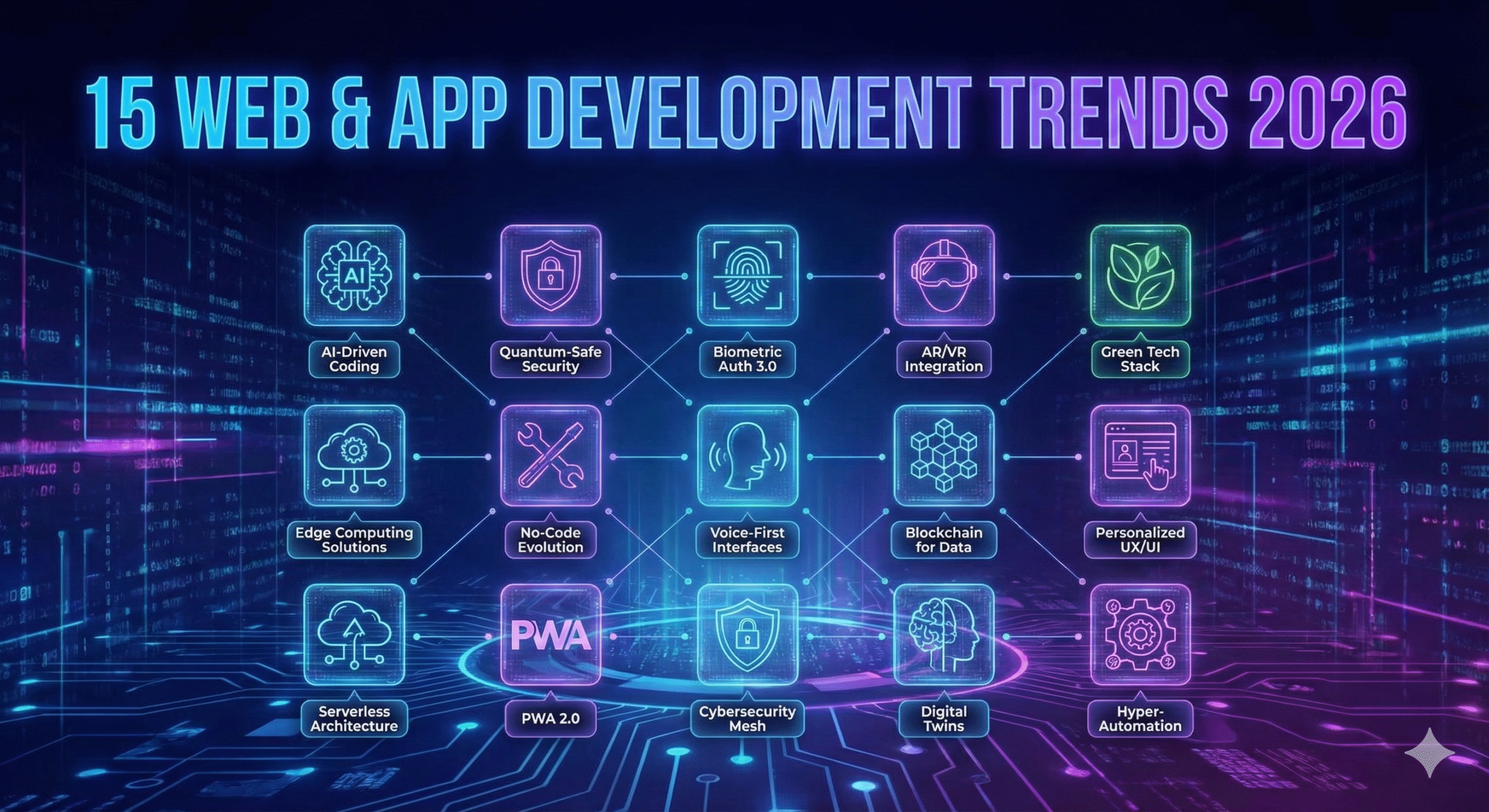
Today’s users demand instantaneous performance, hyper-personalization, and interfaces that intuitively understand their intent. The gap between native mobile applications and web experiences has all but vanished, and the cloud has become smarter and more distributed. To thrive in this environment, organizations must align their digital strategies with the currents shaping the future. Below is an expert analysis of the 15 critical web and app development trends dominating 2026.
1. AI-Augmented Development as Standard Practice
Artificial Intelligence in 2026 is no longer just a feature you add to an app; it is the foundation upon which apps are built. We have moved beyond simple code-completion tools like the GitHub Copilot of yesteryear. Today, AI-augmented development involves intelligent agents that can generate entire modules, write comprehensive test suites, and automatically refactor legacy codebases for performance.
This trend is shifting the role of the developer from a “writer of code” to an “architect of solutions.” AI handles the boilerplate and routine debugging, freeing up human ingenuity to focus on complex logic, user experience strategy, and systemic security. Development lifecycles have shrunk dramatically, allowing teams to push features to market at a velocity previously thought impossible.
2. The Absolute Maturation of Progressive Web Apps (PWAs)
The promise of Progressive Web Apps has finally been fully realized. Thanks to near-universal browser support for advanced APIs and the capability of devices to handle complex local processes, PWAs are now the preferred choice for many businesses over expensive native app development. Modern Web App Development has reached an inflection point where the distinction between a browser-based experience and a downloadable native application is practically non-existent to the end-user.
In 2026, PWAs offer flawless offline capabilities, push notifications that rival native OS integration, and access to device hardware like biometrics and advanced camera features. Companies are increasingly opting for a “PWA-first” strategy, maintaining a single codebase that serves desktop, mobile, and tablet users with an app-like experience, drastically cutting development and maintenance costs while improving reach.
3. WebAssembly (Wasm) Bringing Desktop Power to the Browser
For years, JavaScript was the undisputed king of the browser, but it had performance limitations for heavy computational tasks. WebAssembly (Wasm) has shattered those ceilings. By allowing developers to compile code written in languages like C++, Rust, and Go into a format that runs in the browser at near-native speeds, Wasm has unlocked a new tier of web applications.
In 2026, we are seeing full-fledged video editing suites, complex 3D CAD software, and high-fidelity gaming running entirely within web browsers without requiring plugins or installations. This trend is crucial for B2B SaaS platforms looking to migrate heavy desktop software to the cloud without sacrificing performance, making the browser a truly powerful operating system.
4. Edge Computing and Edge AI
The centralized cloud model is being complemented, and in some cases superseded, by edge computing. The demand for real-time applications think autonomous vehicle interfaces, IoT management, and real-time language translation means that sending data halfway across the world to a central server takes too long.
Development in 2026 focuses on pushing data processing closer to the source the “edge” of the network. Furthermore, “Edge AI” involves deploying lighter machine learning models directly onto user devices (smartphones or local IoT gateways). This not only ensures ultra-low latency but also enhances user privacy, as sensitive data doesn’t need to leave the user’s device to be processed.
5. Serverless Architecture 2.0 (Function-as-a-Service)
Serverless computing has matured from a buzzword into the default infrastructure choice for scalable applications. In 2026, “Serverless 2.0” means developers rarely think about server provisioning, patching, or scaling capacity. The focus is entirely on writing individual functions that execute business logic in response to events.
The major shift in 2026 is the improved ecosystem around serverless, addressing previous pain points like “cold starts” and vendor lock-in. Modern serverless architectures allow for incredible cost efficiency you only pay when your code runs and instantaneous elasticity, handling sudden traffic spikes during product launches or viral events without a hitch.
6. Motion UI and Immersive “Scrollytelling”
Minimalism remains important, but static minimalism is dead. User engagement in 2026 relies heavily on Motion UI and interactive narratives, often called “scrollytelling.” As bandwidth increases and device graphical capabilities improve, designers are using sophisticated animations to guide user attention, provide contextual feedback, and tell compelling brand stories.
These aren’t just decorative elements; they are functional aspects of the UI that improve usability. A button morphing into a progress bar, or elements subtly shifting to indicate depth, helps users understand the interface intuitively. Scrollytelling turns a flat webpage into a journey, increasing time-on-site and conversion rates by keeping the user actively engaged with the content flow.
7. The Cybersecurity Mesh and Zero Trust Architecture
The traditional “castle and moat” security model, where you secure the perimeter and trust everything inside, is obsolete. The distributed nature of modern apps using microservices, third-party APIs, and remote workforces necessitates a “Cybersecurity Mesh” approach.
In 2026, Zero Trust is the standard mandate: “Never Trust, Always Verify.” Every single access request, whether from outside the network or within an application’s own microservices, must be authenticated and authorized dynamically. Developers are now integrating security protocols deep into the code level rather than relying on infrastructure firewalls, ensuring that even if one component is breached, the entire system does not fall.
8. Voice Search Optimization and Conversational Interfaces
With the ubiquitous presence of smart speakers and sophisticated mobile assistants, voice interaction has become a primary input method. However, in 2026, this goes beyond simple commands like “what’s the weather.” We have entered the era of conversational interfaces driven by advanced Large Language Models (LLMs).
Web and app developers must now optimize content not just for keywords, but for natural language queries. Applications are integrating voice-driven navigation and search functionalities that can understand context, nuance, and multi-step requests, providing a hands-free experience that is vital for accessibility and multi-tasking users.
9. Low-Code/No-Code Empowerment for Citizen Developers
The democratization of software development has accelerated. Low-Code/No-Code (LCNC) platforms have matured from tools for building simple prototypes into robust enterprise-grade solutions. In 2026, these platforms are heavily integrated with AI assistants, making them even more powerful.
This trend allows “citizen developers” business analysts, marketers, or HR professionals to build functional applications to solve their immediate needs without overburdening IT departments. For professional developers, LCNC platforms are used to rapidly speed up the creation of standard CRUD (Create, Read, Update, Delete) interfaces, leaving them more time to focus on bespoke, complex architecture.
10. Sustainable “Green” Web Design and Coding
Digital sustainability has moved from a niche concern to a core business metric. The internet accounts for a significant portion of global electricity usage, and in 2026, consumers and regulators are demanding greener digital products. “Green coding” involves optimizing algorithms to use less processing power and architecting systems to minimize data transfer.
From a design perspective, this includes implementing energy-saving dark modes as standard, lazy-loading assets, and choosing eco-conscious hosting providers. Reducing a website’s carbon footprint often goes hand-in-hand with improving its performance and loading speed, creating a win-win for the planet and user experience.
11. WebXR and Augmented Reality Commerce
Augmented Reality (AR) on the web, often referred to as WebXR, is transforming e-commerce and education. Users no longer want to download a separate app just to see how a sofa looks in their living room or try on virtual sunglasses. In 2026, browser-based AR capabilities are sophisticated enough to handle these experiences seamlessly.
Developers are integrating 3D models directly into product pages, allowing for immersive “try-before-you-buy” experiences that significantly reduce return rates and boost conversion. This technology is also making waves in training and education applications, overlaying digital information onto the real world through standard mobile browsers.
12. Blockchain for Decentralized Identity (Self-Sovereign Identity)
While the crypto hype carries on, the underlying blockchain technology has found a critical use case in web development: Decentralized Identity or Self-Sovereign Identity (SSI). The traditional model of storing user names and passwords in centralized databases is a massive security risk.
In 2026, we are seeing a shift toward users managing their own encrypted identity wallets. Applications verify the user’s identity via the blockchain without ever actually receiving or storing their private data. This enhances security, simplifies login processes across multiple platforms, and gives users true ownership of their digital footprint.
13. Micro-Frontend Architecture
Just as monolithic backends were broken down into microservices, monolithic frontends are being broken down into micro-frontends. As web applications become incredibly complex, having a single, massive frontend codebase becomes unmanageable for large teams.
Micro-frontends allow different teams to own distinct parts of the user interface (e.g., one team manages the search bar component, another manages the shopping cart). These components can be built using different frameworks (React, Vue, Svelte) and deployed independently. This approach in 2026 is essential for enterprise-scale agility and scalability.
14. 5G-Native Rich Experiences
With 5G networks reaching maturity globally in 2026, developers can finally rely on high-speed, low-latency connections as a baseline for mobile users. This opens the door for data-intensive applications that were previously impractical on cellular networks.
We are seeing a surge in real-time collaborative tools, high-definition cloud gaming, 4K video streaming integration within apps, and rich, interactive media experiences that load instantly. Developers are now designing mobile experiences that assume a near-broadband connection, enabling richer functionality on the go.
15. Accessibility as an Automated Non-Negotiable
Digital accessibility (a11y) is no longer an afterthought or an optional “nice-to-have.” Driven by stricter global regulations and a wider societal push for inclusivity, accessibility is baked into the development process from day one.
In 2026, development pipelines include automated accessibility testing tools integrated with AI that scan code for WCAG (Web Content Accessibility Guidelines) violations in real-time, much like a spell-checker. Creating digital products that are usable by people with disabilities including visual, auditory, motor, and cognitive impairments is now a fundamental standard of professional web and app development.