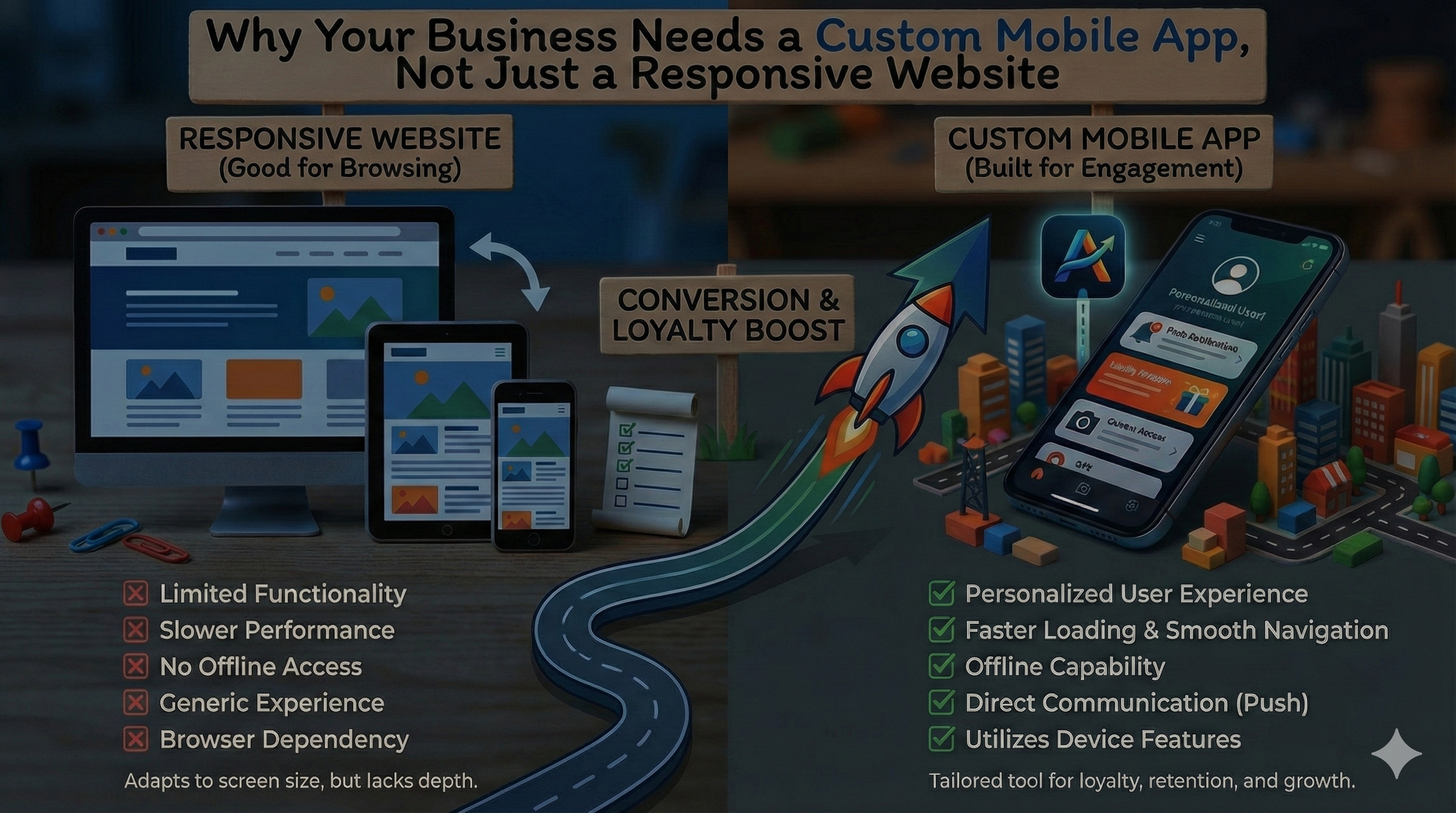
In the digital landscape of 2025, a responsive website is no longer a competitive advantage it is merely the price of admission. For over a decade, businesses have been told that “mobile-first” web design was the silver bullet for capturing the smartphone generation. While ensuring your site looks good on a vertically oriented screen is essential for SEO and initial discovery, relying on a browser-based experience to drive customer loyalty, retention, and high-value transactions is a strategy that is rapidly becoming obsolete. The modern consumer demands speed, personalization, and seamless functionality that the mobile web simply cannot deliver.
The limitations of the mobile browser are becoming increasingly glaring as user expectations skyrocket. Latency, reliance on constant internet connectivity, and the friction of repeated logins are silent killers of conversion rates. When a user has to wait for a page to reload or fumble with passwords in a checkout line, they don’t just get annoyed; they abandon the cart and head to a competitor who occupies a permanent slot on their home screen. The shift is not just technical; it is behavioral. The browser is for searching; the app is for doing.
To thrive in this new era, forward-thinking companies are recognizing that investing in professional Mobile App Development is the single most effective lever for maximizing Customer Lifetime Value (CLV). By transitioning from a passive web presence to an active, installed application, businesses can unlock native device capabilities like biometrics and push notifications that transform a casual visitor into a loyal brand advocate. This article dives deep into the data, psychology, and technology that make custom apps a non-negotiable asset for growth-focused enterprises.
The Behavioral Shift: Discovery vs. Destination
The distinction between a mobile website and a mobile app has evolved beyond code; it is now defined by user intent. In 2025, the mobile browser serves primarily as a discovery engine. It is where users go to find quick answers, compare prices, or look up a physical address. It is a transactional, ephemeral environment where your brand is framed by the browser’s interface and crowded by competitor tabs just a click away.
In stark contrast, a mobile app is a destination. When a user downloads your application, they are effectively granting you digital real estate on their most personal device. This act signals a psychological commitment to your brand. Recent data highlights that users now spend approximately 90% of their mobile media time within applications, leaving a meager 10% for the mobile web. This isn’t just a statistic; it’s a clear indicator that the “app economy” has swallowed the mobile web whole. If your business strategy relies solely on that 10% slice of browser time, you are fighting a losing battle for attention.
The Conversion Gap: Why Apps Print Money
Perhaps the most compelling argument for moving beyond a responsive site is found in the hard metrics of conversion efficiency. The friction inherent in the mobile web acts as a filter that eliminates all but the most determined customers. Conversely, native apps create a “walled garden” a controlled, distraction-free environment optimized for one thing: action.
Research consistently shows that mobile apps achieve conversion rates that are 3x higher than mobile websites. This discrepancy is driven by the superior User Experience (UX) of native applications. In an app, payment details can be stored securely, allowing for one-tap purchasing via Apple Pay or Google Wallet. Address fields are pre-filled, and the interface responds instantly to touch gestures without the “jank” associated with loading web pages.
Furthermore, engagement depth is significantly higher in apps. Users view over 4 times more products per session within an app compared to a mobile site. This suggests that once a user is inside your app, they are in a “shopping mindset,” ready to explore and purchase, rather than a “browsing mindset,” ready to bounce back to Google. For retailers, service providers, and B2B platforms, this conversion gap represents millions in potential revenue left on the table by relying solely on a responsive website.
Technical Superiority: The Power of Native Architecture
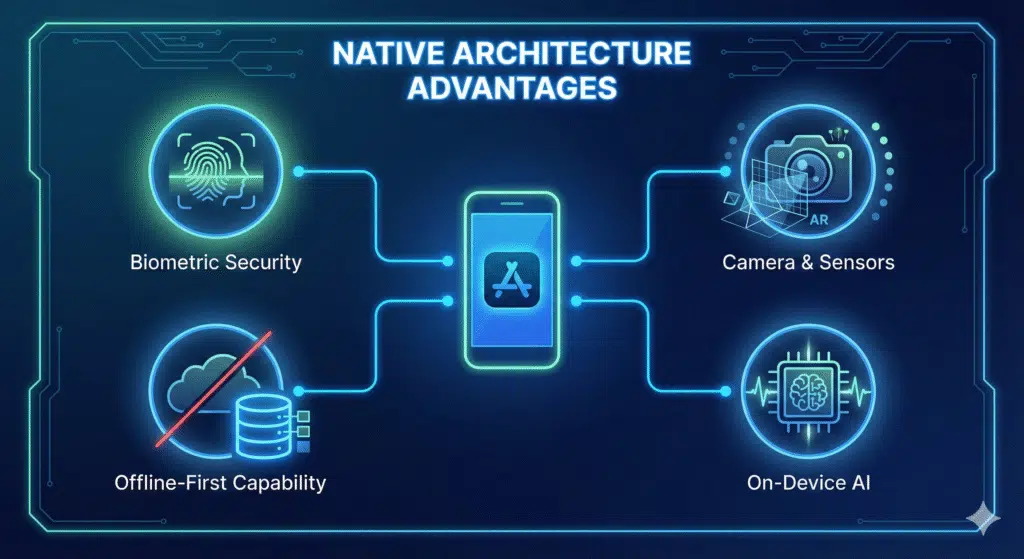
The debate between web and apps often centers on “reach” versus “richness.” However, modern native apps have widened the technical gap so significantly that the “richness” of an app is now required to capture the market. A responsive website is confined to the browser sandbox, which limits its access to the device’s hardware for security reasons. A custom app, however, has direct access to the “metal” of the device.
1. Biometric Authentication for Frictionless Security
One of the biggest hurdles in the digital customer journey is the login screen. Forgot-password flows are conversion killers. Native apps leverage FaceID, TouchID, and iris scanning to authenticate users in milliseconds. This doesn’t just improve security; it removes a massive psychological barrier to entry. When a customer can open your app and confirm a purchase with a glance, the friction of the transaction drops to near zero.
2. The “Offline-First” Advantage
We often assume internet connectivity is ubiquitous, but “dead zones” in subways, elevators, or rural areas are common. A responsive website fails catastrophically without a connection the user sees an error page and leaves. A custom app can be architected to be “offline-first.” This means core content, product catalogs, and even forms are cached locally. A field technician can fill out a report, or a commuter can read articles without a signal. The app queues the data and syncs it specifically when connectivity is restored, ensuring business continuity regardless of network status.
3. Utilization of Camera and Sensors
Native apps can utilize the device’s camera and sensors in ways a browser cannot. For a retail brand, this might mean using Augmented Reality (AR) to let users “try on” glasses or visualize furniture in their living room. For a logistics company, it could mean using the camera to scan barcodes or the LiDAR sensor to measure package dimensions instantly. These immersive features create a sticky, high-value experience that a website simply cannot replicate.
The Engagement Engine: Push Notifications vs. Email
Communication is the lifeblood of retention, but traditional channels are failing. Email open rates have plummeted, often hovering below 20%, as inboxes become flooded with spam and promotional clutter. Social media reach is throttled by algorithms that demand you “pay to play.”
Push notifications remain the only channel that offers direct, unmediated access to your customer. A push notification appears on the lock screen the most valuable real estate in the digital world. It demands attention. When executed correctly, push notifications can drive retention rates that are double those of email-only campaigns.
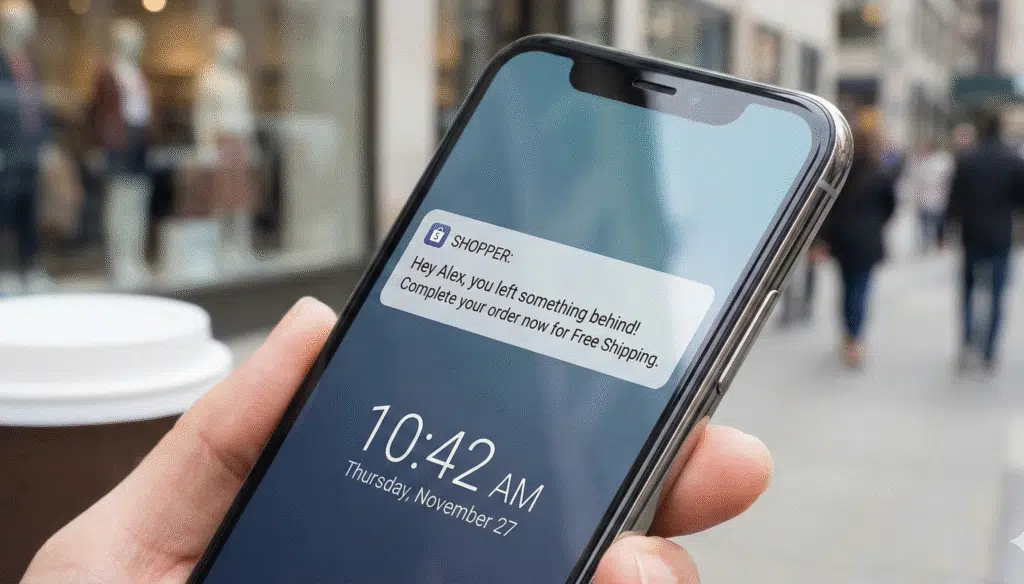
The true power of push lies in context. Unlike a website, which loses track of the user once they close the tab, an app knows where the user is and what they are doing.
- Geofencing: A coffee shop app can trigger a notification with a discount code the moment a user walks within 100 meters of a branch.
- Behavioral Triggers: An e-commerce app can detect that a user abandoned a cart and send a gentle reminder two hours later, perhaps offering free shipping to close the deal.
- Transactional Updates: Real-time updates on shipping status or service appointments build trust and reduce call center volumes.
The AI Revolution: On-Device Intelligence
As we navigate through 2025, Artificial Intelligence is shifting from the cloud to the edge. “On-device AI” is the new frontier, and it is almost exclusive to native apps. Running AI models directly on a user’s smartphone (using chips like Apple’s Neural Engine) offers three distinct advantages: Speed, Privacy, and Cost.
A custom mobile app can process data locally without sending it to a server. For a healthcare app, this means analyzing patient data or images on the phone, ensuring HIPAA compliance and total privacy. For a language learning app, it means real-time pronunciation feedback with zero latency. For the business, offloading processing to the user’s device saves massive amounts of money on cloud computing costs. Agencies like The Softix are at the forefront of this shift, building apps that use on-device learning to hyper-personalize the user experience, predicting what a user wants before they even tap a button.
Brand Equity: The Psychology of the Home Screen
There is an intangible but powerful value to having your logo sit on a user’s home screen next to Instagram, WhatsApp, and their banking app. It elevates the perception of your brand. It signals that you are a serious player, invested in providing a premium experience.
This “billboard effect” keeps your brand top-of-mind. Every time a user unlocks their phone (which happens hundreds of times a day), they register your logo peripherally. This constant visual reinforcement builds subconscious brand preference. When the need for your service arises, the user will instinctively tap the app rather than opening a browser and searching for a generic term that might lead them to a competitor.
Case Study: Engineering Growth with The Softix
To understand the real-world impact of choosing a custom app over a generic web solution, we can look at the track record of The Softix, a premier US-based software development agency. Their approach goes beyond writing code; they act as strategic partners who engineer growth.
- Whisps: For this popular cheese snack brand, a standard web presence wasn’t enough to drive deep engagement. By building a custom digital solution that optimized the user journey, The Softix helped drive a 200% increase in monthly sessions and a massive 300% boost in organic search visibility.
- Joshua Legal: Trust is the currency of the legal profession. By creating a dedicated, secure, and accessible mobile experience, this firm saw a 140% increase in monthly sessions, proving that even service-based industries benefit immensely from the credibility and accessibility of an app.
These examples illustrate that a custom app is not an expense; it is a revenue-generating asset. Whether it is gamifying the mortgage process to increase engagement by over 200% or streamlining e-commerce checkout to boost conversion rates, the ROI of custom engineering is undeniable.
When Is a Responsive Site Enough?
To be a seasoned expert, one must be honest: not every business needs an app immediately. If your primary goal is purely content consumption (like a simple blog) or if you are a local restaurant with a static menu and no online ordering, a highly optimized responsive website is likely sufficient.
However, you should start planning for Mobile App Development if:
- You require recurring transactions: If users buy from you more than once a month, an app makes that process smoother.
- You need access to device features: If your service benefits from GPS, cameras, or biometrics.
- You have a loyalty program: Digital loyalty cards are best managed in an app.
- You value personalization: If you want to tailor the experience based on user behavior.
The Bottom Line: The Strategic Imperative
In 2025, the question is no longer “Do I need an app?” but “Can I afford to lose customers to competitors who have one?” A responsive website is a brochure; a custom mobile app is a business partner. It lives in your customer’s pocket, learns their preferences, secures their data, and facilitates their life.
The gap between “mobile-friendly” and “mobile-optimized” is where market leaders are made. Businesses that cling to the mobile web as their primary engagement channel risk ceding their most valuable customers to those who offer the seamless, intelligent, and secure experiences that only a native application can provide.
If you are ready to transition from a passive web presence to an active mobile strategy, you need a partner who understands both the code and the business logic. The Softix stands ready to help you navigate this journey, delivering innovation with the precision required to dominate your market. Don’t just build a website that fits on a screen; build a business that fits into your customer’s life.
Share