NVIDIA stock is one of the loudest searches in the United States today. According to Google Trends on August 27, 2026, queries such as nvidia stock, nvda stock, and nvidia stock price jumped past 200,000 searches in 24 hours—up roughly 200% from a typical day. Investors are watching earnings. Operators should watch something more practical: AI is about to get more expensive to run.
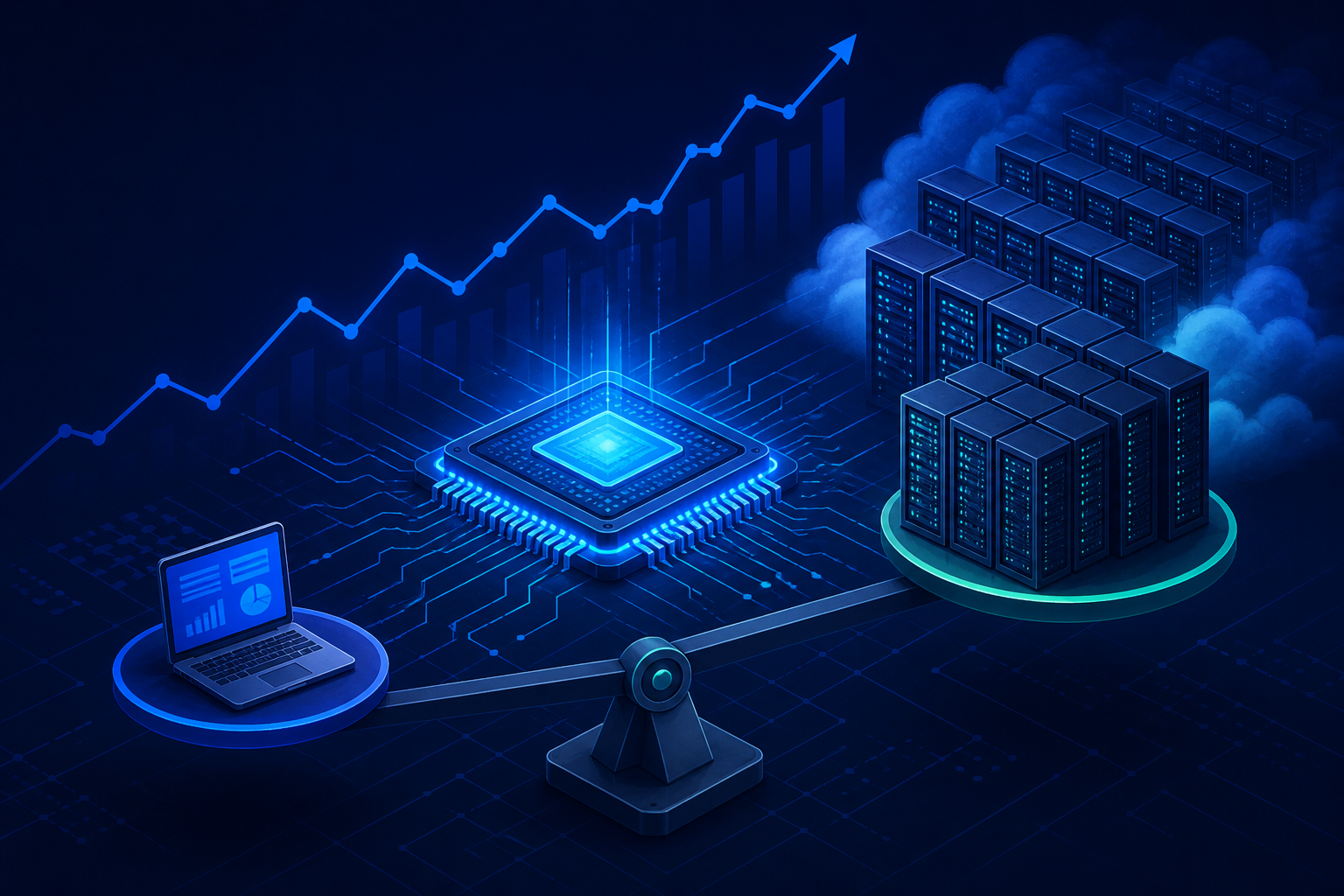
Bloomberg reported on August 22 that NVIDIA has told major customers AI servers using its Grace Blackwell and upcoming Vera Rubin chips will cost more than 15% extra on many configurations starting in early 2027. The driver is not a marketing stunt. High-bandwidth memory (HBM) and DRAM—made almost entirely by Samsung, SK Hynix, and Micron—cannot keep up with AI demand. NVIDIA is passing that bill through. Cloud providers will pass it through again. Your SaaS bill, API invoice, and custom AI project estimate sit at the end of that chain.
This guide is written for founders, product leaders, and operations teams at SMBs—not Wall Street. You will learn why NVIDIA stock is moving, how a 15% hardware hike shows up in software costs, a decision framework we use with clients (we call it LITE), and when to keep using APIs versus when to rebuild architecture so you are not hostage to GPU inflation.
Why NVIDIA Stock Is Trending Today
NVIDIA became the public face of the AI boom because its accelerators sit inside the machines that train and run large models. Related searches today are not about gaming GPUs. They are about price, earnings, and whether the AI build-out can still get cheaper every year.
- nvidia stock / nvda stock: 200K+ daily searches, still active
- Related queries: nvidia stock price, nvda stock price, AI server costs
- News catalyst: 15%+ AI server price notices + closely watched quarterly results
Financial sites will argue about valuation. Software companies should treat the spike as a cost-of-goods signal. When the dominant AI chip vendor cannot absorb memory inflation, every layer above it—Azure, AWS, Google Cloud, OpenAI, Anthropic, and the custom apps sitting on those APIs—has less room to discount.
What a 15% AI Server Hike Actually Means for SMBs
You probably do not buy Grace Blackwell racks. You still pay for them. Here is how the cost travels:
- Memory makers raise HBM/DRAM prices because supply is full.
- NVIDIA raises quotes on AI servers rather than shrinking its ~75% gross margin.
- Hyperscalers (Microsoft, Google, Amazon, Oracle) revise capex and GPU rental rates.
- Model vendors adjust API pricing, rate limits, or “premium” model tiers.
- Your product pays more per token, per image, per agent run—or your margin disappears.
Tom’s Hardware noted that a 15% rise on multi-million-dollar racks adds hundreds of thousands of dollars per rack at hyperscale. For an SMB, the equivalent is quieter: a support agent that used to cost $0.04 per ticket creeps to $0.06; a monthly OpenAI bill that was $1,200 becomes $1,600; a “cheap” GPU cloud instance is no longer cheap. None of those invoices say “NVIDIA.” They still originate there.
What Other Sites Are Saying (and What They Miss)
We reviewed the current coverage before writing this piece so we would not repeat it:
| Source | Angle | Gap for SMBs |
|---|---|---|
| Bloomberg / Barchart | Investor and hyperscaler bill shock | No software architecture advice |
| Tom’s Hardware | Component-level DRAM / GeForce spillover | Hardware audience, not product teams |
| Enterprise IT explainers | Capex models for data-center buyers | Assumes you own racks |
| GPU-cloud blogs | H100 hourly rates and colo math | Useful later; most SMBs should not start there |
The missing article is the one your CFO actually needs: how to keep shipping AI features without buying NVIDIA hardware or getting crushed by pass-through cloud costs. That is the rest of this post.
The LITE Framework: Control AI Cost Without Owning GPUs
At Softix we use a four-step sequence with clients. It is deliberately conservative. Most SMBs should never own data-center GPUs. They should get excellent at not needing them.
L — Leverage APIs until the unit economics break
Start with hosted models (OpenAI, Anthropic, Google, Azure OpenAI). You pay per use, you get security patches, and you avoid CUDA ops. Set a hard monthly cap and a per-feature budget (for example: $0.12 max per resolved support ticket). If a feature cannot stay under the cap after prompt and caching work, do not “just buy a GPU.” Redesign the feature.
I — Isolate GPU-heavy work from the rest of the product
Do not put image generation, long-document summarization, and chat in one unbounded pipeline. Split workloads: cheap classification models for routing, retrieval-augmented generation (RAG) for knowledge, expensive frontier models only for the 10% of cases that need them. Isolation is how you survive a 15% infrastructure hike—you raise cost on the expensive 10%, not the entire app.
T — Trim the model, not the product
Before you scale GPUs, shrink tokens. Practical moves we ship in production:
- Cache repeated answers and embeddings
- Use smaller models for classification and extraction
- Retrieve 3–5 chunks instead of dumping entire PDFs into context
- Quantize or distill only if you have a stable, high-volume workload
- Batch jobs overnight instead of real-time when users can wait
Teams that skip this step buy hardware to hide a messy prompt. Hardware inflation then punishes them twice.
E — Evaluate ownership last (and usually skip it)
Own silicon only if three things are true: utilization is high and predictable, data cannot leave your network, and a specialist GPU cloud still costs more after reserved pricing. A workstation for internal RAG can make sense. A DIY eight-GPU rack for a 12-person company almost never does. If you are unsure, you are not ready to own hardware.
API vs Custom Software vs Own GPUs: A 2026 Cost Snapshot
Numbers move monthly. Treat these as planning ranges we see on SMB projects in 2026, not quotes.
| Approach | Typical monthly cost | Best for | NVIDIA hike impact |
|---|---|---|---|
| Hosted APIs | $200–$5,000 | Most SMBs, agents, copilots | Indirect (vendor pass-through) |
| Specialist GPU cloud | $1,500–$8,000 per GPU | Steady inference, fine-tunes | Direct rental increases |
| Custom software on APIs | $15k–$80k build + API opex | Products with real users | Architecture can absorb hikes |
| On-prem workstation | $4.5k–$15k one-time | Private internal tools | Buy now vs later (memory inflation) |
| Own AI servers | $250k+ per node | Hyperscale only | 15%+ on next-gen racks |
Rule of thumb: If AI is a feature, stay on APIs and invest in custom software that meters, caches, and degrades gracefully. If AI is the product and GPU hours are your COGS, you need a cost model before you need more chips.
Five Software Decisions That Matter More Than NVIDIA’s Share Price
1. Meter every AI call in your application
Log model, tokens, latency, and feature name. Without this, a 15% upstream hike is invisible until the credit card statement. Build a simple admin dashboard on day one of any SaaS or agent project.
2. Put a kill switch on expensive models
When spend exceeds budget, automatically fall back to a cheaper model or a rules engine. Users should see “basic mode,” not an outage. That is product design, not DevOps.
3. Prefer RAG over giant context windows
Long context is convenient and expensive. A well-built knowledge index plus a mid-size model usually beats stuffing 200 pages into a frontier model—especially after token prices stop falling.
4. Do not train a model you cannot afford to retrain
Fine-tunes lock you into GPU hours. Prompting plus retrieval is cheaper to update when vendors change prices. Fine-tune only for a stable, high-volume task with measured lift.
5. Treat AI agents as cost centers with SLAs
Autonomous agents loop. Loops multiply tokens. If you followed our AI agents for business guide, add a step budget (max N tool calls per ticket) before you grant more autonomy. Hardware inflation makes runaway agents a finance problem, not just a safety problem.
Should You Buy NVIDIA Hardware for Your Business?
Short answer for most Softix clients: no. Longer answer:
- Buy a workstation if you process sensitive documents internally all day and cloud APIs are a compliance blocker.
- Rent specialist GPUs for a defined training or batch job with a start and end date.
- Stay on APIs for customer-facing products, copilots, and AI-assisted development workflows.
- Never buy racks because NVIDIA stock is up. That is a different business.
Memory shortages also mean waiting to buy hardware can cost more later. That is an argument to lock architecture now—not an argument to become a mini data center.
How Softix Helps Teams Build AI Products That Survive Cost Shocks
Softix is a U.S.-headquartered partner for startups and SMBs. We do not sell GPUs. We design software that uses AI without betting the company on one vendor’s rack price.
- Cost-aware architecture: metering, caching, model routing, and fallbacks built into the product
- Custom applications: CRM, portals, and mobile apps that call AI as a controlled dependency
- SaaS platforms: usage-based billing so you pass cost through fairly instead of eating it
- SEO + technical content: so buyers researching NVIDIA, AI costs, and custom development find a practitioner—not just a ticker page
Book a call or contact us if you want a review of your current AI stack. We will tell you whether you have a software problem, a prompt problem, or a hardware problem—and most teams do not have a hardware problem.
Frequently Asked Questions
Why is NVIDIA stock trending on Google Trends today?
Search volume in the U.S. crossed 200K+ in 24 hours, driven by earnings attention and reports that AI servers using NVIDIA chips will cost more than 15% extra on many 2027 configurations because of memory shortages.
Will NVIDIA’s price hike raise ChatGPT or cloud AI prices?
Not always on the same day, and not always with NVIDIA’s name on the invoice. Hyperscalers and model vendors absorb some cost and pass some through via higher GPU rental, tighter free tiers, or premium model pricing. Budget for upward pressure through 2027.
Should a small business buy NVIDIA GPUs in 2026?
Only for private, high-utilization internal workloads or compliance constraints. Customer-facing products should use APIs and cost controls first. Buying servers because the stock is trending is not a software strategy.
How much do AI features cost for an SMB?
Many production copilots run on a few hundred to a few thousand dollars per month in APIs if they are metered. Unbounded agents and image pipelines can exceed that quickly. Custom development cost is separate from inference cost—plan both.
What is the cheapest way to add AI to custom software?
Use a hosted API, retrieve only the data you need, cache repeats, and keep a cheaper fallback model. That combination beats both “paste everything into GPT-5” and “buy an H100.”
Does this affect vibe coding and AI coding tools?
Indirectly. Coding agents consume tokens and run in GPU-backed clouds. Seat prices may hold while usage limits tighten. See our vibe coding enterprise guide for governance; add spend alerts the same way you would for a production agent.
Final Thoughts: Watch the Bill, Not Just the Ticker
Google Trends is useful because it shows what people are anxious about today. NVIDIA stock is the headline. The operating story is simpler: AI compute is no longer on a guaranteed downward price curve. Memory is the bottleneck. Servers are going up more than 15% for many next-gen configs. Software teams that meter usage, isolate expensive steps, and stay API-first will feel a pinch. Teams that treated GPUs as infinite and cheap will feel a shock.
You do not need to out-trade NVIDIA. You need software that still makes money if GPU hours get 15–30% more expensive. That is an engineering and product problem—and it is solvable if you start before the next invoice cycle.
Share