
If your team loves its AI tools but finance still shrugs when you ask about AI ROI for small business, you are not alone. Coverage of McKinsey’s latest State of AI survey wave—fielded online from May 4 to June 8, 2026 across 1,719 respondents in 97 countries—again highlights a stubborn gap: many workers report personal productivity gains, while the share of organizations attributing positive enterprise EBIT impact to AI remains low and largely flat versus the prior year (TechTimes summary; see also McKinsey’s State of AI research hub).
This article is for founders, ops leads, and product owners at US SMBs who want a clear path from “we bought seats” to “we can defend the spend.” Softix builds custom software and SaaS products for teams that need AI inside real workflows—not another generic assistant layered on top of broken processes.
What the latest survey wave actually says (and what it doesn’t)
Treat survey results as reported attribution, not audited P&L. Independent write-ups of the 2026 McKinsey QuantumBlack survey converge on a few headline signals:
- A minority of respondents attribute any positive enterprise EBIT contribution to AI (commonly reported around the high-30% range, roughly flat year over year).
- A much smaller share—often described as about 6%—qualify as “AI high performers” (significant impact and a higher share of EBIT attributed to AI).
- Among people who use AI in their roles, personal productivity scores are far more common than company-level earnings claims.
- Vertical, bounded use cases (for example operations and service workflows with measurable outputs) are where cost or revenue effects show up more often than broad chatbot rollouts.
- Agentic systems are scaling faster in large enterprises than in smaller organizations, while AI operating costs (including token spend) are starting to constrain usage for a material minority of respondents.
Those numbers describe what leaders say they can attribute—not a causal proof that a particular tool “works.” For an SMB, the useful takeaway is simpler: diffuse copilots rarely survive a CFO review; redesigned workflows with meters do.
Why individual speed doesn’t become company profit
McKinsey and others describe a familiar “gen AI paradox”: horizontal assistants are easy to roll out and feel helpful, but the time saved often stays on the person’s desk. Unless you redesign what happens next—more qualified leads closed, fewer tickets reopened, fewer hours of manual reconciliation—the gain never appears as revenue or cost reduction.
In practice, Softix sees three failure modes in SMB AI projects:
- Seat sprawl without process change — everyone gets a chatbot; nobody owns a KPI.
- Pilot forever — a demo works on five tickets; production needs auth, audit logs, edge cases, and an owner.
- Invisible cost — agentic loops burn 5–30× the tokens of a single Q&A turn (as industry analysts have warned), so “cheap experiments” become noisy OpEx.
If you already explored task-level agents, pair this piece with our practical guide to AI agents for business. Agents help; they do not replace workflow design.
What high performers do differently (translated for SMBs)
You do not need a billion-dollar transformation office. You do need the behaviors that separate noise from earnings:
| Practice | What large “high performers” tend to do | SMB translation |
|---|---|---|
| Workflow redesign | Change the process, not only the tools | Map one revenue or cost process end-to-end and remove handoffs AI can own |
| Measurement | Baselines and isolated tests | Capture cycle time, error rate, and $ per outcome for 2–4 weeks before go-live |
| Leadership | Visible executive ownership | One founder/ops owner with budget and permission to change roles |
| Scope | Growth + efficiency | Pick a use case that either cuts measurable cost or accelerates a revenue bottleneck |
| Build vs buy | More in-house builds when SaaS doesn’t fit | Use SaaS where the process is commodity; custom apps where the process is your moat |
Nearly three-quarters of McKinsey’s high-performer cohort report fundamentally redesigning workflows because of AI—versus roughly a quarter of everyone else, according to reporting on the survey. That single contrast is the strategy.
The Softix SMB playbook: Measure → Redesign → Ship → Meter
1. Measure one process, not “AI in general”
Pick a workflow with volume and recoverable mistakes: lead qualification, support triage, invoice matching, onboarding checklists, or renewal risk review. Record:
- Volume per week
- Median cycle time
- Error / rework rate
- Fully loaded cost per completed outcome
- Where humans wait on other humans (or on copy-paste)
If you cannot write those five numbers on a whiteboard, you are not ready to claim ROI.
2. Redesign the work before you pick a model
Ask: which steps should a human approve, which should software execute, and which should disappear? Example redesign for support triage:
- Before: every ticket hits a shared inbox; humans classify, search docs, draft, send.
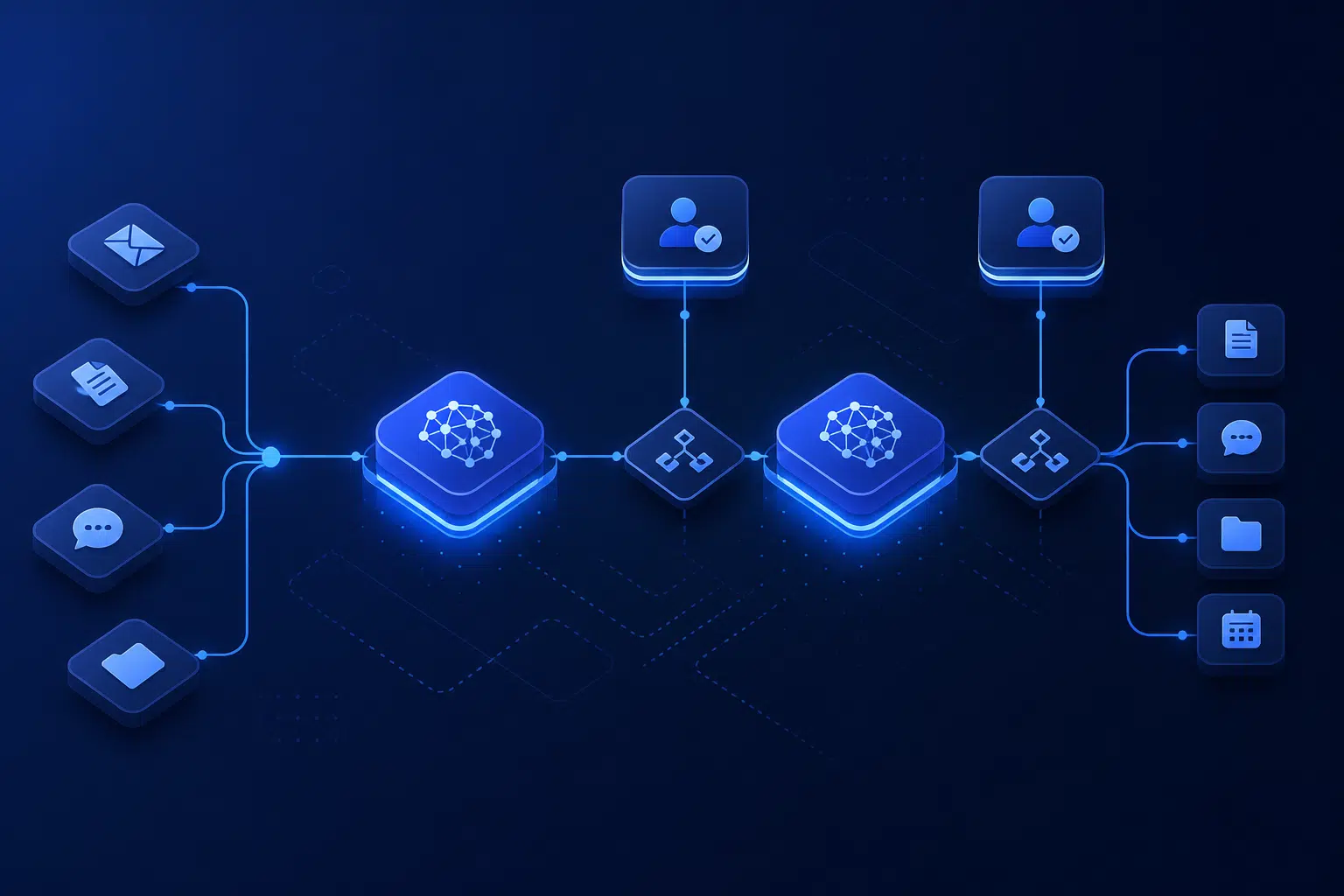
- After: software classifies and retrieves approved knowledge; a human only reviews exceptions; the system logs outcomes back to CRM.
That is software architecture, not a prompt library. Softix often implements it as a thin web app or CRM-connected service—not a free-floating chat window.
3. Ship the smallest production slice
Production means auth, permissions, audit trails, retries, and a kill switch—not a weekend Zapier demo. Prefer:
- One channel (email or chat or form)
- One customer segment
- Explicit human-in-the-loop gates for irreversible actions (refunds, outbound email, contract changes)
4. Meter outcomes and token cost in the product
Instrument:
- Tasks completed without human touch
- Escalation rate
- Time-to-resolution
- Cost per successful task (including model/API spend)
- Quality samples reviewed weekly
If token spend climbs while escalation stays flat, you have an architecture problem—routing, caching, retrieval quality—not a “buy a smarter model” problem. For cost-sensitive designs, see also our note on keeping AI features resilient when infrastructure prices move.
Build, buy, or hybrid: a blunt decision table
| Situation | Prefer | Why |
|---|---|---|
| Commodity process (basic email drafting, meeting notes) | Buy SaaS seats | Speed; low differentiation |
| Process is your competitive edge | Custom or SaaS product with Softix | You own the workflow and the data model |
| Many tools, one fragile glue layer | Custom integration layer / CRM development | One audit log, one permission model |
| Regulated or high-stakes actions | Custom with explicit approvals | You need evidence, not vibes |
| Unclear ROI after a 30-day pilot | Stop or redesign | More seats won’t fix a measurement gap |
A 30-day pilot checklist SMBs can actually finish
Week 1: Choose one process; lock baseline metrics; name an owner.
Week 2: Redesign the flow on paper; define human gates; list systems of record (CRM, helpdesk, billing).
Week 3: Build or configure the thinnest production path; enable metering.
Week 4: Run against real volume; compare to baseline; decide scale / iterate / kill.
Kill criteria are healthy. A failed pilot that teaches you the process was the problem is cheaper than a year of unused licenses.
How Softix helps teams turn AI spend into software outcomes
Softix is a software partner, not a model vendor. We help SMB teams:
- Turn messy operations into productized workflows
- Build CRM-connected apps and internal tools with clear approval gates
- Ship SaaS features where AI is a metered dependency, not a black box
- Keep security, logging, and cost controls in the same release as the “AI demo”
Book a call or contact Softix if you want a frank review of an AI initiative that feels busy but doesn’t show up on the income statement. We’ll tell you whether you have a process problem, a product problem, or a measurement problem—and most teams have all three in different proportions.
Frequently Asked Questions
Why isn’t AI showing up on our P&L if everyone says they’re faster?
Personal speed only becomes earnings when the saved time is converted into more output or lower cost through a redesigned process. Horizontal copilots rarely force that conversion.
What’s a realistic first AI ROI project for an SMB?
A high-volume, semi-structured workflow with recoverable mistakes—support triage, lead routing, document extraction into your system of record—with baselines and a four-week kill/scale decision.
Do we need agents to get ROI?
Not always. Many wins come from better retrieval, routing, and workflow software. Agents help when multi-step tool use is required; they also multiply cost and failure modes. Start with the process map.
How should we talk to a CFO about AI spend?
Lead with baseline metrics, projected cost per successful outcome (including tokens), and a pilot end date. Avoid “innovation” as the sole justification.
Final thoughts
The latest survey wave is a reminder, not a surprise: adoption without redesign produces thin books. For SMBs, the winning move is unglamorous—pick one process, measure it, rebuild it in software, meter the result, and only then scale. Softix builds that software with you.
Share