For decades, the “Cash Flow Gap” has been the silent killer of small businesses. You deliver the work today, send the invoice tomorrow, and then… you wait. Thirty days. Sixty days. Sometimes ninety days. In the past, bridging this gap meant walking into a bank, burying yourself in paperwork, and waiting weeks for approval.
Welcome to 2026. The era of “Invisible Finance” is here.
Today, invoice factoring is no longer a clumsy banking product; it is a seamless, digital experience powered by AI invoice factoring algorithms and sophisticated software architectures. We are witnessing a shift where cash flow isn’t managed by filling out forms it’s managed by clicking a button on a dashboard.
But here is the critical insight that most tech blogs miss: The revolution isn’t just about the financial logic. It’s about the User Experience (UX). The most powerful AI in the world is useless if the interface is confusing, slow, or untrustworthy.
At The Softix, we believe that the future of finance lies at the intersection of intelligent code and human-centric design. In this deep dive, we explore how Agentic AI, Fintech web design 2026 trends, and automated invoice processing are rewriting the rules of business lending and how you can build the platforms that drive this change.
Section 1: The Brain – How AI is Changing the Rules
In 2025, we spoke about “Predictive AI” systems that could guess what might happen. In 2026, we have moved to Agentic AI. These are systems that don’t just predict; they take action.
From Manual Review to “Zero-Touch” Approval
Traditional factoring involved a credit officer manually reviewing an invoice, checking the debtor’s credit score, and calling to verify the details. This process cost an average of $20-$30 per invoice in labor.
Automated invoice processing has slashed that cost to pennies. Modern software uses Optical Character Recognition (OCR) to “read” an invoice instantly, extracting key data points like PO numbers, line items, and tax IDs without human intervention.
But the real magic happens in the risk assessment.
- The Old Way: Checking a static credit score (which looks at the past).
- The 2026 Way: Machine Learning risk assessment models that analyze real-time data. The software looks at the debtor’s shipping data, social media sentiment, seasonal payment trends, and even macroeconomic indicators to predict the probability of repayment with 98% accuracy.
Fraud Detection in the “Deepfake” Era
As financial tools get smarter, so do fraudsters. We are seeing a rise in “synthetic identity fraud,” where criminals use AI to create fake businesses and fake invoices.
To combat this, invoice factoring software development now prioritizes security above all else. New platforms utilize behavioral biometrics—analyzing how a user types, swipes, and navigates the site—to confirm identity. If an invoice looks real but the metadata suggests it was generated by a script, the AI flags it instantly. This is the new standard for B2B payment automation: security that operates invisibly in the background.
Section 2: The Face – Why Web Design Makes or Breaks Fintech
You can have the best AI algorithm in the world, but if your platform looks outdated, users will not trust you with their money. In the financial sector, design is not decoration; it is a trust metric.
At The Softix, we have identified the defining Fintech UX/UI trends that are dominating 2026. If you are building a financial platform, these are non-negotiable.
1. The Rise of “Calm Design”
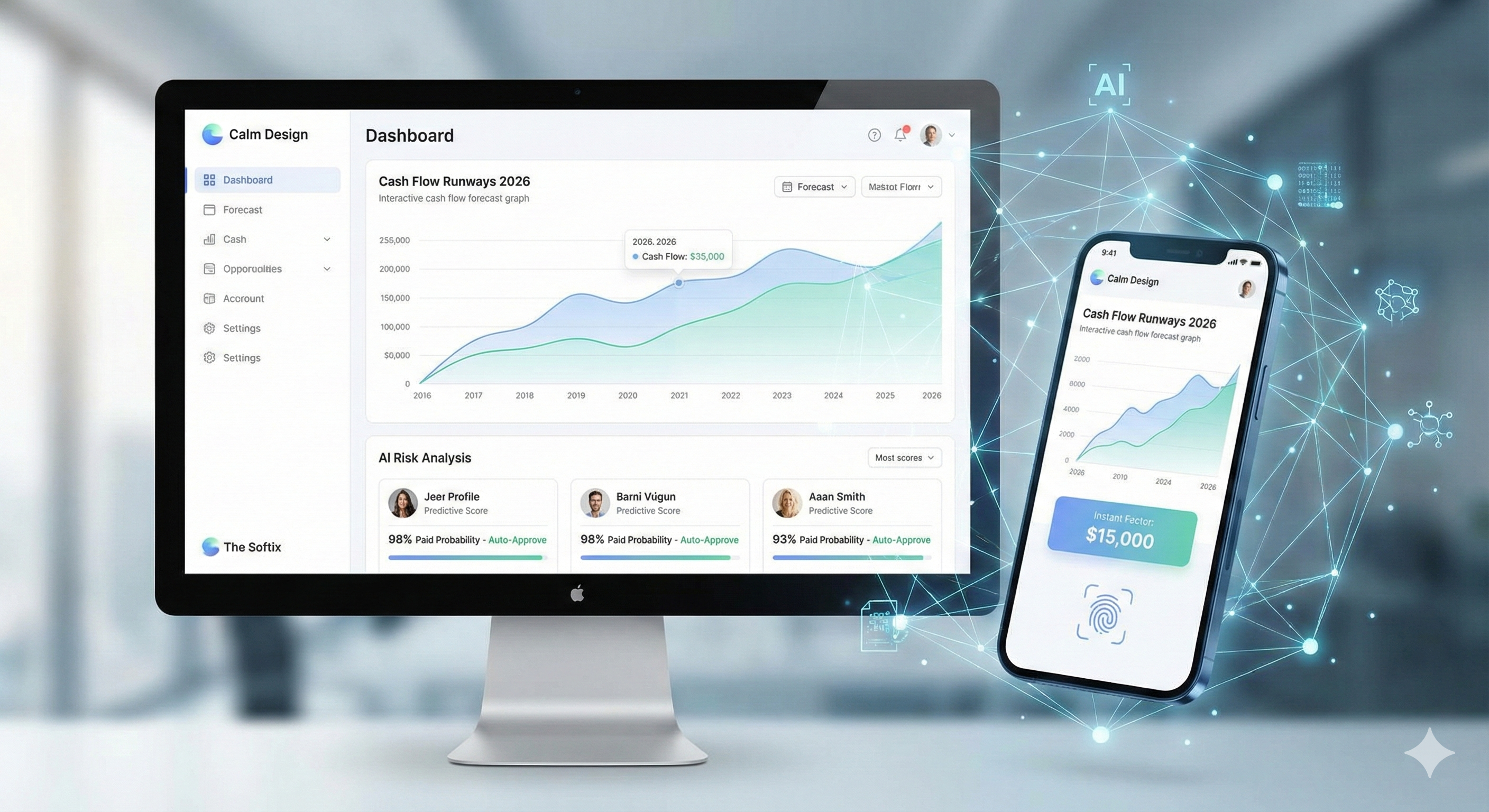
In the early 2020s, fintech apps were noisy—flashing notifications, gamified badges, and urgent pop-ups. The trend for 2026 is Calm Design. Business owners are stressed. They come to a factoring platform to solve a cash flow problem, not to be bombarded with noise.
- What it looks like: Generous white space, muted color palettes (soft blues and greens), and “anticipatory” interfaces that only show information when it’s relevant.
- The Technical Impact: Calm design requires faster load times. A clutter-free interface must be backed by ultra-clean code to ensure instant responsiveness.
2. Data Visualization Dashboards
The modern CFO doesn’t want to see a spreadsheet; they want to see a story. Data visualization dashboards are now a core component of fintech web design. Instead of a list of transactions, successful platforms use interactive heat maps and cash flow runways. A user should be able to see, at a glance:
- “If I factor this invoice today, my cash flow turns positive by Friday.”
- “This client pays late 40% of the time.”
Designing these dashboards requires a deep understanding of information architecture a service that lies at the heart of what we do at The Softix.
3. Frictionless Onboarding (The KYC Challenge)
The biggest drop-off point for any financial app is the “Sign Up” process. Know Your Customer (KYC) regulations require users to upload IDs, tax documents, and bank statements. Fintech web design 2026 solves this with “Progressive Disclosure.” Instead of asking for 20 documents upfront, the design guides the user through bite-sized steps.
- Tech Integration: Users can now drag-and-drop a PDF of their bank statement, and the system’s OCR immediately auto-fills the application form. No typing required. This reduces abandonment rates by over 60%.
4. Mobile-First Finance
It is a myth that B2B finance happens on desktop. In 2026, over 55% of invoice factoring approvals happen on a mobile device. A CEO might approve a factoring deal while in an Uber or waiting for a flight. If your platform isn’t fully responsive if the charts break on a mobile screen or the “Approve” button is too small for a thumb tap you are losing business. Mobile-First Finance isn’t just about scaling down the desktop site; it’s about reimagining the workflow for touch interaction.
Section 3: 2026 Tech Trends in Factoring
Beyond the interface, the underlying infrastructure of invoice factoring is evolving. Here are the trends driving the next wave of cash flow automation tools.
Embedded Finance 2.0
In the past, if a business wanted to factor an invoice, they had to log out of their accounting software, log into a factoring portal, and upload the data. Today, we are seeing the explosion of Embedded Finance. Factoring capabilities are now being built directly via API into ERPs (like SAP or Oracle) and accounting tools (like QuickBooks or Xero).
- The Opportunity: If you run a B2B SaaS platform, you can now integrate factoring into your own product, opening a new revenue stream. This requires specialized invoice factoring software development to ensure secure API handshakes.
Dynamic Discounting & Real-Time Payments (RTP)
Static fees are dead. AI now enables dynamic discounting, where the fee for factoring an invoice changes in real-time based on risk and market rates. Furthermore, with the adoption of Real-Time Payments (RTP) networks globally, “Same Day Funding” has become “Same Second Funding.” Once the AI approves the invoice, the funds land in the business’s account instantly, 24/7/365.
Voice and Conversational UI
“Hey, factor my last three invoices from Client X.” Voice-activated financial commands are moving from novelty to utility. Integrating Natural Language Processing (NLP) into your web app allows users to interact with their finances conversationally, removing the need to navigate complex menus.
Section 4: Building Custom vs. Off-the-Shelf
For businesses and startups looking to enter this space, a common question arises: Should we buy a white-label solution or build custom software?
While off-the-shelf software is cheaper initially, it fails to deliver the Fintech web design 2026 standards required to win in a competitive market.
The Case for Custom Development
- Unique Workflows: Every industry factors differently. Construction factoring (with progress billing) is vastly different from trucking factoring (freight bills). Custom software allows you to build workflows that match the specific niche.
- Scalability: As your data grows, generic platforms slow down. A custom-built architecture by The Softix is designed to handle millions of transactions without latency.
- Security Ownership: When you build your own platform, you own the code and the security protocols. You are not reliant on a third-party vendor’s patch schedule to keep your data safe.
- Brand Identity: In a crowded market, your UX is your brand. You cannot achieve “Calm Design” or perfect “Mobile-First” flows using a rigid template.
Conclusion: The Future is Automated
The future of invoice factoring is not about banking; it is about technology. It is about AI invoice factoring algorithms that understand risk better than a human ever could. It is about Fintech web design that makes borrowing money feel as simple and stress-free as sending a text message.
In 2026, the companies that will win are not the ones with the most capital they are the ones with the best software.
Whether you are a Fintech startup looking to disrupt the lending market, or a forward-thinking enterprise needing a custom dashboard to manage your own cash flow, the technology you choose today will define your success tomorrow.
Are you ready to build the future of finance? At The Softix, we specialize in high-end software development and UX/UI design for the financial sector. We don’t just write code; we build digital ecosystems that drive growth.
Contact The Softix Today to discuss your project and get a free consultation on the latest FinTech architectures.