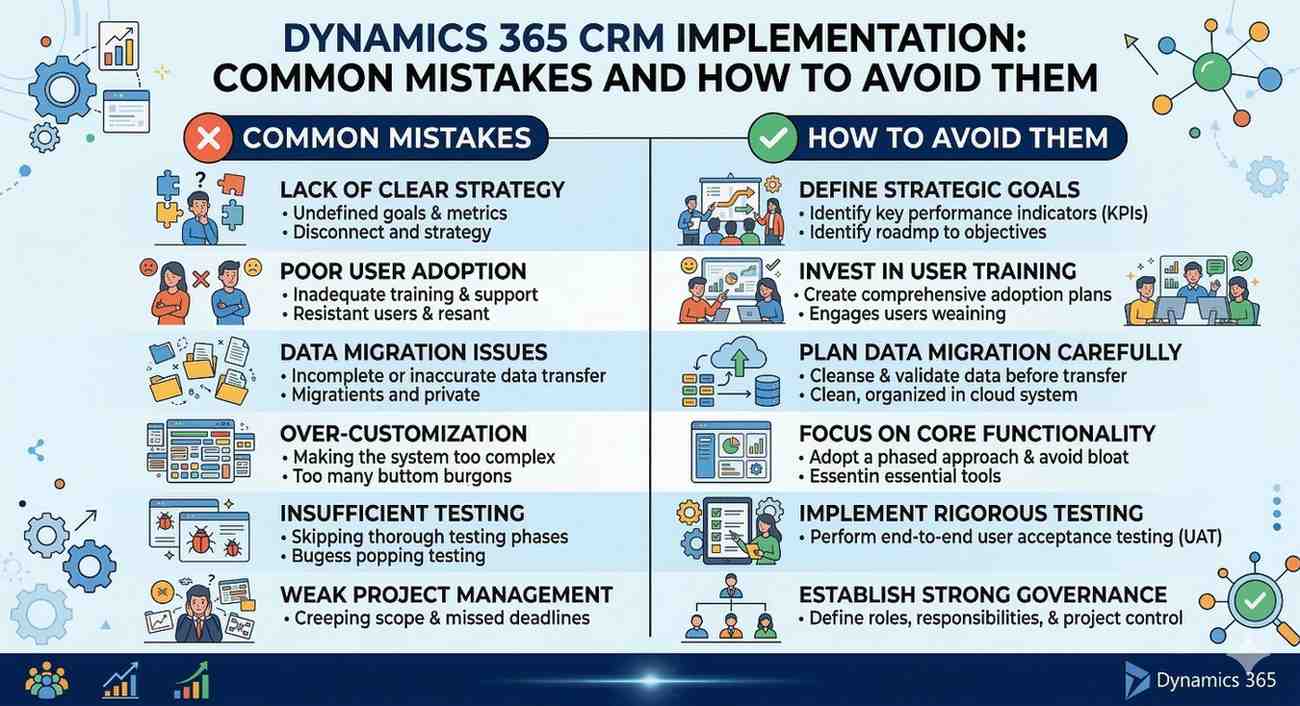
Implementing Microsoft Dynamics 365 CRM is a transformative endeavor that promises to streamline operations, unify customer data, and supercharge sales teams. However, the path to a successful deployment is often littered with challenges. Statistics show that a significant percentage of large-scale CRM projects either fail to meet objectives, exceed budgets, or suffer from low user adoption . The good news is that these failures are rarely due to the software itself, but rather due to preventable human and procedural errors.
To turn your Dynamics 365 implementation into a success story, you must navigate around common pitfalls. From misaligned goals to data migration nightmares, understanding these traps is the first step toward avoiding them. This guide explores the most frequent mistakes organizations make and provides actionable strategies to ensure your CRM becomes a revenue-generating asset rather than a costly misstep.
The Pitfall of Poor Planning and Unclear Objectives
One of the most fundamental and most common mistakes in Dynamics 365 implementations is diving into configuration without a clear roadmap. It is easy to be seduced by the platform’s powerful features, but without defined business outcomes, the project is doomed to wander. Often, implementations fail because there is a misalignment between business and technology; the IT team receives the software without understanding the urgent business need it addresses, leading to poor goal setting and a lack of direction .
To avoid this, you must start with “Revenue Process Architecture” rather than configuration. Before a single line of code is written or a field is created, map out how revenue flows through your organization. Define what success looks like with measurable Key Performance Indicators (KPIs), such as reducing sales cycle time by 10% or increasing lead conversion rates . Your CRM strategy should be a direct reflection of your corporate strategy, whether that involves growth, cost reduction, or enhancing customer experience . Establishing a cross-functional team with an Executive Sponsor, Project Manager, and Department Leaders ensures that the vision is clear, shared, and tied to tangible business metrics from day one .
Navigating Customization and Integration Complexities
While Dynamics 365 offers robust out-of-the-box functionality, the real magic and risk lies in how you shape it to fit your unique processes. A frequent misstep is over-customization. It’s tempting to modify every screen to match legacy systems exactly, but this can lead to “customization debt,” where the system becomes brittle, difficult to upgrade, and expensive to maintain . Similarly, integration overreach connecting too many fragile applications too quickly can degrade system performance and create security risks .
This is where engaging experienced CRM development services becomes invaluable. Expert developers understand the delicate balance between configuration and customization. They know to leverage out-of-the-box features first, utilize no-code Power Platform tools second, and resort to custom code only when absolutely necessary to meet a specific, high-value business requirement . Professional CRM development services ensure that customizations are documented, sustainable, and built with an eye on future upgrades . They also architect integrations using a phased approach, perhaps starting with Microsoft 365 and high-priority Power Automate flows to ensure core stability before expanding to more complex third-party systems . By partnering with specialists, you protect your investment and ensure the system remains scalable and adaptable.
Data Migration: The Make-or-Break Moment
“If you build it, they will come” does not apply to CRM data. Users will not “come” to a system that is populated with incomplete, duplicate, or inaccurate data. Data migration is often underestimated; when handled poorly, it leads to a “garbage in, garbage out” scenario that erodes trust in the entire platform from Day One . The process is not merely a technical lift-and-shift; it requires a strategic governance framework.
Successful data migration begins long before the actual transfer. It involves duplicate rationalization to eliminate conflicting records, field-level mapping to ensure legacy data aligns with the new Dataverse schema, and ownership normalization to establish accountability . Treat data migration as a project in itself. Start by identifying the essential data that must be moved—often accounts, contacts, and open opportunities—and cleanse it thoroughly . Implement validation checkpoints to confirm accuracy before go-live. By establishing high data quality standards and assigning data stewards to oversee the process, you build a foundation of trust that encourages user adoption and reliable reporting .
The User Adoption and Change Management Disconnect
Perhaps the most cited reason for CRM failure is low user adoption rates. You can have the most perfectly configured system in the world, but if your sales team finds it cumbersome or sees no value in it, they will bypass it, preferring their spreadsheets and offline notes. This is often a symptom of inadequate change management. Organizations frequently focus on the technical “go-live” and neglect the human element, failing to communicate the “why” behind the change or provide adequate training .
To drive adoption, you must sell the benefits, not just the features. Start by involving users early in the process through discovery sessions to understand their pain points and workflows . Create role-specific dashboards and forms that make their daily tasks easier, not harder . Identify “change champions” within your teams—those excited about the new technology—and empower them to advocate for the system and provide peer-to-peer support . Training should be continuous and tailored, moving beyond generic tutorials to role-based scenarios that show users exactly how the CRM helps them hit their quotas and manage their accounts more effectively .
Underestimating the Need for Testing and Governance
Even with perfect planning, skipping rigorous testing is a recipe for disaster. Deploying an untested or under-tested configuration into a production environment can lead to catastrophic schema mismatches and SQL errors, breaking critical integrations and API queries . Furthermore, a lack of ongoing governance can lead to security vulnerabilities and “data quality debt,” where the system slowly becomes polluted with stale opportunities and duplicate contacts over time .
Adopt a disciplined approach to Testing and Validation. Utilize a structured environment strategy with separate sandbox, UAT, and production instances . Before full deployment, conduct thorough User Acceptance Testing (UAT) with pilot users to validate that the system functions as expected in real-world scenarios . Post-go-live, establish a governance framework with role-based access controls, audit trails, and regular “stale-opportunity sweeps” to maintain data integrity . Remember, a CRM is a living system that requires ongoing care and structured oversight to remain effective.
Conclusion
Implementing Microsoft Dynamics 365 CRM is a journey, not a destination. By acknowledging the common pitfalls—unclear objectives, over-customization, poor data management, neglected user adoption, and insufficient testing—you can proactively build a strategy to avoid them. The goal is to create a system that feels intuitive to your users, trustworthy in its data, and aligned with your organization’s financial and operational goals .
When you prioritize disciplined architecture over quick fixes, and user experience over feature bloat, you transform Dynamics 365 from a simple database into the central nervous system of your revenue operations. With careful planning, the right expertise, and a relentless focus on the people who will use it every day, your implementation will not only succeed—it will become a competitive advantage that drives sustainable business growth.