In the world of software development, the advice given to beginners has remained static for nearly a decade: “Start with the easy stuff.” We are told to embrace Python for its English-like syntax, dive into HTML/CSS for instant visual gratification, or play with Scratch to understand logic without the pain of typos.
However, as we move deep into 2025 and look toward 2026, a shift is occurring in the developer community. The binary distinction between “Easiest” and “Hardest” programming languages is crumbling. With the rise of AI tools that can generate simple code in seconds, the value of a developer is no longer defined by how quickly they can write a for loop in JavaScript. It is defined by their ability to manage complexity, optimize memory, and build systems that don’t break under pressure.
This article explores the deceptive nature of “simplicity,” the rising necessity of “difficulty,” and why the hardest languages to learn might actually be the easiest to maintain.
The “Easy” Trap (Python, JavaScript, and Ruby)
If you read any standard tech blog, Python and JavaScript universally top the “Easiest” lists. They are the darlings of coding bootcamps and self-taught developers. The logic is sound: they offer high abstraction levels, meaning the computer handles the nitty-gritty details (like memory management) so you don’t have to.
The Illusion of “English-like Syntax”
Python is often praised for reading like English. As noted in analyses of top software development firms, this lowers the barrier to entry significantly. You can write a script to scrape the web or analyze data in ten lines of code.
But here lies the trap. Because Python is lenient allowing you to play fast and loose with data types and structures—it allows beginners to build “houses of cards.” In a professional environment, “easy” code often becomes “fragile” code.
- The Hidden Cost: Python’s dynamic typing means errors often aren’t caught until the program is actually running (runtime errors). In large-scale artificial intelligence or backend systems, this can lead to catastrophic failures that are notoriously difficult to debug.
- The Scaling Issue: What starts as an easy syntax becomes a nightmare of optimization when you need high performance. As Whizzbridge notes in their counter-intuitive analysis, mastering the advanced metaprogramming and decorator patterns of Python is actually one of the harder challenges in tech.
The JavaScript Jungle
JavaScript is the backbone of the web. It provides immediate feedback in the browser, making it highly rewarding for learners. However, its ecosystem is a chaotic shifting sand. The language itself is easy; the environment is hard.
- Framework Fatigue: To be a modern Full Stack Developer, knowing JavaScript isn’t enough. You must master React, Next.js, TypeScript, and Node.js. The “easy” language is buried under layers of complex tooling.
- Silent Failures: JavaScript tries to be helpful. If you try to add a number to a word, it won’t crash; it will just combine them into a string (e.g.,
5 + "apples" = "5apples"). This “feature” creates bugs that can hide in a codebase for years.
The Verdict: “Easy” languages allow you to run fast, but they don’t force you to run correctly. In 2026, where code quality is paramount, starting easy requires a disciplined mindset to avoid bad habits.
The “Hard” Advantages (Rust, C++, and Haskell)
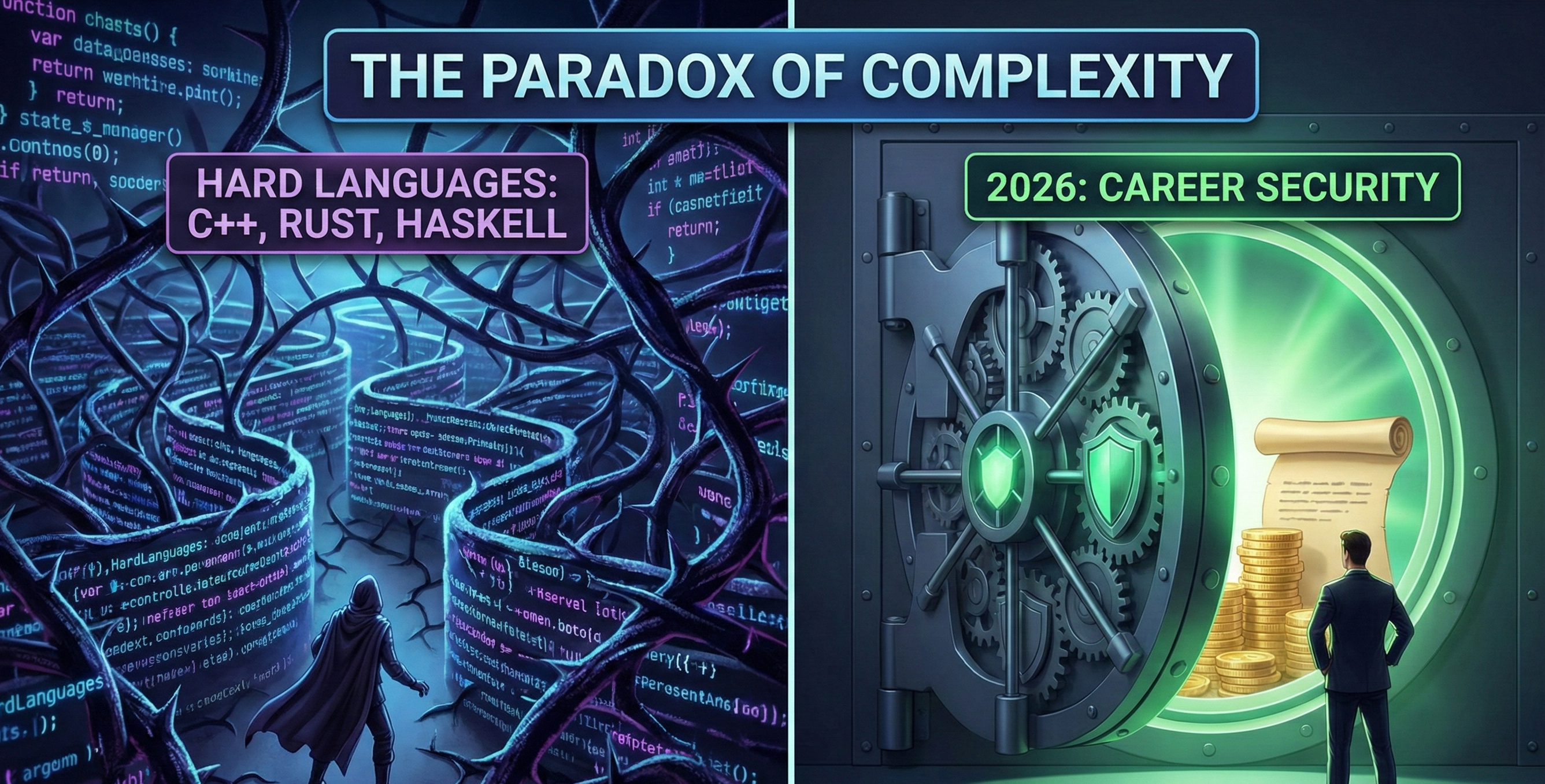
On the other side of the spectrum, we have the “beasts”: C++, Rust, and Haskell. These languages are often vilified in beginner guides for their steep learning curves, complex syntax, and unforgiving compilers. However, a trend identified by Acodez and Sharpener suggests that these languages are seeing a resurgence, not just among seniors, but among ambitious juniors.
Rust: The Strict Teacher
Rust has gained a reputation as one of the hardest languages to learn due to its unique “Ownership Model.” Unlike Python, which has a garbage collector that cleans up memory for you, Rust forces you to manually understand exactly where your data lives and when it dies.
- Why it pays off: The compiler is strict, often screaming at you for mistakes before you can even run the program. This is frustrating for a learner, but it is a godsend for a professional. If a Rust program compiles, it is almost guaranteed to be free of memory bugs.
- The Career Boost: Because the learning curve is a “filter,” developers who master Rust are in high demand for critical infrastructure roles.
C++: The Grandfather of Complexity
C++ remains the gold standard for game development and high-frequency trading. It gives you direct access to the hardware.
- The Double-Edged Sword: You can control every single bit of memory, which allows for incredible speed. However, as noted in Phaedra Solutions’ analysis, one wrong move results in a “segmentation fault”—crashing the entire program.
- Why learn it in 2026? Understanding C++ teaches you how computers actually work. It creates a mental model of the machine that makes learning every other language easier.
Haskell: The Math Puzzle
Haskell is often cited by Techreviewer as purely academic or “math-heavy.” It is a functional language where variables cannot change once defined (immutability).
- The Paradigm Shift: Learning Haskell breaks your brain in the best way possible. It forces you to think in terms of data transformation rather than step-by-step instructions. Even if you never use Haskell in a job, the way it teaches you to solve problems will make you a better JavaScript or Python developer.
The Verdict: “Hard” languages front-load the pain. You struggle for the first six months, but once you master the rules, the language protects you from making mistakes.
The Esoteric and The “New Hard” (Malbolge, Zig, and V)
Beyond the standard job-market languages, we must look at the outliers that define the boundaries of programming.
The Impossible: Malbolge
Every blog from Phaedra to Techreviewer mentions Malbolge. It is designed to be impossible. It uses base-3 arithmetic and self-altering code.
- Why does it exist? It serves as a reminder that code is just instructions. It strips away all human readability to show the gap between human thought and machine execution. While you shouldn’t learn it for a job, looking at a snippet of Malbolge reminds you to be grateful for C++.
The New Contenders: Zig and V
A fascinating trend for 2026 is the rise of what Acodez calls “Lightweight Programming Languages.”
- Zig: Aiming to replace C, Zig removes the hidden complexity. It has no hidden control flow, no hidden memory allocations, and no preprocessor. It is “hard” because it forces you to be explicit, but “easy” because it is readable.
- V Language: A statically typed language designed for maintainability. It attempts to combine the simplicity of Go with the safety of Rust.
These languages represent the future: tools that are difficult enough to be safe, but simple enough to be readable.
Part 4: The Strategy for 2026 and Beyond
So, how do you navigate this landscape? The blogs analyzed from Fullstack Academy and Sharpener often pitch a specific path based on their service models (Bootcamps or “Pay After Placement”). However, a neutral synthesis of the data suggests a hybrid approach.
1. The “Sandwich” Method
Do not just pick “Easy” or “Hard.” Sandwich them.
- Start Easy (Months 1-3): Use Python or JavaScript to grasp the basics of loops, variables, and logic. Get that dopamine hit of building something visible.
- Go Hard (Months 4-9): Pivot to C or Rust. You don’t need to become an expert, but you need to struggle with memory management and types. This will cure you of the “sloppy coding” habits picked up in Python.
- Return to Utility (Months 10+): Go back to your main language (JS/Python) with your new perspective. You will write cleaner, more efficient code because you understand what is happening under the hood.
2. AI is the New Syntax
In 2026, “Hard syntax” is less of a barrier because AI tools can help write the boilerplate. The difficulty now lies in System Architecture and Logic.
- The “Hardest” part of programming is no longer missing a semicolon (
;). - The “Hardest” part is telling the AI exactly what you need the system to do and verifying that it did it correctly.
- Languages with strong type systems (Rust, TypeScript, Haskell) are actually better for AI collaboration because the strict rules help the AI make fewer hallucinations.
3. Match the Language to the Goal
- Goal: Rapid Prototyping / Data Science: Stick to Python. The ecosystem is unbeatable.
- Goal: Enterprise Systems / Infrastructure: Learn Java or C#. They are the middle ground—verbose but stable.
- Goal: High Performance / Systems Engineering: Rust or C++. This is where the highest salaries and highest job security often lie.
Conclusion: Embrace the Friction
The distinction between “Easiest” and “Hardest” programming languages is a marketing gimmick used to sell courses. In reality, programming is the art of solving problems.
- HTML/CSS are easy to write but hard to organize at scale.
- C++ is hard to write but gives you superpowers over the hardware.
- Python is easy to read but hard to optimize.
As we move through 2026, the best developers will not be those who look for the path of least resistance. They will be the ones who embrace the friction of the “Hard” languages to build mental resilience. Whether you are browsing a tech reviewer site or considering a full stack academy, remember this: The code that is hardest to write is often the code that is easiest to live with.
Don’t fear the compiler errors of Rust or the pointers of C++. They are not gatekeepers; they are guardrails. In an era of AI-generated code, your ability to understand the deep, complex “hard” parts of computing is the only thing that guarantees your value cannot be automated away.