Introduction: The Talent Paradox of the Digital Age
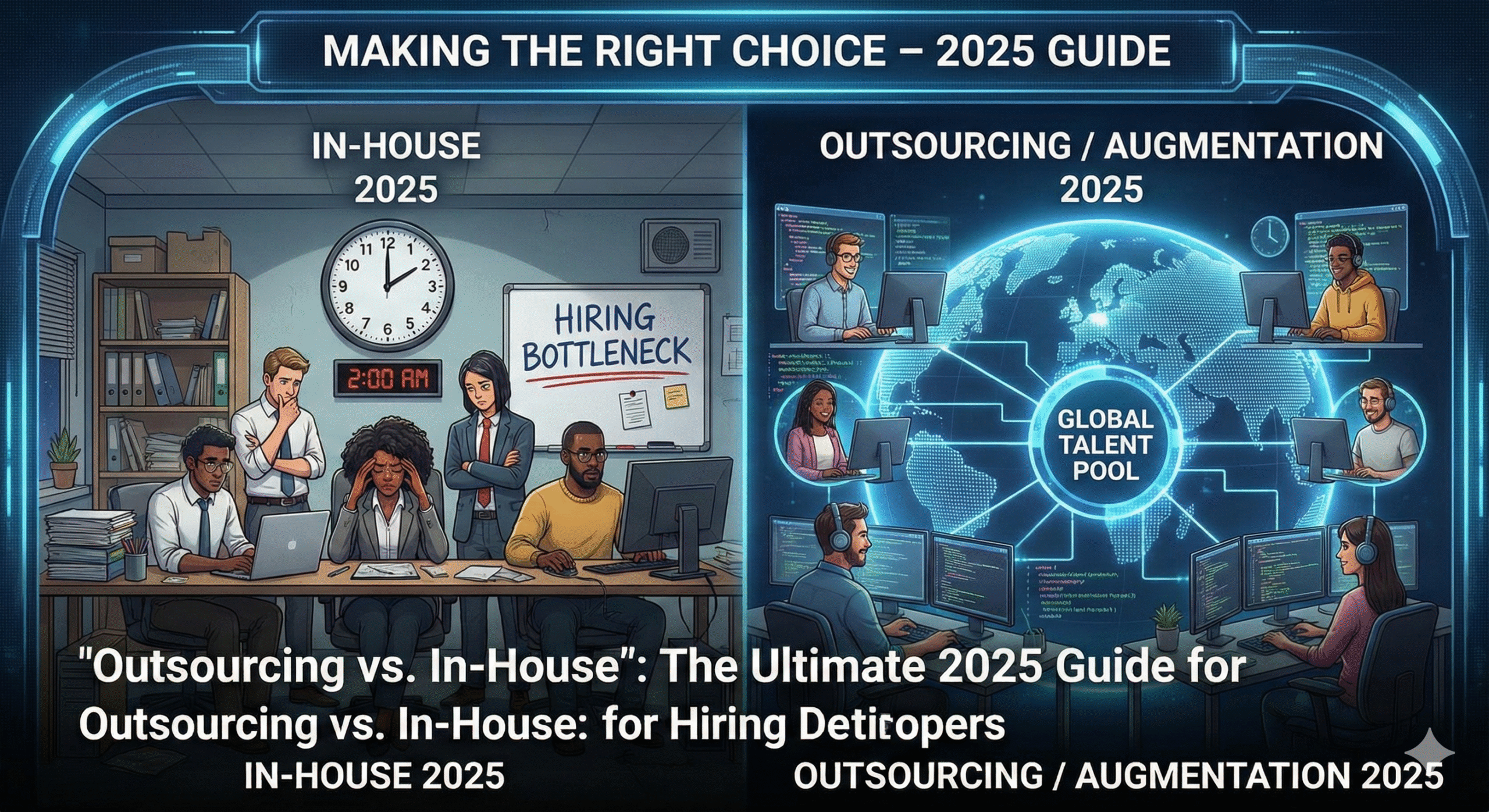
It was 2:00 AM on a Tuesday, and the CTO of a promising fintech startup sat across from me, the glow of his monitor illuminating a look of sheer exhaustion. His problem wasn’t a lack of vision; he had a roadmap that could disrupt the market. His problem wasn’t capital; they had just closed a healthy Series A funding round. His problem was people specifically, the inability to find them. He had spent the last three months trying to hire two senior backend engineers. Between exorbitant salary demands, equity negotiations, and fierce competition from tech giants, his product roadmap was frozen in time.
This scenario is not unique. As we navigate through 2025, technology leaders face a paradoxical crisis: technology is more accessible than ever, yet the talent required to wield it is increasingly scarce. The global shortage of skilled IT professionals has intensified, with recruiters reporting that finding qualified candidates is their single biggest challenge. In specialized fields like Artificial Intelligence (AI) and machine learning, the gap is even wider, creating a bottleneck that threatens to stifle innovation for companies that refuse to adapt their hiring strategies.
For decision-makers, this creates a high-stakes strategic crossroads. On one path lies the traditional model of hiring developers in-house building a fortress of internal talent that offers control and cultural cohesion but comes with crippling fixed costs and slow scalability. On the other path lies the modern approach of leveraging global talent. But the binary choice of “us vs. them” is outdated. The landscape of 2025 is nuanced, driven by hybrid models and strategic partnerships that function less like vendors and more like extensions of your core team.
At The Softix, established in 2022 and headquartered in the USA, we have observed this shift firsthand. We bridge the gap between American business strategy and global engineering execution, empowering startups and enterprises to transcend the limitations of local hiring. This guide is designed to be the final word on the subject. We will dissect the financial anatomy of your hiring decisions, explore the psychological nuances of team management, and provide a roadmap for leveraging global talent to build world-class software. Whether you are scaling a SaaS platform or modernizing legacy infrastructure, these insights will help you make the right choice.
Chapter 1: The In-House Development Model – The Hidden Cost of Control
To understand why outsourcing software development has become such a compelling alternative, we must first conduct a rigorous audit of the traditional in-house model. For decades, the standard advice for serious tech companies was to “own your tech.” While this axiom holds truth for core intellectual property, the mechanics of building an in-house team in 2025 are fraught with hidden complexities and escalating costs that many founders fail to anticipate.
1.1 The Illusion of the Sticker Price
When a founder budgets for a new developer, they often look at the base salary and stop there. In the United States, the average salary for a senior software developer ranges significantly depending on the region. However, seasoned executives know that the base salary is merely the tip of the financial iceberg. The “fully loaded” cost of an employee—the Total Cost of Ownership (TCO) is significantly higher, often 2.7 times the base salary when all factors are considered.
The Hidden Overhead
Every internal hire brings a backpack of fixed costs that must be paid regardless of productivity or company revenue:
- Benefits and Taxes: Payroll taxes, health insurance, 401(k) contributions, and other mandatory benefits can immediately add 25-30% to the base salary.
- Infrastructure: Providing a professional workspace whether a physical desk in a high-rent district or a remote setup with a high-end laptop, monitors, and ergonomic furniture costs thousands of dollars per employee annually.
- Software Licensing: The modern developer stack is expensive. Licenses for IDEs, Jira, Slack, GitHub Enterprise, and cloud environments accumulate rapidly, creating a hefty monthly operational expense.
1.2 The Recruitment Quagmire
The process of internally hiring developers is a time-intensive drain on your most valuable resources: your existing leadership.
- Time-to-Hire: The average time to fill a tech role can stretch from 6 to 12 weeks. During this period, your product roadmap is stalled. Features that could be driving revenue are sitting in the backlog, and competitors are not waiting for you to catch up.
- Acquisition Costs: Recruitment agencies typically charge a significant percentage of the first year’s salary as a placement fee. Even internal recruiting requires spend on job board ads and recruiter licenses.
- The Opportunity Cost: Perhaps the most damaging cost is the time your CTO or VP of Engineering spends interviewing candidates instead of architecting the system. If your tech lead spends 10 hours a week on interviews for three months, that is over 100 hours of high-value strategic work lost forever.
1.3 The Retention Treadmill
In a market defined by talent scarcity, retention is a constant battle. The average tenure of a software engineer in major tech hubs is often less than two years. High turnover decimates productivity. When a developer leaves, they take “tribal knowledge” with them the understanding of why the code was written a certain way. Replacing them costs up to 200% of their annual salary when factoring in lost productivity, recruitment of a replacement, and the ramp-up time for the new hire.
Chapter 2: The Outsourcing Evolution – From Commodity to Strategy
The narrative around outsourcing has shifted dramatically. In the early 2000s, outsourcing was primarily a cost-arbitrage play sending low-value maintenance work to the cheapest bidder. Today, it is a strategic lever used by the world’s most innovative companies to access elite talent and accelerate velocity.
To make the right choice, you must understand the different flavors of outsourcing. It is no longer a monolithic concept; it comprises distinct models tailored to different business needs.
2.1 IT Staff Augmentation: The Elastic Workforce
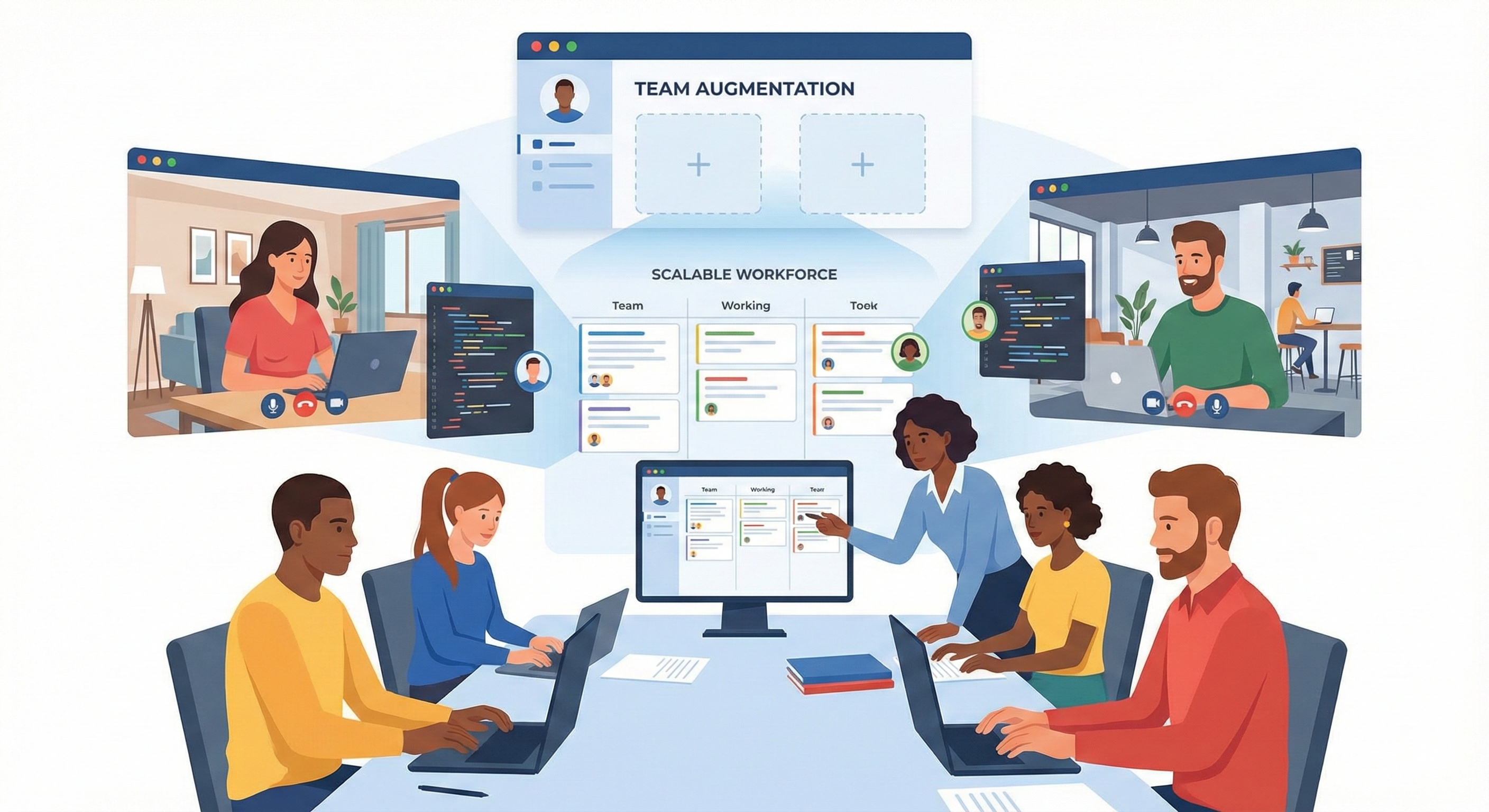
IT staff augmentation is the practice of adding external professionals to your existing team for a specific period. These developers are employed by the vendor (like The Softix) but report directly to your managers.
The Mechanism of Flexibility
Imagine you are building a custom CRM. You have a solid core team, but you suddenly realize you need to integrate a complex AI analytics module. You don’t need a full-time AI engineer forever; you need one for six months. IT staff augmentation allows you to “inject” this specific skill set into your team instantly.
- Scalability: You can scale up from 5 to 15 developers to meet a crunch deadline, then scale back down to 5 once the release is live. This elasticity turns fixed labor costs into variable costs, protecting your cash flow.
- Control: Unlike project outsourcing, you retain full managerial control. The augmented staff attends your daily stand-ups, uses your Jira board, and follows your coding standards. They are, for all intents and purposes, your team members, just without the HR liabilities.
2.2 Dedicated Development Team: The Strategic Pod
For companies that lack internal management bandwidth or need to build a product from scratch, the dedicated development team model is superior. Here, the vendor builds a self-contained unit including Project Managers (PMs), QA engineers, designers, and developers that works exclusively on your project.
In this model, the vendor acts as a strategic partner. You provide the vision and the roadmap; the vendor handles the execution. Because the team is dedicated long-term, they build the same deep domain knowledge as an in-house team. They understand your business logic and user base. Furthermore, vendors like The Softix have “bench” talent and active recruitment pipelines. We can assemble a full cross-functional pod in weeks, whereas hiring developers individually to form such a team internally could take six months or more.
Chapter 3: The Financial Anatomy – A Comparative Analysis
Let’s move from theory to hard data. For the CFO or budget owner, the decision often comes down to the spreadsheet. A detailed financial comparison between hiring in-house in Western markets versus engaging an outsourced partner reveals stark differences.
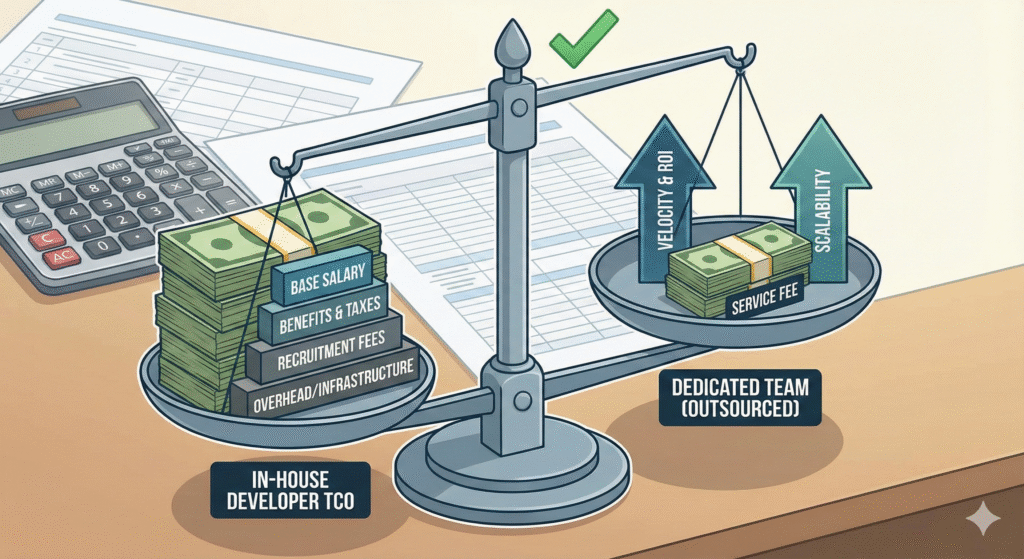
3.1 Total Cost of Ownership (TCO) Comparison
When you compare the models side-by-side, the cost savings of outsourcing are undeniable. An in-house senior engineer commands a high base salary, but the addition of recruitment costs, payroll taxes, benefits, equipment, and bonuses can nearly double that figure. In contrast, an outsourced engineer typically comes at a flat hourly or monthly rate. There are no recruitment fees, no payroll taxes, no hardware costs, and no severance risks. The vendor absorbs all these liabilities.
The Bottom Line: Companies can often secure a dedicated development team of three engineers for the price of one fully-loaded in-house senior developer. This is not just cost-saving; it is resource multiplication.
3.2 The ROI of Velocity
The financial argument for outsourcing software development extends beyond cost savings; it is about revenue generation. Startups operate on a runway. If you have limited capital and a high burn rate, time is your enemy.
- In-House Scenario: You spend months 1-3 recruiting. Development starts in month 4. You have limited time left to prove viability.
- Outsourcing Scenario: You hire a dedicated team from The Softix. The team starts in Week 2. You gain months of additional development time on the same runway.
This outsourced path allows for more iterations, a more polished MVP, and a higher likelihood of securing the next funding round. Studies consistently show that companies leveraging global outsourcing can bring products to market significantly faster than those relying solely on internal recruitment.
Chapter 4: The Strategic Imperative – Access to Talent and Innovation
In 2025, companies are not just outsourcing to save money; they are outsourcing to survive the talent crisis. The complexity of modern software cloud-native architectures, microservices, AI integration requires a breadth of skills that is difficult to house under one roof.
4.1 The Cognitive Diversity Advantage
There is a powerful, often overlooked benefit to outsourcing: cognitive diversity. Homogeneous in-house teams often share the same educational background and biases. By integrating engineers from different cultures and regions via IT staff augmentation, you introduce new problem-solving approaches. An engineer from a different tech ecosystem might approach a latency issue or a database architecture problem differently, leading to more robust, innovative solutions.
4.2 Niche Expertise on Demand
Consider the rise of AI. Every company wants to integrate Generative AI, but “AI Engineers” are the unicorns of the 2025 job market. Hiring one full-time is expensive and difficult. However, outsourcing providers specialize in pooling this talent. The Softix maintains pools of specialists in SaaS Development, CRM Development, and emerging tech. We allow clients to access these experts for specific project phases. You don’t need to hire a full-time Blockchain dev; you just need to access one for the 3 months it takes to build your secure ledger.
4.3 The “Follow the Sun” Model
Global outsourcing unlocks the potential for a 24-hour development cycle. While your US team sleeps, your offshore team is coding, testing, and deploying. You wake up to completed features and fixed bugs. This cycle radically compresses delivery timelines, giving you a critical advantage in competitive markets like Fintech and E-commerce.
Chapter 5: Managing the Invisible Team – Best Practices for 2025
The biggest fear regarding outsourcing software development is the loss of control. “If I can’t see them, are they working?” This anxiety is natural but outdated. With the right management frameworks, remote teams can be more productive than office-bound ones.
5.1 The Softix Management Framework
At The Softix, we advocate for a management style that emphasizes transparency and integration.
- Radical Transparency: We integrate our dedicated development teams into your existing infrastructure. You shouldn’t have to email a vendor to ask for a status update; you should be able to look at the shared Jira board and see exactly who is working on what ticket in real-time.
- Agile Rituals: We strictly adhere to Agile methodologies. Daily stand-ups, sprint planning, and retrospectives are non-negotiable. These rituals create a rhythm of accountability and communication.
5.2 Bridging the Time Zone Gap
Time zones can be a challenge if not managed well. We recommend the “Golden Overlap” strategy structuring schedules to ensure at least 4 hours of overlap between the client and the dedicated team. This window is used for synchronous communication—meetings, Q&A, blockers. The rest of the day is reserved for “Deep Work,” utilizing tools like Loom for video updates and detailed documentation to ensure work continues smoothly when the other side is asleep.
5.3 Cultural Integration
Don’t treat your outsourced team as “hired guns.” Treat them as colleagues. Onboard your augmented staff just as you would an internal hire. Share your company vision, your quarterly goals, and your brand values. When developers understand the business impact of their code, they make better technical decisions. Psychological safety leads to higher performance and lower turnover.
Chapter 6: Risk, Security, and Compliance
In an era of data breaches and IP theft, security is paramount. A robust outsourcing strategy must account for these risks.
6.1 Intellectual Property (IP) Protection
One of the primary concerns with hiring developers externally is IP ownership. As a US-headquartered entity, The Softix ensures that our contracts are governed by US law. This provides our clients with a level of legal recourse and security that is often missing when contracting directly with offshore freelancers. We ensure that all code written by our teams is “work made for hire” and belongs exclusively to the client from the moment of creation.
6.2 Data Security Standards
Whether it’s GDPR for European customers or HIPAA for healthcare clients, compliance is non-negotiable. Our teams operate in secure environments with strict access controls. Rigorous Non-Disclosure Agreements (NDAs) are signed not just at the company level, but by every individual developer working on your project.
Chapter 7: Industry-Specific Applications
Outsourcing is not a one-size-fits-all solution. Its application varies significantly across industries.
7.1 Fintech: The Security Fortress
For Fintech startups, trust is the product. The challenge lies in building secure, compliant transaction systems while racing to capture market share. Dedicated development teams with specific experience in PCI-DSS and encryption allow Fintechs to scale their non-core features (like UI/UX) while keeping core ledger technology secure. Success stories like WhatsApp famously outsourced initial development to manage costs while focusing founder energy on strategy.
7.2 Healthcare: Speed Meets Compliance
The healthcare industry is burdened by legacy systems and strict HIPAA regulations. IT staff augmentation is often used here to modernize specific modules, such as patient portals or telemedicine apps, without disrupting the core hospital information systems. This allows for rapid innovation in a notoriously slow-moving sector.
7.3 Retail & E-commerce: Handling the Spikes
Retailers face extreme seasonality. Traffic spikes during Black Friday require massive resource scaling that sits idle the rest of the year. Retailers use IT staff augmentation to double their DevOps and QA capacity for Q4, then scale back in Q1. This elasticity prevents the waste of paying full-time salaries for peak-capacity needs year-round.
Chapter 8: The Softix Advantage – Why Choose Us?
In a crowded market of outsourcing providers, The Softix stands apart. Our model is designed to neutralize the risks of outsourcing while maximizing the benefits.
8.1 US-Based Headquarters, Global Reach
We are not a faceless offshore entity. We are an American company, headquartered in the USA. This means your contracts are enforceable in US courts, you avoid complex international wire transfers, and you have a local account manager who understands your business context.
8.2 Comprehensive Service Portfolio
We don’t just write code; we build businesses. Our services span the entire digital lifecycle, from SaaS Development and CRM Development to Mobile App Development and SEO & Marketing. We understand that code is useless if no one finds it.
8.3 A Mission of Empowerment
Our mission is to empower startups, growing businesses, and enterprises. We understand the pressure of the “burn rate.” We understand the anxiety of the “launch date.” We align our incentives with yours. We succeed only when your product succeeds.
Conclusion: The Verdict
The question is no longer “Should we outsource?” It is “How strategically can we outsource?”
The most successful companies of the last decade all leveraged outsourcing software development to catalyze their growth. They understood that in the race for innovation, speed is the ultimate currency, and flexibility is the ultimate shield.
Making the Right Choice means recognizing that you cannot do it all alone.
- If you are a Startup, outsourcing is your runway extension. It buys you time and life.
- If you are a Scale-up, IT staff augmentation is your turbocharger. It gives you the capacity to overtake competitors.
- If you are an Enterprise, a dedicated development team is your innovation lab. It allows you to disrupt yourself before someone else does.
At The Softix, we are ready to be that partner. We combine the trust of a US local partner with the power of a global engineering engine. We don’t just fill seats; we fulfill visions. Don’t let the talent shortage stifle your growth. Don’t let fixed costs weigh down your agility. Embrace the future of work. Think IT. Think Softix.