
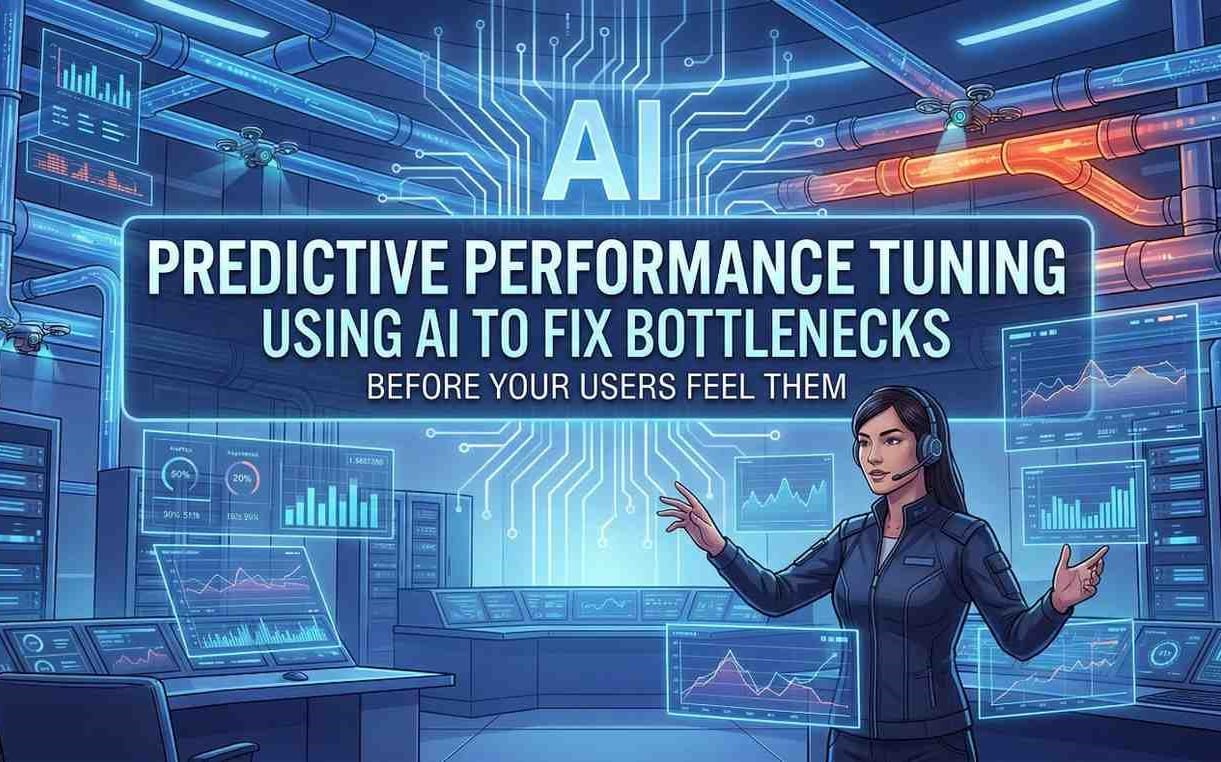
Speed is no longer just a luxury it is the baseline for survival, in the high-stakes digital economy. Modern users expect instantaneous responses, seamless transitions, and zero downtime. However, as web applications grow in complexity, traditional reactive maintenance fixing problems after they occur is becoming obsolete. Enter Predictive Performance Tuning, an innovative approach that leverages Artificial Intelligence (AI) and Machine Learning (ML) to identify and resolve system bottlenecks before they ever impact the end-user experience.
By shifting from a reactive “break-fix” model to a proactive “predict-and-prevent” strategy, businesses can ensure their digital infrastructure remains robust, scalable, and lightning-fast.
1. The Evolution of Web Optimization: From Reactive to Predictive
For decades, performance tuning involved monitoring dashboards and waiting for an alert to trigger. When a server’s CPU usage spiked or a page load time exceeded three seconds, a developer would jump in to investigate. This lag time between the bottleneck occurring and the fix being implemented represents a significant risk to conversion rates and brand reputation.
Predictive Performance Tuning changes the narrative. By feeding historical data into AI models, systems can now recognize the subtle patterns that precede a crash or a slowdown. Whether it’s a memory leak that slowly consumes resources or a seasonal traffic surge that threatens to overwhelm a database, AI provides the foresight needed to scale resources or optimize code in real-time.
2. Understanding the Lifecycle: Web Maintenance vs Web Development
To truly grasp the power of predictive tuning, one must understand where it fits within the broader digital ecosystem. Many stakeholders often confuse two critical yet distinct pillars of site health: web maintenance vs web development. While web development focuses on the initial creation, architectural design, and the deployment of new features, web maintenance is the ongoing process of ensuring those features remain functional, secure, and fast.
Predictive tuning bridges the gap between these two disciplines. While the development phase establishes the performance ceiling, predictive maintenance ensures the site consistently operates at that ceiling. By integrating AI-driven insights into the maintenance lifecycle, businesses can automate routine check-ups and performance patches, allowing developers to focus on innovation rather than fire-fighting.
3. The Architecture of AI-Driven Performance Monitoring
The backbone of predictive tuning is data. Modern web ecosystems generate vast amounts of telemetry data, including server logs, user clickstreams, API latency metrics, and database query execution times. AI algorithms, particularly those specialized in google technical support and advanced cloud infrastructure monitoring, analyze these data points to create a “baseline” of normal operation.
Once the baseline is established, the AI looks for anomalies. For instance, if a specific JavaScript file starts taking 50 milliseconds longer to execute each day, a human might not notice it for weeks. However, an AI-driven monitoring system identifies this “drift” immediately. This level of granular oversight is what allows platforms to maintain 99.9% uptime while delivering content at edge speeds. Leveraging these automated insights reduces the burden on internal teams and mimics the high-level diagnostic precision found in enterprise-level google technical support environments.
4. The Human Element: The Role of a Technical Support Engineer
Despite the rise of automation, the human element remains irreplaceable. A technical support engineer acts as the architect and the ultimate decision-maker in the predictive tuning process. While AI can identify a bottleneck and even suggest a fix, the technical support engineer is responsible for validating these insights and ensuring they align with the broader business objectives.
In a modern DevOps environment, technical support services have evolved into a high-level advisory role. Instead of manually clearing caches or restarting servers, these professionals now manage the AI models that perform those tasks. High-quality technical support services involve the constant fine-tuning of predictive algorithms to ensure that the system does not generate “false positives” (triggering alerts for non-issues) or “false negatives” (missing actual bottlenecks).
5. Identifying Bottlenecks: Where AI Shines
Predictive tuning is most effective when applied to the three most common digital bottlenecks:
A. Database Query Optimization
Databases are often the silent killers of web performance. As tables grow, queries that were once fast become sluggish. AI can analyze query patterns and predict which tables will require indexing or sharding before the latency becomes visible to users.
B. Asset Delivery and Latency
Using ML-based Image Recognition and Compression, systems can predict which assets a user is likely to request next and pre-fetch them to the edge of the Content Delivery Network (CDN). This reduces the Time to First Byte (TTFB) significantly.
C. Server-Side Resource Exhaustion
By analyzing traffic trends (such as a sudden viral social media post), AI can trigger “Auto-Scaling” protocols. This ensures that additional virtual machines or containers are spun up seconds before the traffic wave hits, rather than minutes after the site has already crashed.
6. Real-Time Anomaly Detection and Self-Healing Systems
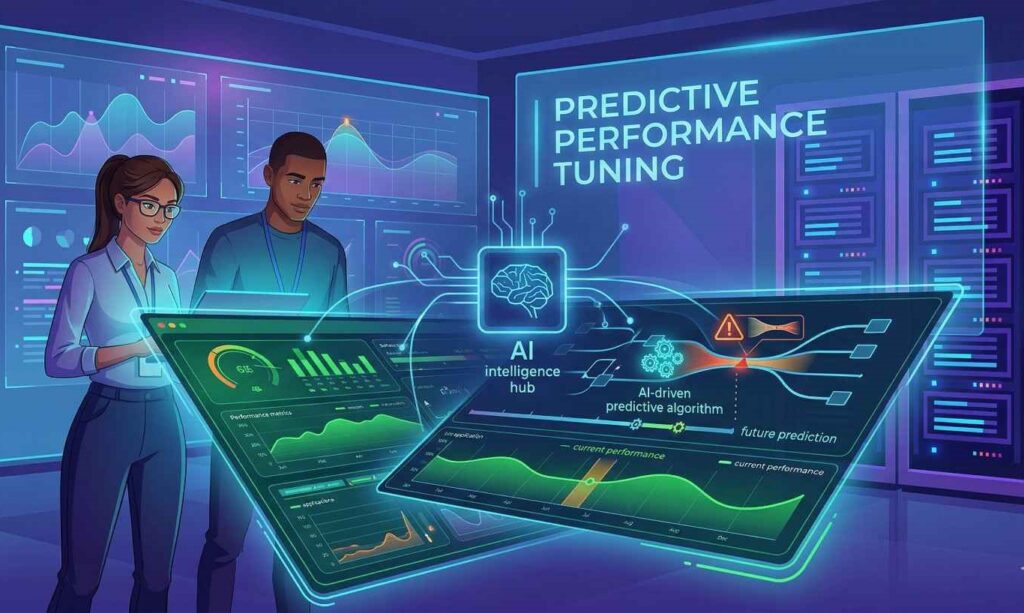
The pinnacle of Predictive Performance Tuning is the “Self-Healing System.” In this scenario, the AI not only predicts a bottleneck but also takes autonomous action to resolve it.
For example, if the system detects an unusual spike in failed login attempts (suggesting a Brute Force attack), it can automatically adjust firewall rules. If it detects a memory leak in a specific microservice, it can gracefully restart that service without dropping any user sessions. This level of automation ensures that the user never “feels” the bottleneck; the system corrects itself in the background, maintaining a seamless front-end experience.
7. SEO and the Business Value of Predictive Tuning
From an SEO perspective, performance is a primary ranking factor. Google’s Core Web Vitals (LCP, FID, and CLS) directly measure user experience. A site that uses predictive tuning to maintain a low Largest Contentful Paint (LCP) will naturally outrank competitors who rely on reactive maintenance.
Furthermore, the business value is clear:
- Reduced Churn: Users stay longer on sites that respond instantly.
- Lower Operational Costs: Preventing a crash is significantly cheaper than recovering from one.
- Brand Trust: Reliability builds loyalty. When a site always works, users trust the brand behind it.
8. Implementing Predictive Tuning in Your Business
Transitioning to an AI-driven performance model requires a strategic shift. It begins with auditing your current infrastructure to identify where data is being collected and where gaps exist.
At The Softix, we specialize in integrating these advanced maintenance and support protocols into your existing framework. Our approach ensures that your website isn’t just “up,” but is optimized to handle the demands of tomorrow. You can explore our specific methodologies for ensuring long-term site health by visiting our Website Maintenance and Support page.
9. The Future: Generative AI and Performance Code Refactoring
The next frontier of predictive tuning is Generative AI. We are approaching a point where AI will not only predict bottlenecks but also rewrite the inefficient code causing them. Imagine a system that identifies a slow-running loop in your backend and automatically submits a Pull Request with a more efficient algorithm.
While we are in the early stages of this “Autonomous Coding,” the predictive tools available today already offer a massive competitive advantage. By staying ahead of the performance curve, you ensure that your digital presence is not just a static brochure, but a high-performance engine capable of driving global business growth.
In Conclusion
Predictive Performance Tuning is the ultimate insurance policy for the digital age. By utilizing AI to fix bottlenecks before users feel them, you move away from the chaos of emergency repairs and toward a state of constant, optimized flow.
Whether you are navigating the complexities of web maintenance vs web development or seeking the specialized expertise of a technical support engineer, the goal remains the same: a flawless user experience. In a world where a millisecond can be the difference between a sale and a bounce, predictive tuning is no longer optional it is the standard for excellence.
Invest in your site’s future today. Don’t wait for your users to tell you there’s a problem. Let the data speak first, and let AI provide the solution before the bottleneck even begins.