Before diving into tactics, it is essential to understand exactly what has changed and why it matters so profoundly. The modern Google SERP in 2026 looks dramatically different from what it did even two years ago. AI Overviews Google’s generative AI summaries that appear at the very top of results for a growing percentage of queries now appear on roughly 30 to 40 percent of all searches, with that number steadily increasing.
These AI-generated blocks pull synthesized answers from multiple sources across the web, citing a handful of trusted pages that informed the summary. Appearing as a cited source inside an AI Overview is the new first-page ranking arguably even more valuable, because it associates your brand directly with the authoritative answer to a user’s question.
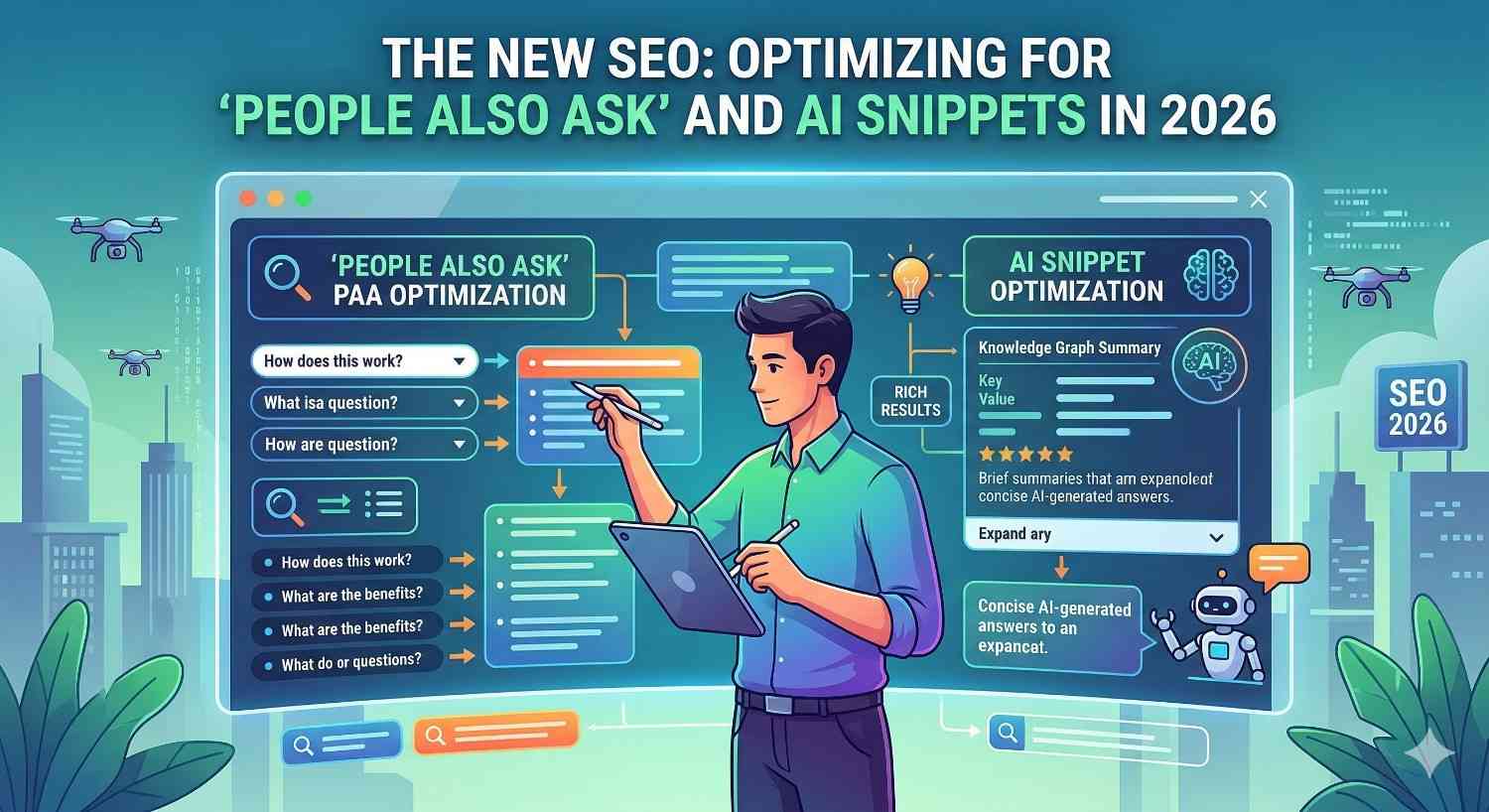
Meanwhile, the “People Also Ask” feature has matured into one of the most powerful visibility tools available. PAA boxes now appear on over 70 percent of all Google searches, often expanding dynamically as users click through related questions. Each question inside a PAA box is a direct window into the intent, curiosity, and decision-making process of your target audience.
Understanding this landscape is not optional it is the foundation upon which every modern SEO strategy must be built.
Why Traditional SEO Tactics Are No Longer Enough
The old SEO playbook was relatively straightforward: conduct keyword research, optimize on-page elements, build backlinks, and wait for rankings to climb. That approach still has value, but it is no longer sufficient as a standalone strategy. Businesses that rely exclusively on SEO services built around legacy tactics keyword stuffing, thin content, and link schemes are not just plateauing. They are actively losing ground to competitors who have adapted to the AI-first search environment.
Here is why the shift demands a new approach. Traditional rankings reward pages that contain target keywords and earn authoritative backlinks. AI Overviews and PAA boxes reward pages that directly, clearly, and comprehensively answer specific questions. The optimization target has changed from “rank for this keyword” to “be the best answer to this question.” That is a subtle but enormously consequential distinction.
Google’s ranking systems, increasingly powered by large language models, are now evaluating content based on its ability to satisfy user intent holistically not just match query terms. Content that is structured to answer questions, backed by genuine expertise, and written with clarity consistently outperforms keyword-heavy content that lacks substance.
Decoding ‘People Also Ask’: How It Works and Why It Matters
The “People Also Ask” feature is powered by Google’s understanding of semantic relationships between questions. When a user searches for a topic, Google’s systems identify clusters of related questions that users commonly ask in connection with the original query. These questions are surfaced dynamically, meaning the PAA box expands with new questions every time a user clicks on one.
This dynamic nature is what makes PAA boxes so extraordinarily valuable from an SEO perspective. A single piece of well-optimized content can appear across dozens of related PAA questions, multiplying its visibility far beyond what a single keyword ranking could ever achieve.
What determines whether your content gets pulled into a PAA box? Several factors are at play. Google favors concise, direct answers typically between 40 and 60 words that immediately address the question asked. The answer should be followed by supporting context that adds depth. Pages with a clear question-and-answer structure, using the exact question as a heading and a focused paragraph as the response, dramatically increase their chances of PAA inclusion.
Schema markup, particularly FAQ schema and How-To schema, signals to Google that your content is structured as question-and-answer content, further improving your eligibility for PAA boxes and other rich result formats.
How to Optimize Content for ‘People Also Ask’ Boxes
Winning PAA real estate requires a deliberate content strategy built around question-based optimization. Here is exactly how to do it.
Research question clusters, not just keywords. Tools like Ahrefs, Semrush, and AlsoAsked.com allow you to map entire ecosystems of related questions around any topic. Instead of targeting a single keyword, build your content around a comprehensive cluster of questions that your target audience is actively asking. This approach naturally aligns your content with the semantic relationships Google uses to populate PAA boxes.
Structure your content with explicit Q&A formatting. Use the exact question as a heading. Follow it immediately with a concise, direct answer in the first paragraph ideally 40 to 60 words. Then expand with supporting paragraphs, data, examples, and context. This structure serves both the PAA algorithm and the human reader simultaneously.
Write for featured snippets within your answers. PAA answers and featured snippets share the same optimization logic. Paragraph snippets reward concise definitions and explanations. List snippets reward step-by-step processes formatted as ordered or unordered lists. Table snippets reward comparative data organized in tabular format. Identifying which format Google currently uses for a given question and mirroring that format in your content is one of the highest-leverage tactics available.
Update existing content strategically. Many PAA opportunities are not about creating new content — they are about enhancing existing pages. Audit your top-performing articles and identify questions that are closely related to the page’s topic but not yet explicitly addressed. Adding dedicated Q&A sections to existing content is often faster and more effective than building new pages from scratch.
Cracking AI Overviews: Getting Your Content Cited by Google’s AI
AI Overviews represent the most significant change to organic search visibility in a generation. When Google’s AI generates a summary for a query, it draws from a curated set of web pages it deems authoritative, relevant, and trustworthy. Being cited in an AI Overview can drive substantial brand visibility even when users do not click through to your site.
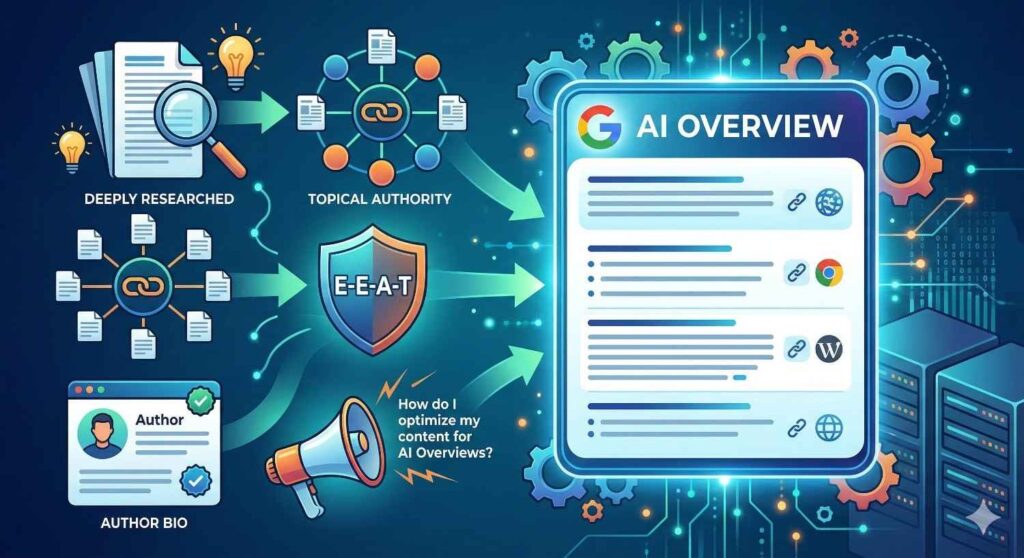
The question every SEO professional is asking in 2026 is: how do you get cited? The answer lies at the intersection of content quality, topical authority, and technical trust signals.
Build topical authority through content depth. Google’s AI systems favor sources that demonstrate comprehensive expertise on a subject. A website with twenty deeply researched, interconnected articles on a specific topic will consistently outperform a site with one thin article on the same subject. Building content clusters a central pillar page supported by multiple in-depth supporting articles signals topical authority that AI systems recognize and reward.
Prioritize E-E-A-T signals rigorously. Experience, Expertise, Authoritativeness, and Trustworthiness (E-E-A-T) have become even more critical in the AI search era. Author bios with verified credentials, citations from reputable external sources, original research and data, and a transparent about page all contribute to the trust signals that influence AI Overview citations.
Write in a direct, authoritative voice. AI systems synthesize answers from sources that state facts clearly and confidently. Hedging language, vague generalizations, and overly promotional writing patterns are less likely to be pulled into AI-generated summaries. Write as an expert speaking directly to a reader who needs a clear, reliable answer.
Optimize for long-tail conversational queries. AI Overviews appear most frequently on informational and long-tail queries the kind of natural-language questions users type or speak when genuinely trying to learn something. Optimizing content specifically for these query types puts you directly in the path of AI Overview generation.
Technical SEO Foundations That Support AI and PAA Visibility
Content quality alone is not enough. The technical foundation of your website must support the discoverability and trustworthiness that AI-powered search features demand.
Page speed and Core Web Vitals remain critical baseline requirements. Slow-loading pages are crawled less frequently and are less likely to be included in AI Overview citation pools. Structured data markup — including FAQ, HowTo, Article, and Organization schemas communicates content structure directly to Google’s systems, improving eligibility for rich results across the board.
Internal linking is also more important than ever. A well-structured internal link architecture helps Google understand the topical relationships between your pages, reinforcing the topical authority signals that drive AI Overview and PAA inclusion. Every content cluster should be tightly interconnected, with clear navigational pathways between pillar content and supporting articles.
Mobile optimization is non-negotiable. With the vast majority of searches now occurring on mobile devices, pages that deliver a subpar mobile experience are systematically disadvantaged in both traditional rankings and AI feature inclusion.
Measuring Success in the AI Search Era
The metrics that define SEO success are evolving alongside the search landscape itself. Click-through rate from traditional organic listings is declining as AI Overviews and PAA boxes answer more queries directly on the SERP. This means brand impressions, citation frequency in AI summaries, and SERP feature appearances are becoming as important as raw traffic numbers.
Tools like Google Search Console now provide visibility into which queries trigger your content in featured snippets and rich results. Third-party platforms like Semrush and Ahrefs are rapidly expanding their SERP feature tracking capabilities, allowing marketers to monitor PAA appearances, featured snippet ownership, and AI Overview citation patterns with increasing precision.
Reframe your success metrics to include share of SERP features, branded search volume growth, and time-on-page as indicators of content authority — not just organic sessions and keyword rankings alone.
Summary: The Future of SEO Belongs to Answer-First Content
The 2026 SEO landscape rewards a fundamentally different kind of content creator one who thinks less like a keyword optimizer and more like a trusted expert answering real questions for real people. The “People Also Ask” boxes and AI Overviews that now dominate the SERP are not obstacles to organic visibility. They are opportunities for brands willing to invest in genuine depth, clarity, and expertise.
The new SEO playbook is built on a simple but powerful premise: if your content is the best available answer to the questions your audience is asking, the algorithms whether traditional or AI-powered will find ways to surface it. Create content that earns trust, structure it so machines can read it, and build topical authority that stands the test of every algorithm update yet to come.
The brands that internalize this shift today are not just adapting to 2026. They are building the kind of durable, authoritative online presence that will continue to compound in value for years ahead.