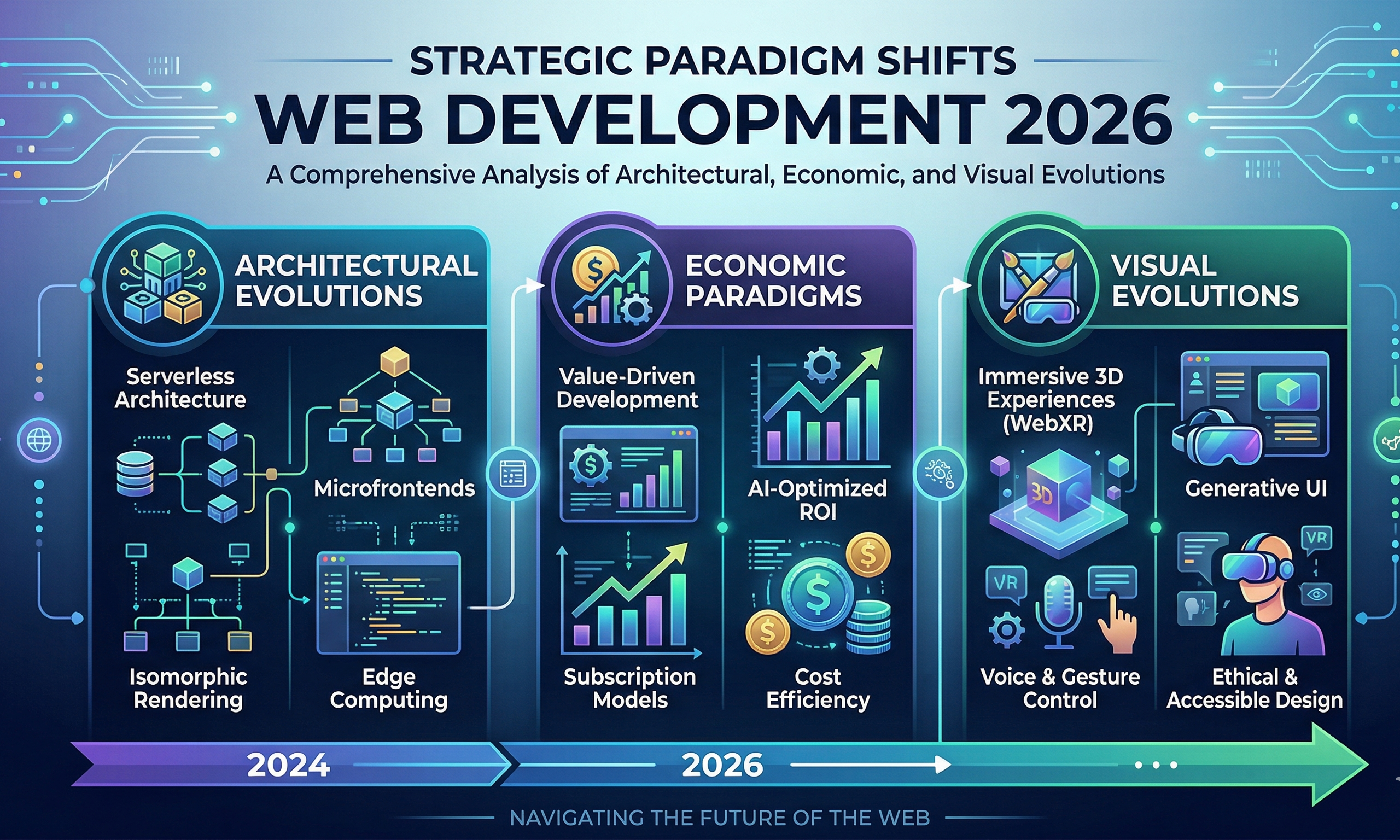
The software and web development ecosystem in 2026 has transitioned into an era of autonomous orchestration, where the traditional boundaries between human creativity and machine execution have blurred. This report provides a multidisciplinary examination of the current state of the industry, analyzing the technical convergence of front-end and back-end disciplines, the maturation of high-performance frameworks, the economic reality of tech careers, and the fundamental shift in digital discovery through generative engines. For an organization like TheSoftix, operating within the competitive tech hubs such as Austin, Texas, understanding these second-order effects is essential for maintaining a premium market position.
The Convergence of Front-End and Back-End Engineering
The historical dichotomy between front-end and back-end development is undergoing a fundamental transformation. In 2026, the industry is moving away from isolated silos toward a unified architectural model driven by Server-First patterns and Edge computing. Front-end development, once limited to visual rendering and user interaction, now encompasses sophisticated server-side logic through React Server Components (RSC) and similar paradigms in Vue and Angular. This shift allows the front-end to act as a high-performance orchestration layer, delegating heavy data processing to the back-end while maintaining near-zero client-side bundle sizes for non-interactive content.
Back-end development has similarly evolved, prioritizing scalability, security, and real-time data handling. The integration of Node.js 22.x and beyond has introduced native support for HTTP/3 and QUIC, significantly accelerating network communication. Concurrently, programming languages like Go and Rust are increasingly favored for compute-intensive microservices due to their superior concurrency and memory safety. The result is a development landscape where Full-Stack proficiency is no longer a generalist aspiration but a technical necessity for building enterprise-grade, AI-integrated systems.
Architectural Evolution Metrics
| Layer | 2020 Standard | 2026 Paradigm | Primary Driver |
| Front-End | Client-Side Rendering (CSR) | Server-First / RSC | Core Web Vitals & SEO |
| Back-End | Monolithic / REST | Microservices / GraphQL / gRPC | Scalability & Flexibility |
| Infrastructure | Centralized Cloud | Edge Computing / Serverless | Low-Latency Requirements |
| Integration | Manual API Wiring | AI-Native Agentic Workflows | Productivity & Automation |
Deep Dive into Programming Languages for 2026
The selection of a programming language in 2026 is governed by the specific requirements of the project’s ecosystem whether it be the rapid prototyping needs of a startup or the stringent security demands of a fintech portal.
The Dominance of TypeScript and JavaScript
JavaScript remains the backbone of the web, but TypeScript has become the mandatory standard for large-scale development. Its ability to reduce runtime errors and provide a structured development environment makes it the preferred choice for 10+ developer teams. In 2026, TypeScript’s integration with AI coding tools allows for even more robust “type-safe” scaffolding, which acts as a guardrail for autonomous agents generating code snippets.
The Efficiency of Go and Rust in High-Load Systems
Go (Golang) continues to capture the back-end market due to its simplicity and exceptional speed in handling concurrent processes. It is frequently utilized in the development of cloud-native applications and microservices where low-latency performance is non-negotiable. Rust, on the other hand, is increasingly adopted for mission-critical systems where memory safety is paramount. Its steep learning curve is justified by the elimination of common security vulnerabilities, making it a “future-proof” investment for enterprise architecture.
The Resilience of PHP and the Python AI Boom
Despite the rise of newer languages, PHP remains a dominant force, powering a vast portion of the web through the Laravel framework and WordPress. Laravel has maintained its reputation as a developer-friendly framework, especially when paired with Vue.js to create responsive, design-forward applications. Python has solidified its role as the premier language for AI-driven web tools and data-heavy applications. Its clean syntax and extensive library ecosystem (e.g., Django, FastAPI) make it the go-to for building predictive analytics platforms and machine learning based dashboards.
Comparative Analysis of Frontend Frameworks: React, Angular, and Vue
The competition between React, Angular, and Vue in 2026 is no longer about which framework is “best,” but which one aligns with a project’s specific governance and scalability needs.
React 19: Flexibility and the Compiled Future
React 19 maintains its position as the market leader, with a developer usage rate of approximately 40.58%. The introduction of the React Compiler has redefined performance optimization by automatically managing component re-renders, effectively deprecating the need for manual hooks like useMemo. This allows React to remain unopinionated while delivering the performance of a highly optimized framework. Its vast ecosystem, including Next.js 15, ensures it remains the primary choice for startups and high-traffic streaming platforms.
Angular 20: The Structured Powerhouse
Angular 20 is the definitive choice for enterprise-scale projects that require strict architectural consistency and long-term maintainability. The framework has moved away from the complexity of Zone.js-based change detection toward a “Signals-based” reactivity model. This allows for fine-grained DOM updates, significantly reducing CPU usage for data-intensive applications such as banking portals and CRM systems. Angular’s “batteries-included” approach incorporating routing, forms, and dependency injection out of the box ensures that large teams follow a unified “playbook,” reducing the friction of onboarding new engineers.
Vue 4: The Progressive Performance Leader
Vue 4 (and its 3.5+ evolutions) has mastered the “middle ground” between React’s library-first approach and Angular’s full-framework model. The adoption of “Vapor Mode” has allowed Vue to achieve blazing-fast rendering speeds (12ms for reactive updates) while reducing its core memory footprint to approximately 12-18 MB for complex applications. Its simplicity and low learning curve make it the ideal framework for MVPs and SaaS platforms where rapid iteration is prioritized.
Framework Performance and Market Distribution 2026
| Metric | React 19 | Angular 20 | Vue 4 |
| Market Share (Dev Survey) | 40.58% | 17.46% | 18.82% |
| Average Salary (U.S.) | $130,000 – $180,000 | $125,000 – $175,000 | $115,000 – $165,000 |
| Render Speed (v. Virtualized) | 45-60ms | 50-70ms | 40-55ms |
| Time to Interactive (Initial) | 1.4 – 2.0s | 1.8 – 2.5s | 1.2 – 1.8s |
| Corporate Backing | Meta (Facebook) | Community-Driven | |
| Learning Curve | Moderate | Steep | Gentle |
The Strategic Decision: WordPress vs. Custom Development
The decision between utilizing a Content Management System (CMS) like WordPress or investing in custom software development in 2026 is one of the most critical choices for a Technical Director.
WordPress: The Market Dominant Entity
WordPress now powers over 43.5% of all websites, driven by its massive ecosystem of over 60,000 plugins. It remains the most cost-effective path for standard projects, with professional implementation typically costing between $7,500 and $25,000. The primary advantage of WordPress is its “speed-to-market,” with standard sites capable of launching in as little as 2 to 6 weeks.
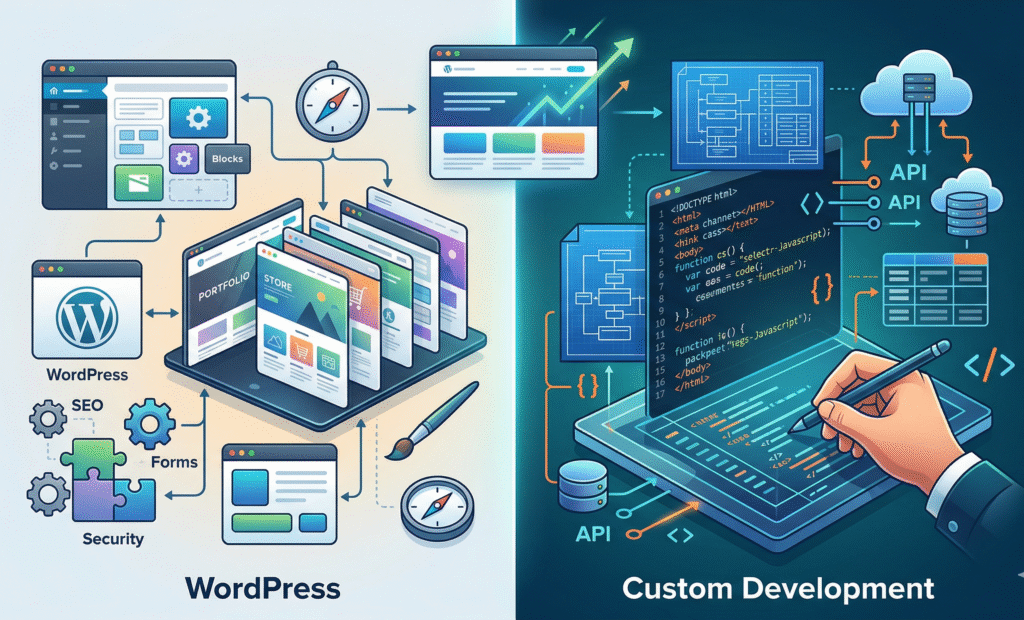
However, the “maintenance tax” of WordPress has become more pronounced in 2026. Security remains a persistent concern; while the core platform is secure, 90% of vulnerabilities are introduced via third-party plugins. Furthermore, the performance overhead of bloated themes can lead to significant abandonments, as 53% of mobile users leave sites that take longer than 3 seconds to load.
Custom Development: Architecture for Scalability
Custom development using frameworks like Next.js, Laravel, or Django is the preferred route for applications with complex data relationships or unique user experience requirements. While initial costs are higher ranging from $50,000 to $200,000+ the 5-year total cost of ownership (TCO) often favors custom builds for enterprise needs. Custom solutions eliminate the dependency on external plugins, reducing the attack surface and providing unlimited creative freedom.
Five-Year Total Cost of Ownership (TCO) Comparison
| Cost Element | WordPress (Professional) | Custom Development (Standard) |
| Initial Development | $12,500 | $75,000 |
| Annual Hosting | $300 | $1,200 |
| Annual Security Monitoring | $1,200 | $2,400 |
| Annual Maintenance/Updates | $2,400 | $4,800 |
| Premium Plugin Renewals | $800 | $0 |
| Security Incidents (Avg. 1/2yrs) | $300 | $0 |
| Estimated 5-Year TCO | $37,000 | $117,000 |
For businesses like TheSoftix, the strategic takeaway is that for projects requiring more than 40% custom functionality, starting with custom development is more cost-effective than attempting to “shoehorn” complex features into a WordPress environment.
UX/UI Design Trends 2026: The Shift Toward Digital Comfort
In 2026, web design has moved beyond the sterile minimalism of the previous decade toward “Expressive Minimalism” and “Digital Comfort”.
Bento Grids and Modular Layouts
Inspired by Japanese lunch boxes, Bento Grids have become the dominant layout style in 2026. This modular approach organizes content into visually balanced, rectangular blocks of varying sizes. It is particularly effective for visual-heavy sites like portfolios, product showcases, and data dashboards, as it provides an organized feel without being rigid.
Immersive Scrollytelling and Spatial 3D
The “Spatial Web” has matured, with interactive 3D elements becoming mainstream in e-commerce and architecture. “Scrollytelling” the use of scroll-triggered animations to guide a user through a narrative has evolved from a novelty into a critical business tool for explaining complex B2B products. These immersive elements, however, must respect “motion accessibility” (WCAG 2.2 guidelines) to ensure the design does not exclude users with vestibular disorders.
Aesthetics: Liquid Glass and Kinetic Typography
“Glassmorphism” has evolved into “Liquid Glass,” characterized by physically plausible blurs, transparency, and floating UI elements that catch light and respond to movement. Kinetic Typography where text itself becomes a dynamic storytelling element is used to emphasize messages and guide user attention purposefully.
| Trend | Business Impact | Practical Implementation |
| Bento Grids | Enhances Scannability | Multi-sized card layouts |
| Expressive Minimalism | Builds Memorable Branding | Negative space + warm textures |
| Spatial 3D | Increases Product Interaction | Interactive WebGL models |
| Dark Mode 2.0 | Reduces Eye Strain | Adaptive contrast based on ambient light |
| Hand-Drawn Elements | Humanizes the Brand | Scribbles, custom illustrations |
Web Development Careers and Economic Landscapes in 2026
The labor market for web developers in 2026 is defined by a high premium on AI integration and full-stack capabilities.
Salary Benchmarks and the AI Premium
AI integration skills now command a salary premium of approximately 9.2% above the general tech market. In the United States, senior full-stack developers can expect annual compensation ranging from $130,000 to $180,000, with top cities like San Francisco and New York pushing past $200,000.
The Emergence of the AI Integration Specialist
A specialized role, the AI Integration Specialist, has emerged to handle the complexities of deploying autonomous agents into live enterprise systems. These professionals focus on “Prompt Tracking,” “Entity Extraction,” and “Agentic AI” workflows, earning a median base pay of approximately $134,188.
Global Salary Benchmarks for Web Developers (2026)
| Region | Entry-Level (0-2 yrs) | Mid-Level (3-5 yrs) | Senior-Level (6+ yrs) |
| United States | $65,000 – $85,000 | $90,000 – $120,000 | $130,000 – $180,000+ |
| United Kingdom | £30,000 – £40,000 | £45,000 – £65,000 | £70,000 – £100,000 |
| Germany | €50,000 – €65,000 | €70,000 – €90,000 | €95,000 – €130,000 |
| UAE (Dubai/Abu Dhabi) | AED 120,000 – 180,000 | AED 200,000 – 300,000 | AED 350,000 – 500,000 |
| India | ₹3 – ₹6 LPA | ₹8 – ₹15 LPA | ₹20 – ₹40+ LPA |
Digital Visibility: SEO to GEO and the Share of Model
Traditional SEO is undergoing a “tectonic shift” as search engines and Large Language Models (LLMs) prioritize “entity understanding” and “generative synthesis” over simple keyword matching.
The Shift to Search Everywhere Optimization
Search is no longer confined to Google; it spans AI assistants, social media communities, maps, and video platforms. In 2026, the concept of “Search Everywhere Optimization” has replaced traditional strategies. For a site like TheSoftix, this means ensuring that AI systems like Perplexity, SearchGPT, and Gemini recognize the brand as an “undeniable local authority”.
Understanding the FACTS Framework
To succeed in 2026, brands must optimize according to the FACTS framework:
- Freshness: Regularly update content with “last updated” dates.
- Authority: Demonstrate expertise through in-depth case studies.
- Consistency: Maintain identical brand information across websites and profiles.
- Trust: Develop a steady stream of reviews and encourage real engagement.
- Semantic Relevance: Connect user “symptoms” to brand “solutions” rather than just matching keywords.
Calculating Share of Model (SoM)
In 2026, Share of Model has replaced Share of Voice as the primary KPI for digital visibility. It quantifies how often a brand is cited in AI-generated summaries.
$$SoM=\left(\frac{\text{Brand Citations}}{\text{Total Citations in AI Responses}}\right)\times 100$$
Organizations tracking SoM can see real-world ROI from their “Generative Engine Optimization” (GEO) efforts, with top-tier strategies achieving a 30-40% boost in AI citations over 6 months.
Competitive Analysis for the Market and Beyond
Austin, Texas, has emerged as a unique technological powerhouse, with a tech workforce that grew by 29.1% recently. For a provider on TheSoftix, the Austin market offers a distinct opportunity: “Silicon Valley expertise” at a cost typically 15-25% lower than New York or Bay Area premiums.
Austin Agency Benchmarks (2026)
| Agency | Alpha Score | Core Specialization | AI Visibility |
| WTT Solutions | 99.8 | AI SEO & GEO Services | Extreme |
| Clear Launch | 94.5 | Paid & Organic Synergy | High |
| Motoza | 92.1 | Local Service Visibility | High |
| TastyPlacement | 90.4 | Tech Startups & Local | Medium |
| Siege Media | 88.9 | Content Engineering | Medium |
Strategic Gaps and the Opportunity for TheSoftix
Research into leading software development blogs reveals significant “content gaps” that a site like TheSoftix can leverage to build authority. While most blogs cover e-commerce statistics, there is a visible lack of detailed content regarding:
- Industry-Specific AI Implementations: Granular looks at healthcare, retail, or finance.
- Experience Design Strategy: Deep-dives into the “psychology of digital comfort”.
- Technical Migration Blueprints: “Paved roads” for teams migrating from legacy systems to modern React or Angular stacks.
The Role of Agentic AI in 2026 Web Applications
Agentic AI represents the shift from “Information Retrieval” to “Goal Execution”. By 2026, these autonomous systems are “digital employees” integrated into the core workflows of web applications.
High-Impact Use Cases for AI Agents
- Autonomous Customer Support: Agents that resolve Tier-1 and Tier-2 issues by integrating directly with CRMs and payment systems.
- Sales Development Agents: Systems that conduct market research, qualify leads, and manage personalized outreach autonomously.
- DevOps & SRE Agents: Proactive monitoring tools that detect anomalies and execute auto-remediation.
- Financial Forecasting Agents: Real-time analysis tools that model scenarios and adjust forecasts dynamically.
| Industry | Agent Task | Business Benefit |
| Healthcare | Patient Monitoring | Faster clinical response times |
| Finance | Fraud Detection | Reduced breach impact and loss |
| Supply Chain | Inventory Rerouting | Optimized carrying costs |
| Manufacturing | Predictive Maintenance | Reduced equipment downtime |
Cybersecurity: Proactive Threat Defense in 2026
The cybersecurity landscape in 2026 is dominated by “AI-driven automation” and “Security-as-Code” paradigms.

Proactive Threats and Automated Responses
Hackers in 2026 utilize malicious software to bypass basic defenses, making “ransomware” a continuous threat for 59% of organizations. To counter this, companies are leaning on AI-driven threat detection that operates at machine speed.
Platform Engineering and Zero-Trust
Security is now “baked in” at the platform engineering level. Shared systems automatically perform security scans and enforce API rules before code is ever deployed. This “Shift Left” approach ensures that vulnerabilities are caught in the development phase.
Final Conclusions and Strategic Recommendations
The transition into 2026 has marked the end of the “traditional” web developer and the birth of the “systems orchestrator“. For a platform like TheSoftix, staying ahead of these trends involves a fundamental shift in business philosophy.
Key Takeaways for Success in 2026
- Embrace the AI Premium: Prioritize recruiting or upskilling into “AI Integration Specialists” to capture productivity gains of 35-45%.
- Prioritize Performance and SEO 2.0: Moving to “Server-First” architectures and optimizing for Share of Model is essential for visibility.
- Invest in Design Character: Use Expressive Minimalism and Bento Grids to drive brand trust and user retention.
- Analyze TCO Before Deployment: For enterprise applications, the 5-year total cost of ownership favors custom builds over plugin-heavy WordPress environments.
The web development industry of 2026 offers unprecedented efficiency for those willing to navigate its complexity with architectural precision. TheSoftix is well-positioned to leverage these shifts by acting as a bridge between high-tier engineering talent and the needs of the generative era.