
Published: September 4, 2026 · Last updated: September 4, 2026 · Author: Softix
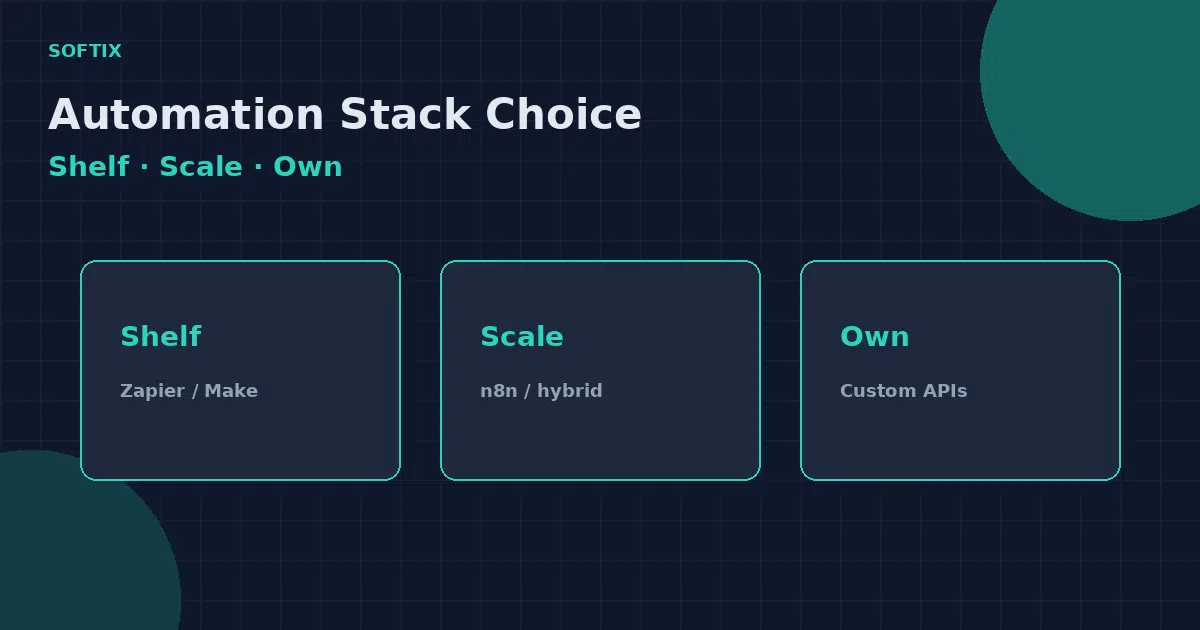
Every US SMB eventually hits the same fork: keep stitching SaaS tools with Zapier or Make, move to n8n (cloud or self-hosted), or fund custom API integrations and custom software. For founders and product/ops leads, the useful question is not “Which logo is winning Twitter?” It is: what stays on the Shelf, when do we Scale off per-task pricing, and what must we Own as durable software?
This Softix business-software brief is evergreen and traffic-first. Softix does not invent competitor task prices—re-check each vendor’s live pricing page before you forecast. Secondary 2026 comparisons (NodeSparks, Integer7, and similar) are orientation only.
What each path is good at (2026 shape)
| Path | Strength | Weakness |
|---|---|---|
| Zapier | Fastest no-code; deepest app catalog | Per-task cost climbs at volume; limited deep custom logic |
| Make | Visual branching; often better mid-volume economics | Still vendor-cloud; catalog smaller than Zapier |
| n8n | Code nodes; self-host option; AI/agent-friendly workflows | Needs technical owner; you operate what you host |
| Custom APIs / services | Exact logic, SLAs, data residency, IP you control | Build and maintain cost; slower first Zap |
Most Softix clients run a mix—not a religion.
The Softix Shelf–Scale–Own framework
Shelf — Buy the boring glue when risk and volume are low
Put on the Shelf when:
- The workflow is linear (trigger → 2–5 actions).
- Failure is annoying, not existential (marketing syncs, internal notifications).
- Non-engineers must edit the flow without a deploy.
- You are validating a process before freezing it in code.
Shelf rules Softix insists on: named owner, documented Zap/scenario, no shared personal OAuth on production customers’ money paths, and a quarterly “delete unused Zaps” review.
Scale — Change platform when volume, logic, or data gravity changes
Scale signals:
| Signal | Softix lean |
|---|---|
| Task/ops bill surprises finance | Re-price Make vs n8n vs custom for your real volume |
| Heavy branching / transforms | Make or n8n over pure Zapier |
| Need self-host / residency | n8n self-host or custom |
| AI decisioning inside the flow | n8n or custom agents with containment—see Softix agent guides |
| Vendor missing a niche API | HTTP nodes help; still may need Own |
Scale is a deliberate migration with dual-run—not a weekend rewrite of every Zap.
Own — Build custom integrations when the workflow is the product
Own when:
- The automation is customer-facing or revenue-critical.
- You need multi-tenant tenancy, audit logs, or contractual SLAs.
- Logic spans systems no iPaaS models cleanly (complex ERP, custom billing).
- You want IP and testable services under your repo—not a fragile canvas.
Softix builds Own as maintainable services with observability—not a pile of undocumented scripts. Pair with Softix CRM and SaaS work when the system of record is yours.
Shelf–Scale–Own at a glance
| Gate | Question | Action |
|---|---|---|
| Shelf | Is this low-risk glue? | Zapier/Make with owners and OAuth hygiene |
| Scale | Did volume/logic outgrow Shelf? | Re-platform with dual-run |
| Own | Is the workflow strategic? | Custom APIs/services with tests and SLAs |
A 30-day decision sprint
Days 1–7: inventory top 20 automations; tag Shelf vs candidate Scale/Own; capture monthly task/ops spend from invoices (your numbers).
Days 8–18: pick one Scale candidate (high bill or fragile logic); prototype in Make or n8n; compare failure modes.
Days 19–30: pick one Own candidate if revenue-critical; scope a thin service; leave true Shelf items alone.
Risks and limits
- iPaaS lock-in is real—export docs and keep canonical process descriptions outside the vendor UI.
- Self-hosted n8n shifts security/patch burden to you.
- “AI agents in Zapier” do not retire containment (agent containment).
- Softix will not quote a universal break-even task count—your unit economics differ.
Is this replacing Softix’s Perplexity + QuickBooks MCP post?
No. That post covers a vendor MCP connector decision (Connect–Contain–Custom). This one is the broader automation platform ladder for US SMBs.
Softix CTA
If your Zap history is a second ERP, Softix can run Shelf–Scale–Own on your top workflows and build the Own layer when it is time. Let’s talk.
Cost discipline without fake break-evens
Softix refuses to publish a universal “switch at N tasks” number. Instead, capture three inputs from your books:
- Last 90 days of Zapier/Make/n8n invoices.
- Engineer hours spent babysitting failed Zaps (honest weekly estimate).
- Incident cost when an automation wrong-wrote CRM or billing data.
If (1)+(2)+(3) exceeds the cost of a scoped Own service with tests, Own is rational—even if the Zap “still works.” Finance understands risk-adjusted cost better than logo preference.
Security minimums on every Shelf flow
- Dedicated integration user per system, not a founder’s personal login
- Least-privilege OAuth scopes
- Alert on spike in task volume (compromise or loop)
- Offboarding checklist that disables Zaps when staff leave
- No production secrets in plain email or shared spreadsheets
These apply whether you Shelf, Scale, or Own.
FAQ
Should marketing keep Zapier while engineering runs n8n?
Often yes. Softix Shelf–Scale–Own is per-workflow, not per-company religion. Document the boundary so customer data writes do not live in unsupervised marketing Zaps.
When do MCP connectors change this ladder?
Vendor MCP connectors (see Softix on Perplexity + QuickBooks) are another Shelf/Contain option. They do not erase Own when you need multi-tenant software of record.
Share