
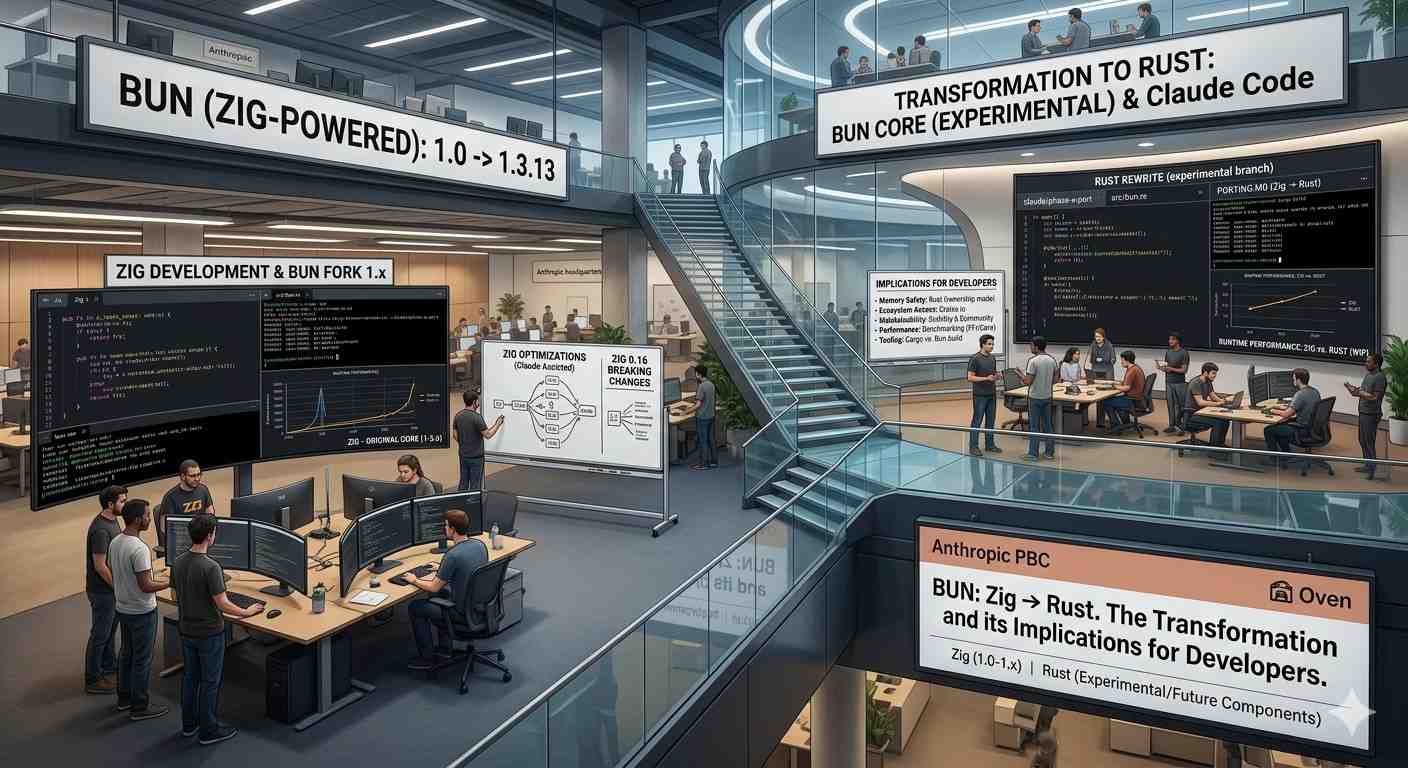
The Genesis of Bun: Performance Through the Lens of Zig
The initial release of Bun in 2022 represented a radical departure from the status quo of JavaScript development. At a time when the ecosystem was fragmented into disparate tools for execution, package management, and bundling, Bun proposed a unified solution. The primary driver for this consolidation was developer experience (DX) and raw performance. Jarred Sumner, the project’s founder, recognized that the overhead of starting multiple processes and serializing data between them was the primary bottleneck in the modern web development loop.
To solve these issues, Sumner chose the Zig programming language. Zig was an unconventional but calculated choice. As a systems language designed to replace C, Zig offers manual memory management without hidden control flow, a feature the Bun team utilized to write highly optimized allocators and parsers. One of the most significant advantages of Zig was its $comptime$ capability the ability to execute code at compile time to generate highly specialized machine code based on the specific requirements of the runtime.
| Language Metric | Zig 0.16 | Rust 1.93 | C++ (V8 Context) |
| Memory Management | Manual / Explicit | Ownership / Borrow Checker | Manual / Smart Pointers |
| Standard Library Maturity | Evolving (Pre-1.0) | Highly Mature | Extremely Mature |
| C/C++ Interoperability | Seamless (Native) | High (via FFI/Bindgen) | Native |
| Compilation Model | DAG-based (0.16) | Incremental / LLVM | Incremental / LLVM |
| Error Handling | First-class / Explicit | Result / Options | Exceptions / Error Codes |
The performance dividends of this choice were immediately evident in Bun’s startup times. By leveraging Apple’s JavaScriptCore (JSC) instead of Google’s V8, Bun avoided the heavy initialization costs associated with the latter. JSC was originally optimized for mobile browsers where battery life and instant responsiveness are paramount. In the context of server-side execution, this translated to “cold start” times that were 4–10x faster than Node.js, a critical metric for serverless and edge computing architectures.
The Anthropic Factor: Bun as the Billion-Dollar Runtime
The trajectory of Bun was fundamentally altered on December 2, 2025, when Anthropic announced its acquisition of the runtime and the Oven team. This acquisition was not merely a corporate consolidation but a strategic move to secure the underlying infrastructure of the AI revolution. Anthropic’s flagship developer tool, Claude Code a terminal-based agentic coding harness had reached a $1 billion annual run-rate revenue within just six months of its public release.
Claude Code relies on Bun to perform high-speed iterations. For an AI agent to be effective, it must be able to write a function, run its test suite, observe the failure, and refactor the code in a matter of milliseconds. Traditional Node.js workflows, with their reliance on slow package installs and transpilation steps, were insufficient for this level of autonomy. Bun’s all-in-one architecture, which integrates a bundler, test runner, and the fastest package manager in the ecosystem, provided the “unprecedented velocity” required for agentic software engineering.
| Throughput Metric | Node.js 24 | Deno 2.7 | Bun 1.3 |
| Express req/sec | ~14,000 | ~29,000 | ~52,000 |
| Native API req/sec | ~45,000 | ~85,000 | ~110,000 |
| Package Install (Medium Project) | ~20s | Varies (Cache-based) | ~1s |
| Cold Start (AWS Lambda) | ~245ms | ~180ms | ~156ms |
Under Anthropic’s stewardship, Bun transitioned from an enthusiast’s performance tool to critical AI infrastructure. This shift brought with it an influx of resources but also a change in roadmap priorities. Development began focusing on features like “agentic hooks” APIs that allow AI agents to more effectively monitor and manipulate the runtime environment—and deep optimizations for high-intensity AI workloads.
The Friction of Innovation: The Zig Upstream Controversy
The decision to migrate from Zig to Rust was not a spontaneous choice but the culmination of a philosophical and technical conflict within the systems programming community. In early 2026, the Bun team attempted to upstream significant improvements to the Zig compiler. These changes, which included parallelizing semantic analysis and optimizing the LLVM backend, were claimed to make Bun’s internal debug builds over 4x faster.
However, the Zig core team, led by Andrew Kelley, rejected the contributions. The reasons cited were both technical and procedural. Technically, the Zig team argued that Bun’s implementation of parallel semantic analysis was “intrinsically incorrect” within the context of Zig’s memory model, leading to non-deterministic compilation errors in approximately 30% of runs. Procedurally, the Zig team had recently implemented a strict “no AI code” policy. Because the Bun team utilized Claude models to assist in the refactoring and optimization of their Zig fork, the contributions were disqualified under these new governance rules.
This conflict highlighted a growing divide in the industry. The Zig team prioritized “correctness” and manual, human-driven reasoning, as seen in Matthew Lugg’s 30,000-line manual refactoring of the Zig dependency graph. In contrast, the Bun team, backed by Anthropic, embraced a “shipping-first” mentality accelerated by AI. This friction eventually made the Bun team feel “unwelcome” in the Zig ecosystem, prompting the search for a more stable and AI-compatible alternative: Rust.
The Rust Migration: A Pivot to the Security Mandate
The transition to Rust, documented in the claude/phase-a-port branch of the Bun repository, represents one of the largest automated code migrations in history. The port involved moving approximately 770,000 lines of code across 1,600 files from Zig to Rust. This move was driven by more than just interpersonal friction; it was a pragmatic response to the changing security landscape of 2026.
By mid-2026, memory safety had transitioned from a “best practice” to a “mandate.” Regulatory bodies like CISA began requiring that critical infrastructure be written in memory-safe languages to mitigate the 70% of vulnerabilities stemming from buffer overflows and use-after-free errors. Rust’s ownership model and borrow checker provided the formal guarantees that Zig’s manual memory management could not easily replicate at scale.
Furthermore, the Rust ecosystem offered a level of stability and tooling maturity that was essential for an enterprise-backed project. The availability of mature libraries (crates) for networking, cryptography, and database drivers allowed the Bun team to focus on the runtime’s core logic rather than reinventing foundational components. This shift also aligned Bun with the broader movement in the JavaScript ecosystem, where core tools like Rspack, Rolldown, and Oxc were already being reconstructed in Rust to eliminate the bottlenecks of legacy Node.js infrastructure.
Vibe Coding: The Methodology of the Future
The Bun-to-Rust migration served as a high-profile validation of “Vibe Coding.” This methodology, named “Word of the Year” in 2025, describes the process of using natural language prompts and AI agents to build, refactor, and maintain complex software systems. Adoption has reached near-total penetration in 2026, with 92% of U.S. developers now using AI coding tools daily. In the case of Bun, the migration was handled by a “coordinator” AI that read the original Zig source, mapped it to equivalent Rust abstractions, and managed the translation of a massive test suite to ensure functional parity.
| Development Phase | Traditional Engineering | Vibe Coding (2026) |
| Initialization | Manual Architecture Design | Natural Language Prompting |
| Implementation | Code Authored by Human | AI-Generated Drafts / Refinements |
| Debugging | Manual Tracing / Profiling | AI-Assisted Log Analysis / Fixes |
| Documentation | Written Post-Hoc | Auto-Generated from Source |
| Maintenance | High Manual Overhead | Automated “Vibe Cleaning” |
While Vibe Coding allowed for a migration speed that would have been impossible for a human team (porting 770k lines in months rather than years), it introduced new classes of technical debt. Critics in the community pointed to “hallucinations” in critical unsafe blocks and argued that the resulting code might be “unmaintainable spaghetti” for human engineers. This has led to the emergence of “Vibe Coding Cleaners” senior systems engineers whose primary role is to audit and sanitize AI-generated codebases for safety and performance.
Performance Analysis: Synthetic Triumphs vs. Production Realities
The “Runtime Wars” of 2026 have moved beyond simple “Hello World” benchmarks toward a more nuanced understanding of performance. While Bun remains the champion of synthetic benchmarks, real-world applications tell a more complex story.
The Real-World Convergence
When testing actual applications with database connections, business logic, and third-party integrations, the performance gap between Bun, Deno, and Node.js often collapses. For example, in an Express-based workload with a Postgres backend, all three runtimes typically deliver approximately 12,000 requests per second. The 2.4x performance advantage Bun enjoys in “raw” tests disappears because the primary bottleneck shifts to I/O wait times and serialization overhead at the database driver level.
However, Bun’s performance wins in “cold” scenarios remain transformative. In serverless environments like AWS Lambda, Bun’s startup times of 156ms (vs Node’s 245ms) translate directly into lower compute bills and improved user experience. This makes Bun the superior choice for ephemeral workloads and microservices that must scale rapidly in response to traffic spikes.
Tooling Consolidation and CI/CD Gains
The most tangible benefit for developers switching to Bun is the simplification of the toolchain. By combining the runtime, package manager, bundler, and test runner into a single binary, Bun eliminates “configuration hell” and dependency sprawl.
| Tool Category | Legacy Node.js Stack | Bun 1.3 Alternative |
| Package Manager | npm / yarn / pnpm | bun install |
| Bundler | Webpack / Vite / esbuild | bun build |
| Test Runner | Jest / Vitest | bun test |
| Transpiler | Babel / tsc / ts-node | Native bun execution |
| Hot Reloading | nodemon | bun --hot |
These gains are particularly noticeable in CI/CD pipelines. A medium-sized React project that takes 18 seconds to install dependencies on npm can be completed in 2 seconds with Bun. For large-scale enterprises with thousands of builds per day, these “seconds” compound into significant cost savings and faster release cycles.
Stability and the “Production Paradox”
Despite its performance credentials, Bun’s maturity remains a point of contention among senior developers in 2026. The project maintains a “commit first, debug later” strategy to keep pace with the rapidly evolving Node.js ecosystem, resulting in a staggering 4,800 open issues on its GitHub repository.
The Memory Management Challenge
One of the most frequent complaints in production environments involves memory leaks and Resident Set Size (RSS) growth. Reports from 2026 highlight a specific memory leak in Bun’s HTTP model that causes RSS to rise by 8 to 12 MB per hour even when the application is idle. These issues often only surface in long-running workloads, leading to the “Production Paradox”: a runtime can be significantly faster than Node.js in a 60-second benchmark but slower and less reliable over a 24-hour deployment cycle.
Node.js Compatibility and Native Modules
While Bun achieves ~98% compatibility with Node.js APIs, the remaining 2% represents a significant hurdle for legacy migrations. Native C++ modules compiled with node-gyp such as legacy versions of bcrypt or sharp often fail in the Bun environment. Teams at The Softix and other professional agencies must conduct rigorous dependency audits before recommending a total switch from Node.js, particularly for mission-critical enterprise systems that rely on stable LTS releases.
Security and the Claude Code Source Leak: A Case Study in Risk
The dangers of the “all-in-one” and “default-on” philosophy were laid bare in the Claude Code source leak incident of March 31, 2026. An accidental packaging error in the @anthropic-ai/claude-code npm package resulted in the exposure of approximately 512,000 lines of original TypeScript code.
The root cause of the exposure was Bun’s default behavior of generating full source maps unless explicitly disabled. A single missing line in the .npmignore file allowed a 59.8 MB .map file to be published, which contained the entire unobfuscated source tree hosted on Anthropic’s cloud storage. This incident highlighted two critical 2026 security trends:
- Toolchain Sensitivity: The behavior of the build tool (Bun) can have catastrophic security implications if its defaults are not understood by the release team.
- Rapid Exploitation: Within 24 hours of the leak, threat actors had already created thousands of malicious forks on GitHub, seeding them with “Vidar” and “GhostSocks” malware disguised as the leaked source code.
For developers, this serves as a reminder that the speed and convenience provided by Bun must be balanced with traditional security rigors, such as zero-trust architecture and rigorous auditing of build artifacts.
The Strategic Implications for The Softix and Digital Agencies
For a full-service software development company like The Softix, the transformation of Bun from a performance-focused runtime to an AI infrastructure cornerstone has direct implications for service delivery and technical strategy.
Custom Software and saas-development
In the context of web app development and saas-development, the choice of Bun can significantly reduce operational costs. The 30–40% lower memory usage at idle compared to Node.js allows for higher container density on cloud platforms, reducing infrastructure overhead. Furthermore, Bun’s built-in support for the Prompt API and local LLM execution (such as Gemini Nano) enables the development of “private-first” AI features that process sensitive user data locally on the device rather than in the cloud.
Custom wordpress development and Web Design
While WordPress remains PHP-based, the surrounding ecosystem of frontend build tools is being swept up in the Bun/Rust revolution. Using Bun for custom wordpress development allows for near-instant hot reloading and significantly faster asset bundling compared to traditional Webpack-based workflows. This improves developer velocity and allows agencies to deliver high-quality, performance-optimized websites with shorter turnaround times.
SEO and Marketing Optimization
The performance of the runtime has a direct impact on Core Web Vitals, which remain a primary ranking factor in 2026. Bun’s superior server-side rendering (SSR) speeds for frameworks like Next.js and Elysia contribute to lower Time to First Byte (TTFB) and improved First Contentful Paint (FCP) scores. Agencies offering SEO services must now account for the runtime environment as a critical component of technical SEO, recommending high-performance stacks that combine Bun’s speed with Rust-based build tools like Rolldown.
Architectural Forecast: The Roadmap to 2027
As Bun continues its migration to Rust, the long-term outlook for the JavaScript ecosystem is one of “Stable Pluralism.” The era of a single dominant runtime (Node.js) has been replaced by a triad of specialized options: Node for stability, Deno for security, and Bun for performance and AI.
The next frontier for Bun involves deep integration with the “Agentic Workplace.” We can expect to see features such as native support for autonomous background daemons (inspired by the leaked KAIROS project) and “Coordinator” modes that allow multiple AI agents to collaborate within a single runtime instance. Furthermore, the stabilization of the Rust core will likely address the persistent memory leaks and segmentation faults that have hindered Bun’s adoption in “mission-critical” enterprise backends.
Conclusion: Navigating the New Performance Paradigm
The transformation of Bun from Zig to Rust is more than a technical footnote; it is a signal of the maturation of the AI-driven development era. For developers, the implications are clear: performance is no longer an optional luxury but a fundamental requirement for the next generation of agentic software. However, this speed must be tempered with an understanding of the underlying architectural shifts.
The migration to Rust addresses the critical need for memory safety and enterprise stability, while the embrace of Vibe Coding reveals a future where the distinction between “writing code” and “prompting code” becomes increasingly blurred. For agencies like The Softix, staying at the forefront of this transition means leveraging the speed of Bun for rapid prototyping and AI integration while maintaining the rigorous engineering standards required to protect clients from the security and stability risks of a rapidly evolving ecosystem. In the world of 2026, the successful developer is not the one who chooses the “fastest” tool, but the one who builds a resilient architecture capable of harnessing speed without compromising on the foundations of trust and reliability.
Share