
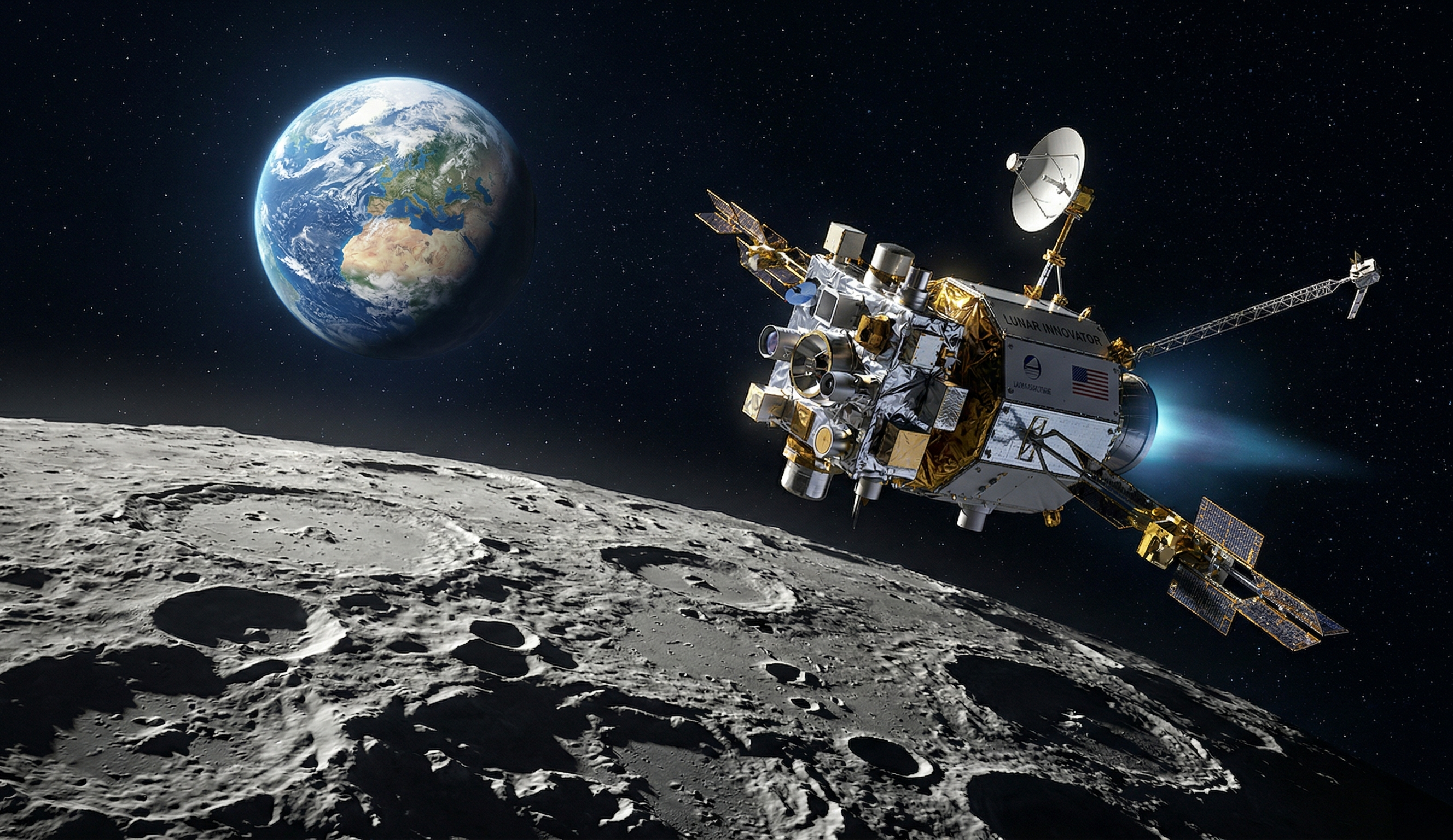
The successful execution of the Artemis II mission on April 1, 2026, represents a definitive pivot in the human approach to deep-space exploration. This mission, carrying four astronauts on a ten-day high-altitude lunar flyby, serves as the ultimate validation of the Space Launch System (SLS) and the Orion spacecraft’s ability to sustain life in the harsh radiation environment of cislunar space. Unlike the Apollo missions of the 20th century, which were characterized by bespoke, isolated hardware, the modern lunar frontier is powered by an integrated ecosystem of commercial-off-the-shelf (COTS) logic, advanced artificial intelligence, and high-bandwidth communication architectures that mirror the most resilient digital platforms on Earth. The complexity of these missions necessitates a sophisticated synthesis of hardware reliability and software agility, where the physical constraints of orbital mechanics are managed through the lens of modern computational efficiency.
Visualizing the Cosmos through Digital Precision
To facilitate the interpretation of these multi-domain datasets, advanced Custom Website Design serves as the critical interface through which researchers and the public engage with the raw mission telemetry, ensuring that high-density scientific information is rendered with clarity and interactive depth. The current era of space exploration produces data streams of unprecedented volume and variety, ranging from 4K ultra-high-definition video feeds to sub-millisecond telemetry from thousands of spacecraft sensors. Traditional methods of data presentation are no longer sufficient to meet the needs of a global scientific community that requires real-time access to these findings. Consequently, agencies have turned to cutting-edge web technologies like WebGL 2.0 and WebGPU, which allow for hardware-accelerated 3D visualizations directly within a browser environment, enabling researchers to manipulate lunar terrain maps or simulate docking procedures with near-zero latency.
The psychological dimension of data interpretation is equally prioritized through the application of Gestalt principles similarity, proximity, and continuity to mission control interfaces. By organizing disparate data points into coherent visual structures, these designs reduce the cognitive load on operators who must monitor the spacecraft’s health during high-stakes maneuvers like the outbound correction burns or the critical reentry phase. For instance, during the Artemis I mission, the unexpected erosion of the Orion heat shield was identified and analyzed through visual trend analysis that highlighted anomalies in thermal sensor data, a process that would have been significantly faster without high-fidelity visualization tools. Furthermore, the move toward “silent deployment” of updates to web-based scientific portals ensures that as datasets grow, the software infrastructure scales invisibly, maintaining performance even as millions of global users track mission milestones in real-time.
The Modular Foundation of Mission-Critical Software
The integration of custom wordpress development services allows for a modular, secure, and highly scalable documentation and media management system that supports the complex needs of modern space agencies, proving that open-source flexibility can meet the most stringent engineering standards. Organizations such as NASA have increasingly adopted WordPress to manage their expansive digital presence, leveraging its “Multisite” capabilities to centralize governance over hundreds of departmental sites while maintaining brand consistency and ironclad security. This shift toward modular content management reflects a broader trend in aerospace software: the transition from monolithic, rigid systems to a “Space-Based Architecture” (SBA). In this paradigm, applications are constructed from self-sufficient processing units (PU) that operate independently, allowing mission-critical systems to scale horizontally and handle sudden spikes in telemetry processing without risking a total system failure.
The logic of decoupling and statelessness, foundational to both custom wordpress development services and deep-space software, ensures that if an individual service malfunctions such as the sporadic life-support issues reported during the Artemis II flyby—the primary navigation and vital functions remain unaffected. This “design for failure” philosophy assumes that hardware and software will inevitably encounter issues in the unpredictable lunar environment, requiring the system to “degrade gracefully” rather than fail catastrophically. By implementing circuit breakers and bulkheads within the code, engineers can isolate faulty modules, such as a localized radiation-induced memory error, while maintaining the overall integrity of the mission. This maturation of software engineering in space is further supported by the use of “Event-Driven Architecture,” where asynchronous communication allows rovers and satellites to react to environmental hazards in real-time without constant, latency-heavy coordination with Earth-based controllers.
Connectivity Protocols and the Lunar 5G Infrastructure
The deployment of a robust lunar network is foundational to modern wordpress website development logic, where high service availability and network scalability are paramount for real-time data ingestion and the support of a growing number of interconnected lunar devices. As NASA and its international partners transition from isolated flybys to a permanent surface presence, the need for an interoperable communications and navigation (C&N) infrastructure, known as LunaNet, has become critical. This architecture leverages the same principles as terrestrial 5G networks, utilizing a node-based system to provide machine-to-machine (M2M) communication, precise positioning, and high-speed data transfer. The challenge lies in the lunar terrain, specifically at the South Pole, where statically charged regolith can interfere with signals and the mountainous topography creates significant shadows in coverage.
In response to these challenges, projects like the Lunar LTE Studies (LunarLiTES) have been conducting extensive field tests in emulated lunar environments to refine the deployment of 5G antennas. The use of millimeter-wave (mmWave) technology provides the high throughput necessary for streaming scientific data, while sub-6 GHz bands offer the resilience needed for long-range connectivity in rural or obstructed areas. This dual-layer approach mirrors the architectural decisions made in wordpress website development, where front-end responsiveness is balanced with back-end stability. By treating each lunar rover, lander, and habitat as an individual node in a massive, scalable network, mission designers can ensure that scientific yield is maximized through the use of edge computing. This allows data to be pre-processed on-site, reducing the volume of information that must be backhauled to Earth via the limited bandwidth of traditional radio frequency links.
Autonomous Navigation through AI and Sensor Fusion
The transition to the lunar frontier is significantly accelerated by the integration of Artificial Intelligence (AI) into the core of spacecraft navigation systems. Due to the inherent 1.3-second light-speed delay between the Earth and the Moon, direct manual control is increasingly impractical for complex maneuvers. AI-driven autonomous navigation systems allow vehicles to independently analyze their surroundings, detect obstacles, and plan safe routes in real-time. These systems rely on a combination of computer vision and LiDAR (Light Detection and Ranging) sensors to build detailed maps of the immediate environment, a process known as Simultaneous Localization and Mapping (SLAM).
At the heart of this technology is the “Sensor Fusion” algorithm, which synthesizes data from multiple sources star trackers, gyroscopes, and surface cameras to maintain precise orientation and location in environments where GPS does not exist. This capability was pioneered by the Perseverance rover on Mars, which utilized its AutoNav system to navigate 88% of its journey autonomously, and it is now being adapted for the high-velocity requirements of lunar landing and flyby missions. For the Artemis program, the use of reinforcement learning (RL) controllers allows spacecraft to compute continuous control actions that optimize for multiple objectives simultaneously, such as minimizing travel time while maximizing energy efficiency and avoiding collision hazards.
The onboard processing of these massive sensor datasets is enabled by radiation-mitigated, high-performance computers. These systems utilize edge computing to make navigation decisions locally, which is essential during communication blackouts or high-latency periods. The implication of this autonomy is a shift in the role of human operators from active pilots to mission managers, who oversee the AI’s decision-making process through high-bandwidth telemetry links. This shift not only increases safety but also significantly reduces the operational costs of long-duration missions by minimizing the need for large, round-the-clock teams of human navigators.
Strategic Reconfiguration: The Shift from Gateway to Surface Base
On March 24, 2026, NASA executed a structural shift in its lunar strategy by officially shelving the Lunar Gateway program. Initially conceived as an orbital space station that would serve as a “way station” for missions to the surface, the Gateway was reassessed due to budget constraints, the desire for faster surface deployment, and the intensifying geopolitical competition. This “strategic simplification” redirected approximately $20 billion toward the development of a permanent lunar surface presence, prioritizing the establishment of a base at the South Pole over the long-term maintenance of an orbital platform. This decision reflects a geopolitical logic where the United States seeks to secure a leading position in lunar surface operations, offering stronger strategic signaling than an orbital station could provide.
The cancellation of the Gateway has profound implications for the Artemis timeline and international partnerships. Artemis III, once intended as the first crewed landing of the 21st century, was redesigned as an orbital mission focused on docking tests, with the first landing now targeted for Artemis IV in 2028. While this change introduces alliance-management challenges for international partners, NASA intends to repurpose Gateway technologies such as habitation and power modules—to support surface-based infrastructure or upcoming Mars missions. By removing the intermediate orbital layer, NASA is moving toward more direct mission profiles, relying more heavily on commercial landers.
This pivot also signals a transition to a “customer-based” model for NASA, where the agency will increasingly procure services from private companies for missions beyond Artemis VI. This strategy is designed to foster a competitive commercial ecosystem, making lunar access more affordable and sustainable in the long term. The repurposing of hardware, such as converting an orbital module into a core for upcoming Mars explorations, demonstrates a pragmatic approach to capital investment, ensuring that the billions spent in previous years are redirected toward the most immediate strategic goals.
Starship HLS: The Power of Scale and In-Space Refilling
The cornerstone of the new surface-first lunar strategy is the SpaceX Starship Human Landing System (HLS). Starship represents a paradigm shift in spacecraft design, moving away from the small, disposable capsules of the past to a fully reusable, heavy-lift architecture capable of carrying over 100 tons of cargo to the lunar surface. The vehicle’s massive internal volume over 600 cubic meters provides more habitable space than any previous lunar mission, effectively serving as a mobile base for astronauts during extended stays. This capacity is essential for delivering the building blocks of a permanent presence, such as habitats, rovers, and scientific laboratories, which would be impossible to launch using traditional rockets.
A critical innovation that enables Starship’s lunar mission is “In-Space Refilling”. Because launching a fully fueled Starship from Earth’s deep gravity well is energetically prohibitive, the vehicle will launch with only a partial load and rendezvous with a propellant depot in low Earth orbit. Tanker variants of Starship will then deliver propellant to these depots, allowing the HLS to depart for the Moon with a full tank. This maneuver overcomes the historical limitations of payload mass, allowing for a dramatic increase in the amount of equipment that can be delivered to the lunar surface.
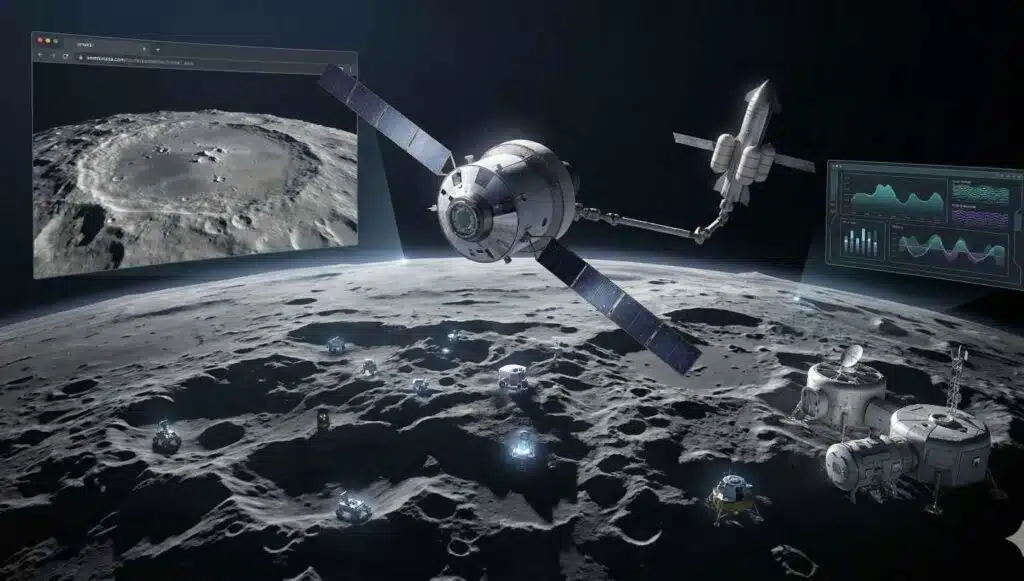
The efficiency of this approach allows Starship to deliver approximately 100 times more payload to the Moon than the Apollo Lunar Module could achieve. Starship’s landing variant is also thermally optimized to limit propellant “boiloff” during the transit and while on the lunar surface, a crucial technical challenge for long-duration missions where cryogenic fuels must remain liquid for weeks or months. Furthermore, the lander’s dual airlocks are larger than the entire habitable volume of the Apollo lander, providing the crew with unparalleled operational flexibility for moonwalks and surface experiments. At a projected cost of $100 million per metric ton of cargo delivered by 2028, Starship is poised to become the primary logistical engine of the next frontier.
Advanced Propulsion: The Move Toward Nuclear Energy
While current missions like Artemis II rely on refined chemical propulsion specifically the liquid oxygen and liquid hydrogen used by the SLS and the RS-25 engines the long-term viability of deep-space exploration depends on the transition to nuclear propulsion. Chemical rockets are limited by the energy density of their fuel, which makes interplanetary travel slow and mass-intensive. Nuclear Thermal Propulsion (NTP) and Nuclear Electric Propulsion (NEP) offer a solution by providing significantly higher efficiency, allowing for faster travel times and reduced exposure to cosmic radiation.
NTP systems use a nuclear reactor to heat a lightweight propellant, typically liquid hydrogen, to extreme temperatures, resulting in an efficiency that is roughly double that of the best chemical engines. This higher performance is critical for missions beyond the Moon, such as the upcoming human exploration of Mars, where travel duration is a primary risk factor for crew health. In tandem with propulsion, aerospace leaders are developing Fission Surface Power (FSP) to provide a sustained energy source for lunar bases. Unlike solar power, which is intermittent due to the long lunar night, a compact fission reactor can generate electricity continuously for years. This “always-on” power is critical for life-support systems, resource mining, and maintaining the stability of sensitive scientific instruments in the extreme cold.
Resilience and Fault Tolerance in Digital Operations
The software that powers a lunar flyby must be even more resilient than the hardware it controls. In the vacuum of space, digital systems are subject to “bit flips” and other radiation-induced errors that can crash conventional software. To mitigate these risks, space-based software is designed using the principles of fault tolerance and high availability. Fault tolerance emphasizes maintaining continuous operation during unexpected failures, while high availability ensures that services remain accessible even during maintenance or minor disruptions.
A common strategy in aerospace is the use of “bulkheads” isolating different parts of a system so that a failure in one does not cascade through the entire architecture. This is combined with “circuit breakers,” which automatically shut down a failing service to prevent it from overwhelming the rest of the system. This philosophy of “failing smart” is essential for missions like Artemis II, where the crew depends on the spacecraft’s computers for every aspect of their survival, from oxygen regulation to the precision timing of reentry burns. For space flight, critical systems like the Orion Flight Computer are designed for full fault tolerance, often using triple-modular redundancy where separate processors perform the same calculation and “vote” on the correct answer.
The 2026 Space Economy: Industrialization and Sovereignty
The innovations powering lunar flybys are driving a broader economic transformation known as the “industrialization of space”. As of 2026, the focus has shifted from mere “access to orbit” to the ability to design, deploy, and operate complex systems in a sustained and sovereign manner. This is evident in the reorganization of satellite manufacturing toward “proliferated architectures,” where large constellations of small satellites provide resilient global connectivity and data services. These constellations serve as critical infrastructure, not only for Earth-based internet but as the backbone for the deep-space communications network.
“Technological Sovereignty” has emerged as a strategic requirement for space-faring nations. Having in-house capabilities in key technologies from rad-hardened processors to secure communication protocols is essential for ensuring national security and operational continuity in the face of geopolitical tensions. In the United States, established aerospace firms are scaling these proliferated architectures to support secure communications and missile defense. Meanwhile, the “Direct-to-Device” (D2D) revolution is embedding satellite networks directly into terrestrial telecom ecosystems, allowing seamless communication across planetary boundaries.
Future Outlook: From Flybys to Surface Civilization
The technological trajectory established by the Artemis II flyby leads directly to the construction of a permanent human presence on the Moon and, eventually, a mission to Mars. The shift from an orbital station to a $20 billion surface base represents a commitment to exploring the lunar South Pole, where the presence of water ice could provide the resources needed for rocket fuel and life support. This “Moon-to-Mars” strategy uses the lunar surface as a laboratory to test the autonomous AI, nuclear propulsion, and long-term habitation systems required for the multi-year journey to the Red Planet.
As space technology continues to advance, the distinction between “aerospace” and “digital” continues to blur. The innovations that power a lunar flyby from the interactive visualizations that render mission data to the 5G networks that connect lunar rovers are the same technologies that drive innovation on Earth. By adopting the modular, resilient logic of the modern web and leveraging commercial partnerships, space agencies are ensuring that the return to the Moon is not a singular achievement, but the foundation for a sustainable space-faring civilization. The success of Artemis II on April 1, 2026, is thus not just a milestone in flight, but a testament to the power of integrated digital and physical innovation in the next frontier.
Share