
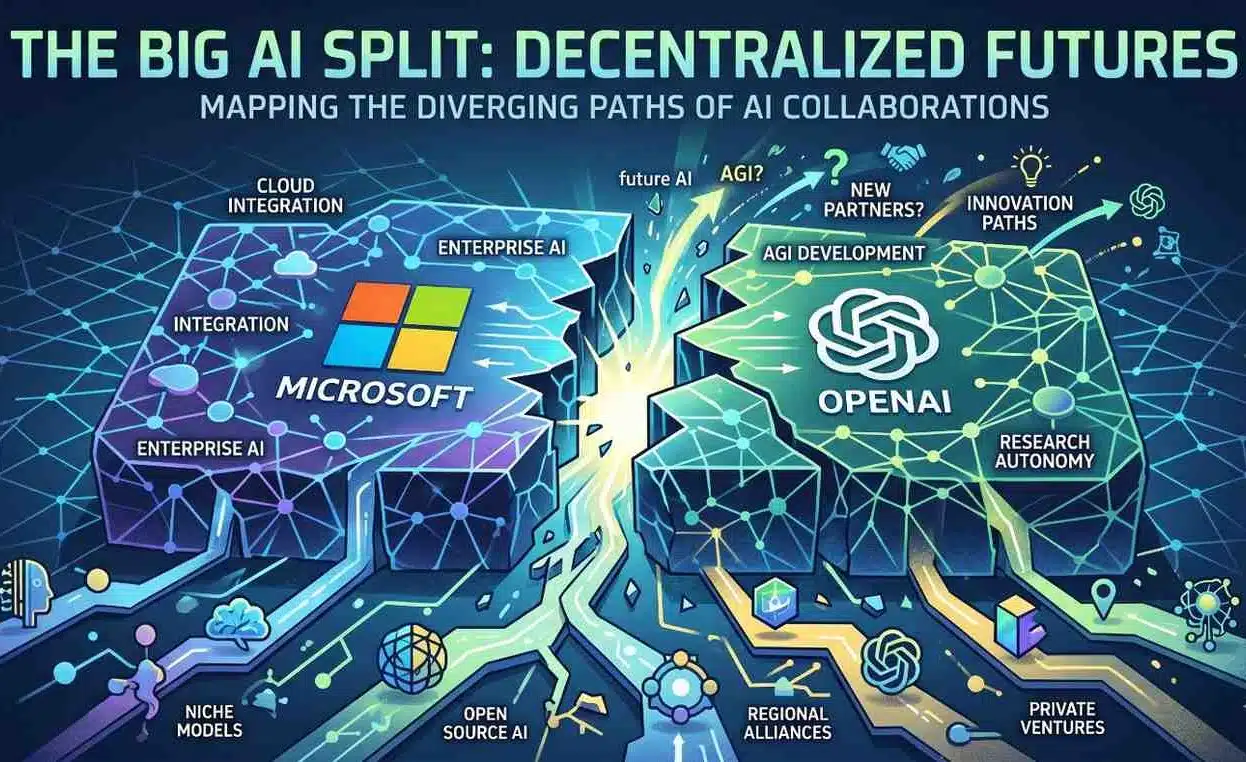
The formal restructuring of the partnership between Microsoft and OpenAI, finalized on April 27, 2026, marks the definitive end of the initial era of intelligence exclusivity and the commencement of a more fragmented, competitive, and infrastructure-heavy phase in the global technology market. This realignment is not a total dissolution but rather a strategic “bifurcation” where both entities have acknowledged that their long-term growth trajectories require greater operational autonomy and diversified cloud dependencies. While Microsoft remains the primary cloud provider and a major shareholder with an equity stake exceeding $135 billion, the removal of the exclusive licensing and cloud hosting clauses fundamentally alters the competitive dynamics for enterprises, developers, and global infrastructure providers.
The Formal Deconstruction of the Exclusive Alliance
The April 2026 amendment represents the most significant shift in the commercial relationship between Redmond and San Francisco since Microsoft’s foundational investment in 2019. At its core, the revised agreement dismantles the “Azure-only” monopoly that previously governed OpenAI’s model distribution. Under the new terms, OpenAI is explicitly permitted to serve its entire product suite to customers across any cloud provider, including competitors such as Amazon Web Services (AWS) and Google Cloud. In exchange, Microsoft has transitioned its exclusive intellectual property license to a non-exclusive format, which remains valid through 2032.
The financial mechanics of the deal have also been overhauled to reflect a maturing market where gross margins on intelligence services are under heavy scrutiny. Microsoft will no longer pay a revenue share to OpenAI for the models integrated into its services, such as Azure OpenAI and Copilot. Conversely, OpenAI’s revenue share payments to Microsoft set at a 20% rate will continue through 2030 but are now subject to a total cap. This financial decoupling allows Microsoft to improve the profitability of its internal products while providing OpenAI with the fiscal certainty needed to pursue its ambitious $750 billion valuation and potential transition to a conventional for-profit corporate structure.
| Contractual Component | Original Terms (Pre-2026) | Amended Terms (Post-April 2026) |
| Cloud Exclusivity | Azure as the sole cloud host for all OpenAI products | Azure as primary; OpenAI free to use any cloud |
| IP Licensing | Exclusive license for Microsoft | Non-exclusive license through 2032 |
| Revenue Sharing (MS) | Outbound payments to OpenAI | Payments terminated |
| Revenue Sharing (OpenAI) | Uncapped payments to Microsoft | Payments capped through 2030 |
| AGI Provisions | Triggered changes upon AGI achievement | Fixed calendar date (2032) regardless of AGI |
Strategic Motivations for Decoupling: Autonomy and Infrastructure
The shift toward a non-exclusive partnership is driven by a mutual recognition that the original deal structure, while successful in launching the current cycle of innovation, had become a bottleneck for both parties. For OpenAI, the dependence on Microsoft’s infrastructure limited its ability to scale horizontally and capture revenue from enterprises heavily invested in AWS or Google Cloud ecosystems. The recent signing of a $38 billion deal with AWS and a $50 billion deal in February 2026 highlights OpenAI’s aggressive pursuit of compute resources outside the Redmond orbit. These deals provide OpenAI with access to hundreds of thousands of Nvidia GPUs and the ability to expand to tens of millions of CPUs for agent-based workloads.
For Microsoft, the revision addresses growing concerns regarding its “structural dependence” on a single research lab for its core product innovation. Satya Nadella’s internal reorganization in March 2026, which placed Mustafa Suleyman in charge of in-house model development, was a clear signal that Microsoft intended to build its own “frontier” systems. By 2026, the competitive landscape had shifted such that model access was no longer a unique advantage; the real battleground had moved to the orchestration layer, data connectors, and the ability to deliver intelligence at a sustainable cost.
Microsoft’s Internal Renaissance: The Pivot Toward Model Autonomy
The transformation of Microsoft’s internal structure in 2026 represents a calculated effort to reclaim the “intelligence stack” from the foundation layer upward. The appointment of Mustafa Suleyman as the lead for the “Superintelligence” mission reflects a shift away from being a mere consumer of third-party research toward becoming a primary producer of state-of-the-art systems. This shift is catalyzed by the realization that AI in tech as a foundational discipline requires vertical integration to optimize both the performance and the financial viability of high-scale products like Microsoft 365 Copilot.
Mustafa Suleyman’s team, which now includes top researchers from the Allen Institute and DeepMind, is focused on building models that can compete directly with the highest-tier offerings in the market while achieving radical efficiencies in inference costs. The release of MAI-Transcribe-1, a speech-to-text system developed by a small team of just ten people, demonstrates this new philosophy: it reportedly provides superior accuracy at half the GPU cost of existing industry standards. Microsoft’s goal is to ensure that its entire product lineup—from Windows and Teams to the more specialized developer tools—can run on a lineage of enterprise-tuned models that are independent of any external provider’s roadmap.
| Microsoft AI Leadership Pillar | Executive Lead | Strategic Focus Area |
| Model Development | Mustafa Suleyman | Frontier models and Superintelligence mission |
| Unified Copilot | Jacob Andreou | Integrating consumer and commercial experiences |
| Copilot Platform | Charles Lamanna | Platform extensibility and developer ecosystem |
| Infrastructure/Quality | Charlie Bell | Quality Excellence Initiative (QEI) and scaling |
| Security | Hayete Gallot | Security Copilot and enterprise governance |
The Strategic Diversification of the Cloud Ecosystem
The transition to a multi-cloud distribution model for advanced intelligence systems has profound implications for the world of website development and enterprise application architecture. As advanced models become available on Amazon Bedrock and other platforms, developers are no longer forced to migrate their entire data estate to Azure to access state-of-the-art reasoning capabilities. This shift allows for a more modular approach to building applications, where intelligence is treated as a component of the broader cloud infrastructure rather than the defining factor of the environment.
The availability of OpenAI’s Codex and other productivity models on AWS Bedrock specifically targets the integration of automated logic into existing software development lifecycles. By 2026, these tools have evolved from simple suggestion engines into “execution layers” capable of taking high-level conceptual ideas and translating them into functional, production-ready code. For organizations managing complex web architectures, the ability to deploy these models within their native cloud tenancy reduces data latency, minimizes egress costs (currently priced around $0.09 per GB on AWS), and simplifies compliance with increasingly stringent regional data sovereignty laws.
OpenAI’s Independent Trajectory: Hardware and Hardware-Free Intelligence
OpenAI’s path in 2026 is defined by a bold expansion into physical products and national-scale infrastructure. The company’s $6.5 billion acquisition of the design firm IO, founded by former Apple designer Jony Ive, signals an intent to move off the screen and into the physical world. The first OpenAI hardware device, expected to launch in the second half of 2026, is rumored to be a wearable or audio-based system that leverages custom 2-nanometer silicon to handle complex tasks locally, bypassing the cloud for many routine interactions. This “edge-first” strategy represents a direct challenge to the traditional cloud-centric model of the past three years.
Simultaneously, OpenAI is participating in massive infrastructure projects that mirror national defense initiatives in their scale and ambition. “Project Stargate,” a joint venture with Oracle, SoftBank, and the White House, aims to invest up to $500 billion in twenty massive data centers across the United States by 2029. This project is a response to the “inference scarcity” that Mustafa Suleyman identified as the defining bottleneck of the 2026 economy. As the industry moves from the training phase to the large-scale real-world deployment phase, the ability to supply the gigawatts of power and millions of chips required for real-time decision-making becomes the ultimate competitive advantage.
| Infrastructure Initiative | Estimated Investment | Key Partners | Objective |
| Project Stargate | $500 Billion | Oracle, SoftBank, MGX | 20 massive US-based data centers |
| AWS Bedrock Deal | $38 Billion | Amazon Web Services | Massive scale for inference workloads |
| IO Acquisition | $6.5 Billion | Jony Ive | Development of first-party hardware |
| Silicon Roadmap | Unspecified | Microsoft, NVIDIA | Custom silicon for 2nm processing |
The Economics of Intelligence: Inference Scarcity and Token Margins
The divergence of the Microsoft-OpenAI partnership is deeply rooted in the changing economics of intelligence delivery. In 2026, the primary challenge is no longer building the “smartest” model, but rather building one that can be run profitably at an immense scale. Inference workloads now consume approximately two-thirds of all intelligence-related compute spending, and GPU lead times have reached nearly a year. This has created a two-tier market where only the products with the highest gross margins can afford to utilize the most advanced models for real-time interactions.
Mustafa Suleyman argues that the industry winners will be those who “nailed the fine-tuning loop” and successfully activated a data flywheel: high-margin products (like legal software or Microsoft 365 Copilot) can pay for premium tokens; those tokens provide lower latency, which drives user retention; high retention generates rich, proprietary data; and that data is used to further refine and optimize the model for specific tasks. This cycle eventually lowers the total cost of ownership (TCO) and creates an insurmountable lead over competitors who are merely using general-purpose models without a feedback loop.
The Rise of Agentic Intelligence and Multi-Agent Orchestration
A significant theme in 2026 is the transition from reactive assistants to autonomous “Agentic Intelligence.” These systems are capable of independent planning, executing multi-step tasks across different software environments, and collaborating with other specialized agents to achieve complex objectives. The autonomous agent market is projected to reach $8.5 billion by late 2026, with long-term forecasts exceeding $35 billion by the end of the decade.
Microsoft’s “Cowork” feature, integrated into the 2026 Copilot suite, is the first major commercial manifestation of this trend. Unlike previous versions that required constant prompting, Cowork can autonomously summarize a week’s worth of meetings, identify action items, draft the necessary emails, and pause only for final user approval before sending. This capability depends on “stateful runtime technology”—co-developed by OpenAI and AWS—which allows agents to maintain memory and context over extended periods and across different platforms.
Sovereignty, Governance, and the New Regulatory Landscape
The decoupling of major intelligence partnerships is also a reaction to the global demand for “Sovereign AI.” Governments and large enterprises are increasingly wary of “black box” public models and are demanding systems that reside within their own jurisdictional and organizational boundaries. The European Union’s AI Act and state-level laws like the Colorado AI Act (effective June 2026) have made governance and auditability operational requirements rather than optional best practices.
In response, the industry is shifting from a “cloud-first” approach to a “strategic hybrid” model. Deloitte predicts that while the cloud will continue to provide elasticity for training, consistency and governance will increasingly be delivered through on-premises systems and edge computing. Microsoft has addressed this through the release of “Azure Local” and “Foundry Local,” which allow organizations to run large multimodal systems in fully air-gapped environments, ensuring that sensitive data never leaves the sovereign boundary.
| Regulatory Milestone | Effective Date | Focus Area |
| EU AI Act (Phase 1) | February 1, 2026 | Governance, transparency, and auditability |
| Colorado AI Act | June 30, 2026 | Consumer protection and bias mitigation |
| Data Residency Expansion | 2025 – 2026 | In-country processing in 15+ nations |
| ISO 42001 Standard | 2026 Adoption | Management system for intelligence ethics |
The Impact on the Professional Workforce and Skills
The restructuring of these major partnerships mirrors a broader reorganization of the global workforce. By 2026, the definition of “talent” has permanently changed, as organizations move toward managing a hybrid workforce where digital agents and human employees operate as co-equal teammates. This has led to the emergence of “Context Engineering” as a critical skill the ability to structure information and define the parameters within which autonomous systems make decisions.
The role of the developer and the information worker is shifting from task execution to orchestration and supervision. In the realm of software engineering, tools like OpenAI Codex are enabling smaller teams to deliver custom applications with significantly lower overhead. This allows “managed intelligence providers” to move beyond traditional technical maintenance and instead focus on delivering business outcomes through the design of intelligent workflows.
Future Outlook: A Modular and Heterogeneous Intelligence Market
The Microsoft-OpenAI “split” of 2026 is not a failure of the partnership but rather a sign of its maturity. The industry has moved beyond the phase of “peak hype” and into a phase characterized by industrialization, optimization, and rigorous ROI scrutiny. Success in this new era is not defined by who has the largest model, but by who can most effectively integrate intelligence into real-world systems and everyday workflows.
For the future of technology collaborations, this means that the era of exclusive, multi-year alliances is likely over, replaced by a more modular and competitive landscape. Enterprises will continue to rely on strong partners but will design their intelligence architectures to be cloud-agnostic and model-flexible. As intelligence becomes an “invisible infrastructure” embedded in every application, the focus will remain on building persistent, sovereign “Corporate Brains” that serve as the single source of truth for an increasingly autonomous global economy.
The divergence of Microsoft and OpenAI allows both companies to pursue their distinct visions: Microsoft as the foundational platform for the enterprise and OpenAI as a ubiquitous, cross-platform intelligence provider. For the rest of the industry, this creates a more open and flexible ecosystem where the benefits of advanced reasoning are no longer locked behind a single gatekeeper but are available to any organization capable of mastering the engineering and economics of this new era.
Inference, Logistics, and the Physical-Digital Convergence
The ultimate realization of the split is seen in the expansion of intelligence into the physical domain, often referred to as “Physical AI” or the “Phygital” frontier. This convergence of machine learning with robotics and the Internet of Things (IoT) represents the next growth area for mid-market companies in manufacturing, logistics, and retail. By embedding intelligence directly into industrial robots, drones, and connected machinery, organizations can achieve “self-healing” systems that resolve issues without human intervention.
This trend is supported by the development of Small Language Models (SLMs) that are optimized for specific industrial tasks and can run on-device or at the edge. This reduces the reliance on a continuous cloud connection, lowering both latency and the risk of operational failure due to external network issues. As these systems become more integrated into the physical infrastructure of the world, the strategic value shifts from the research lab to the engineering firm capable of deploying these systems in high-stakes, real-world environments.
Conclusions and Strategic Recommendations
The realignment of the Microsoft-OpenAI partnership underscores a fundamental shift toward a more mature, competitive, and governed intelligence market. For business leaders and technologists, the following strategic implications are paramount:
- Multi-Cloud Resilience: The end of exclusivity means that organizations should prioritize architectures that are compatible with multiple cloud providers. This reduces vendor lock-in and allows for the optimization of workloads based on cost, latency, and compliance requirements.
- Investment in Data Sovereignty: As the “Corporate Brain” becomes the primary source of competitive advantage, organizations must invest in sovereign data fabrics that ensure their proprietary knowledge remains secure and accessible to their autonomous agents.
- Focus on Inference Efficiency: With inference compute remaining a scarce resource, the selection of models should be driven by “intelligence-per-dollar” metrics. Domain-specific small models often provide a better ROI for targeted enterprise tasks than larger, general-purpose systems.
- Adoption of Agentic Workflows: The transition from reactive chat to proactive orchestration represents the next major leap in productivity. Organizations should begin redesigning their internal processes to incorporate multi-agent systems that can handle complex, multi-step tasks autonomously.
- Governance as a Foundation: Regulatory compliance is no longer an afterthought. Building robust governance platforms that track model performance, bias, and data lineage is essential for scaling intelligence operations in a high-stakes environment.
In conclusion, the events of April 2026 have set the stage for a decade where the power of intelligence is democratized across a broader ecosystem. The competition between Microsoft’s integrated enterprise suite and OpenAI’s multi-cloud, hardware-centric approach will drive rapid innovation, but the true winners will be the organizations that can most effectively harness these tools to transform their operating models and deliver tangible, sustainable value.
Share