
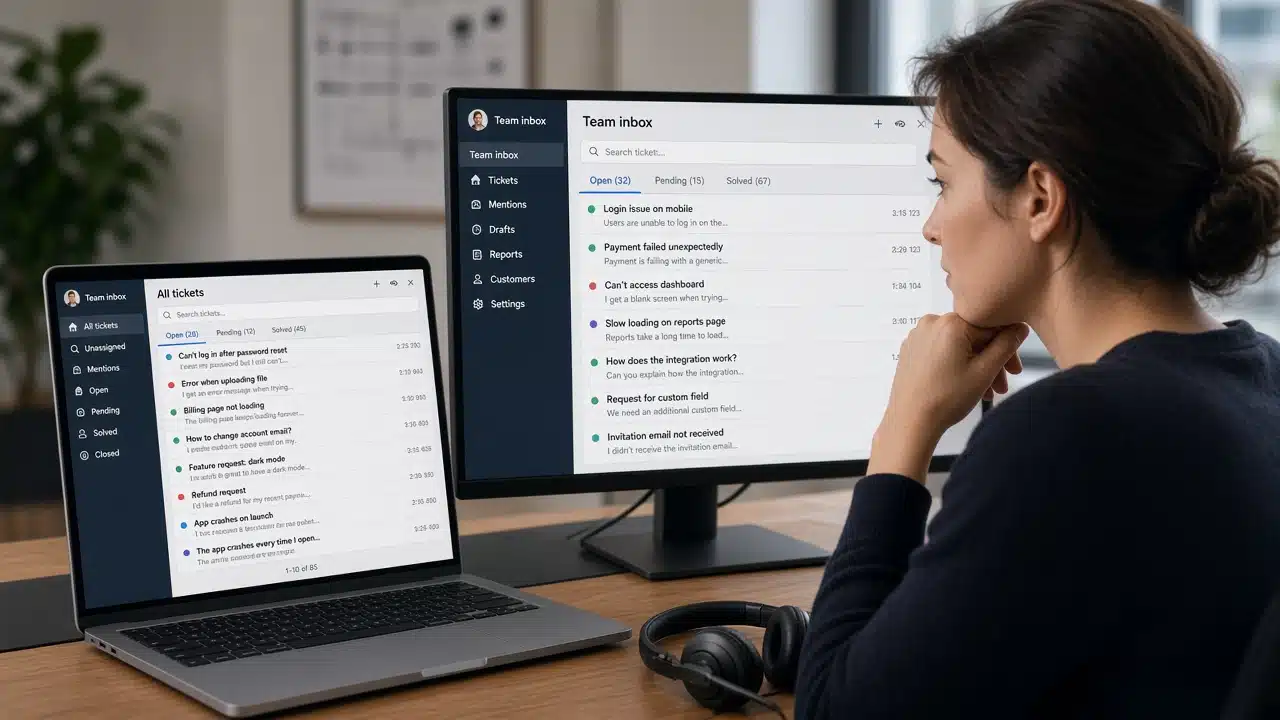
Intercom vs Zendesk for Growing SMBs: Softix Stay–Bridge–Build
Published (planned): September 12, 2026 · Last updated: September 12, 2026 · Author: Softix
Category: Business Software
If you are arguing Intercom vs Zendesk from Twitter screenshots and a single seat price, you will buy the wrong inbox. Intercom vs Zendesk small business is a workflow decision: messaging-first product support versus ticketing-heavy omnichannel operations—plus how AI resolutions are billed. Softix’s Stay–Bridge–Build model helps U.S. SMB founders decide whether to stay on the current tool, bridge with an AI layer, or build custom when support is part of the product.
Facts below come from vendor-published comparison and pricing pages Softix fetched in September 2026, including Intercom’s Intercom vs Zendesk compare page, Zendesk’s Zendesk vs Intercom page, and Intercom’s 2026 platform comparison learning center article. Softix’s Stay–Bridge–Build sequencing is analysis—not an endorsement, and not a quote of your negotiated contract.
Pricing note. Public list prices change. Softix cites vendor-published figures as of the pages above and tells you to re-check before purchase. Softix will not invent discounts.
What each vendor emphasizes (fact vs marketing)
Fact (Intercom compare page). Intercom positions Fin AI Agent and its helpdesk as one platform, states Fin resolves an average of 76% of customer queries at $0.99 per outcome (Intercom’s published claim), and publishes seat pricing alongside outcome pricing. Intercom also states Fin can deploy on an existing Zendesk instance via API.
Fact (Zendesk compare page). Zendesk publishes Support Team and Suite plan list prices (for example Support Team $19/agent/month and Suite Team $55 / Suite Professional $115 on the page Softix fetched) and contrasts Intercom seat tiers (Essential / Advanced / Expert). Zendesk argues for deeper traditional ticketing, omnichannel, and governance; it criticizes Intercom AI add-on economics from Zendesk’s perspective.
Fact (Intercom 2026 comparison article). Intercom’s learning-center table lists Fin AI resolution pricing at $0.99/outcome versus Zendesk figures Intercom lists for verified resolutions, and contrasts base platform seat ranges. Treat competitive tables as vendor-authored—verify on each vendor’s live pricing page.
Softix analysis. Both vendors are selling an AI narrative in 2026. Your job is to map channels (in-app chat, email, phone), SLA needs, and whether support agents live inside the product or a contact center.
Softix Stay–Bridge–Build at a glance
| Softix step | Choose when | Done when |
|---|---|---|
| Stay | Current tool matches channels + reporting; pain is training, not architecture | Written “why we stay” with 12-month cost model from your usage |
| Bridge | Ticketing must remain, but AI resolution is the gap (e.g., Fin on Zendesk per Intercom’s claim) | Pilot with success metrics; no double-agent chaos |
| Build | Support workflows are proprietary product IP or deep ERP/CRM coupling | Build-vs-buy note; see Softix calculator when relevant |
When Build is on the table, Softix’s SMB software build vs buy calculator is a useful internal discussion page—do not invent Softix cost cells if placeholders remain. Softix also ships custom software and integrations under services.
Step 1 — Stay: score fit before brand loyalty
Softix Stay scorecard (analysis)
- Channels — in-app messenger vs email/voice/ticket volume.
- Operations — SLAs, skills routing, multi-brand, sandbox, QA/WFM needs (Zendesk often stronger for classic contact-center ops per its positioning).
- Product adjacency — tours, proactive messages, product-led growth loops (Intercom often stronger per its positioning).
- AI economics — model total cost: seats + per-resolution/outcome fees + add-ons. Re-check live pricing.
- Admin load — who owns macros, intents, and knowledge base freshness?
If Stay scores high, stop shopping. Migration tax is real.
Step 2 — Bridge: AI overlay without ripping the inbox
Fact (Intercom). Intercom states Fin can run on Zendesk without a full migration.
Softix Bridge rules (analysis)
- One system of record for tickets/conversations—avoid dual inboxes without a sync rule.
- Pilot on a single language or product line; measure deflection and CSAT, not only resolution marketing stats.
- Gate write actions (refunds, account changes) behind human approval in early pilots.
- Document data processing / subprocessors before connecting production CRM fields.
Step 3 — Build: when the inbox is not the product
Softix analysis. Build (or heavily customize via APIs) when:
- Your support flow is the workflow product (marketplaces, clinics, field service).
- You need embed UX inside a Softix web app or mobile app that neither vendor fits.
- Compliance forces data residency or audit trails beyond SaaS defaults.
Build does not mean rewriting email. It means owning the orchestration and keeping Zendesk/Intercom—or neither—as a channel endpoint.
30-day Stay–Bridge–Build plan
| Week | Focus | Done when |
|---|---|---|
| 1 | Stay score | Channel + SLA + AI cost worksheet from live vendor pages |
| 2 | Bridge pilot design | Success metrics; data map; owner |
| 3 | Pilot or Stay confirm | Go/no-go with finance sign-off on usage math |
| 4 | Build decision | If Build, scope MVP integrations only—no boil-the-ocean CRM rewrite |
Limits and honesty checks
- Vendor stats are vendor stats. Softix repeats Intercom’s 76% / $0.99 claims as Intercom’s published figures—not Softix measurements.
- List price ≠ invoice. Annual vs monthly, AI overages, and add-ons dominate.
- Not which CRM to buy. Support tooling ≠ Salesforce/HubSpot choice.
FAQ
Is Intercom always better for SaaS?
Often for messaging-first product teams—but not if you need deep phone/SLA contact-center controls Zendesk emphasizes. Score Stay first.
When does Softix recommend Build?
When support orchestration is proprietary and off-the-shelf seats become an integration tax every sprint.
Channel map Softix forces before demos
Before Softix watches a vendor demo, we ask founders to map last month’s volume by channel: in-app chat, email, phone, social, WhatsApp, and internal employee IT if shared. Intercom’s messaging strength and Zendesk’s omnichannel/ticketing strength only matter relative to that map.
Softix analysis. A product-led B2B SaaS with 80% in-app questions scores differently than a multi-location services business with phone SLAs. Stay–Bridge–Build without a channel map is brand shopping.
AI billing Softix models carefully
Both ecosystems now price AI in ways that can dwarf seats. Softix’s worksheet columns are: seats, included AI resolutions/outcomes, overage unit price, mandatory add-ons (copilot, QA, WFM), and implementation services. Softix copies numbers only from live vendor pages at decision time—figures mentioned earlier in this article were fetched September 2026 and may change.
Softix judgment. Finance should sign the usage math, not only marketing’s “AI will deflect 50%” hope. Softix invents no deflection guarantees.
Integration reality for Softix customers
Support tools sit next to CRM and billing. Softix’s recent HubSpot–Salesforce work is a reminder that sync ownership matters; the same Map–Gate–Monitor discipline applies when Zendesk or Intercom becomes another system of engagement. Softix services and custom software teams often Bridge by API rather than ripping inboxes mid-quarter.
If Build wins, Softix may keep Zendesk/Intercom as a channel while a Softix web app owns domain workflows—especially when the Softix build vs buy calculator discussion shows off-the-shelf seats cannot express the process. Softix will not fill invented cost placeholders on that page.
Migration tax Softix budgets
Leaving either vendor means macros, historical tickets, CSAT exports, help-center redirects, and agent retraining. Softix Stay exists because that tax is frequently higher than another year of imperfect fit. Bridge exists because AI overlays can buy time. Build exists when the tax of fitting a generic inbox exceeds the cost of owning orchestration.
Softix workshop agenda (half day)
- Channel + SLA map.
- Live pricing worksheet (both vendors).
- Stay scorecard vote.
- Bridge pilot design or Stay confirmation.
- Build spike list (only if Stay/Bridge fail).
Next step
If you want Softix to facilitate a Stay–Bridge–Build workshop—or to integrate / replace pieces of your support stack—talk to Softix. Softix · Building 41, Johar Town, Lahore · +92 332 6444418. Bring last month’s ticket volume and channel mix; we will not start from a brand preference.
Share