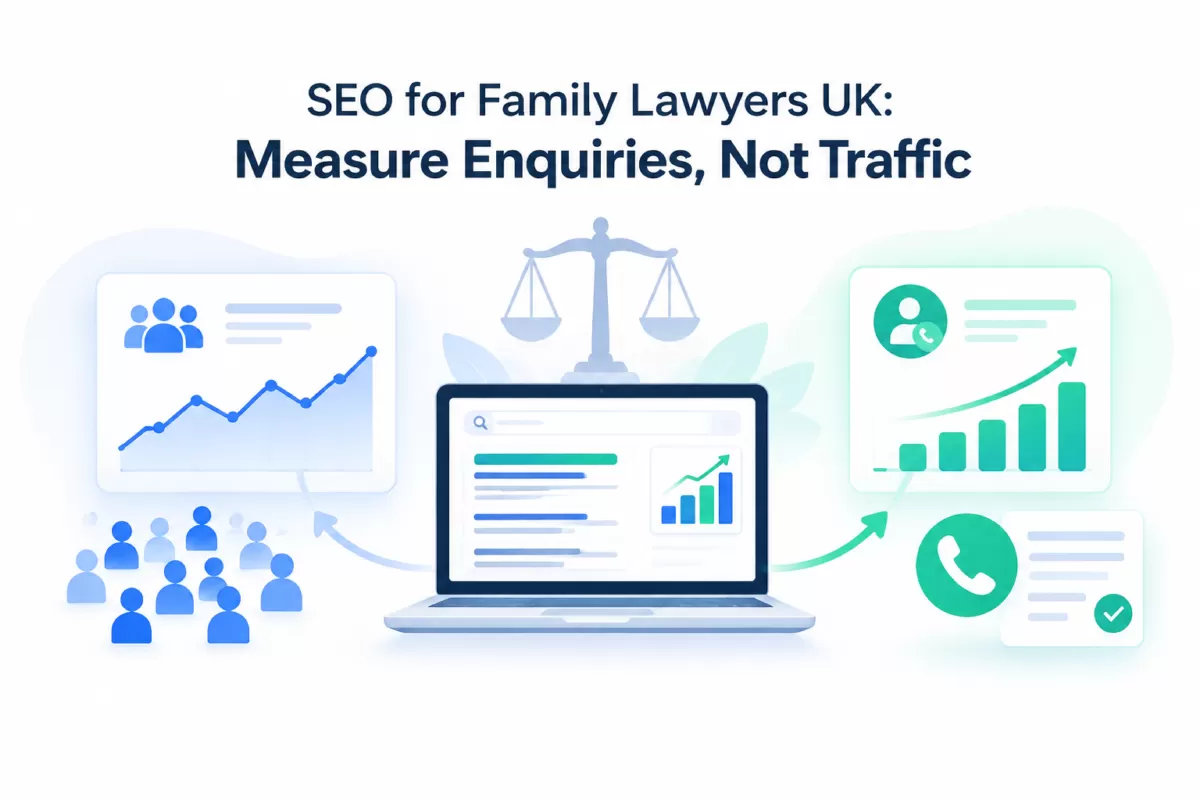
For family law firms in the United Kingdom, an increase in organic search visits can look like progress. But traffic alone does not show whether people are looking for legal help, whether they can reach your firm, or whether an enquiry is relevant to the services you offer.
A more useful way to assess SEO for family lawyers is to follow the path from search to contact, then review what kind of enquiry came through. This gives partners and practice managers a clearer basis for decisions without treating every visit as a prospective client or expecting small data sets to prove more than they can.
Why more organic traffic may not mean more enquiries
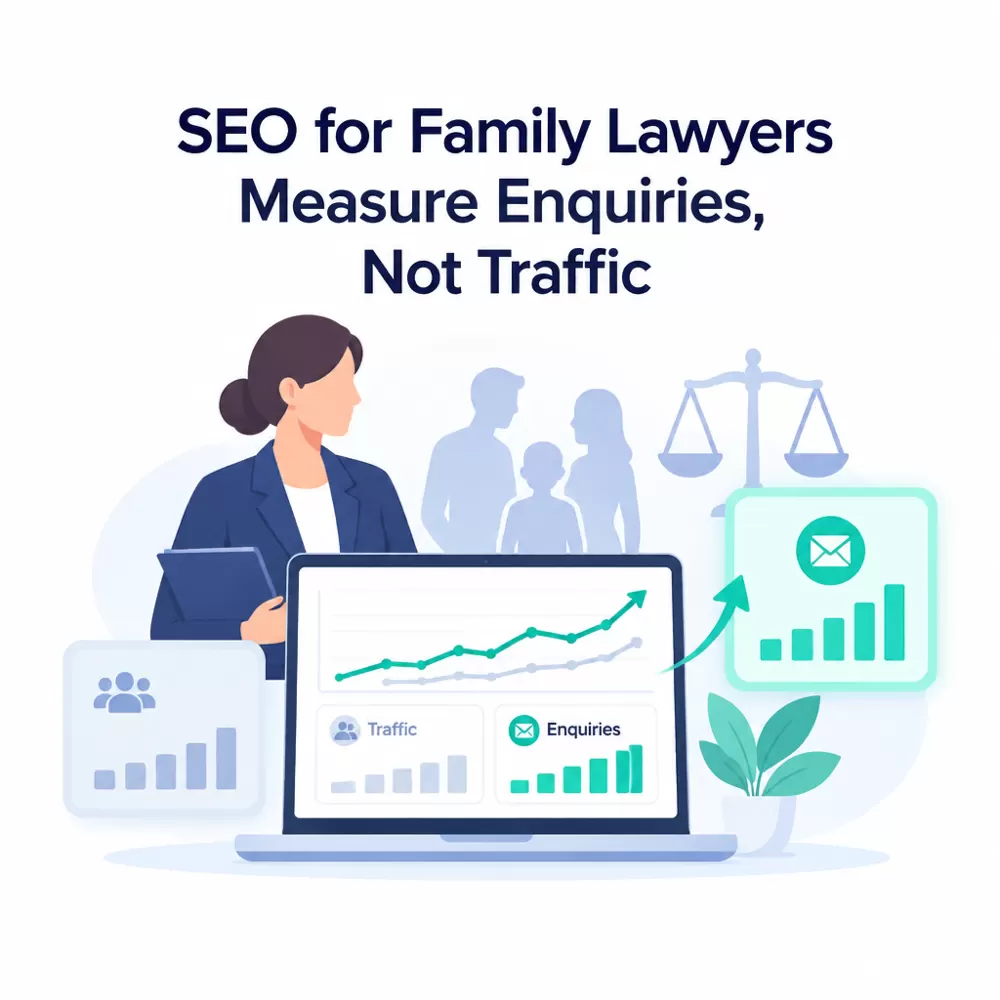
Organic search traffic is the visits a website receives from unpaid search results. It can show that a page is being found, but it does not tell you why someone visited or what they did next. A rise in visits might come from people researching a family law topic, checking a definition, or reading about a process that does not match the firm’s services or location.
That difference matters for a family law firm. A visitor reading general information about divorce may be at an early research stage. Another person searching for a solicitor to help with a financial settlement may be closer to contacting a firm. Both visits can be useful, but they should not be counted as equivalent business outcomes.
Raw traffic can also hide problems. A useful service page might bring in a small number of highly relevant visits, while a broad informational article attracts many readers who never need to speak with a solicitor. If reporting focuses only on total sessions, the second page can appear more successful even when the firm’s actual objective is relevant enquiries.
Set a measurement path that keeps these steps distinct: a search result is seen, a person visits a page, the person takes an action such as calling or submitting a form, and the firm assesses whether that contact fits its services and capacity. No single number tells the full story. The value comes from seeing where the steps connect and where they do not.
Define what a relevant enquiry means for your firm
Before reviewing conversion measurement, agree on what the firm will count as a relevant enquiry. A conversion is a recorded action, such as a form submission or phone call. It does not automatically mean the contact is suitable, new, or likely to become a client. Those distinctions should be clear in reporting.
Partners and practice managers can write a short internal definition using the firm’s own intake criteria. For example, an enquiry might be relevant if it concerns a family law matter the firm handles, comes from someone seeking legal assistance, and is within the firm’s service area or practical remit. The firm may also need to distinguish a new prospective client from an existing client, a supplier, or a job applicant.
Use a few consistent labels rather than relying on free-form notes alone. A basic set could include:
- Relevant: the person is seeking help with a service the firm provides.
- Not relevant: the contact is outside the firm’s services or is not a prospective client.
- Unclear: the available information is not enough to classify the contact.
- Existing contact: the enquiry relates to an existing client or an earlier matter.
These labels are for reporting, not a substitute for the firm’s normal intake decisions. Avoid calling an enquiry “qualified” just because someone filled in a form. A form can contain incomplete details, duplicate submissions, or a request that does not match the firm’s work.
Agree on who applies the labels and when. If one person counts every call as a lead and another excludes repeat callers, monthly comparisons will be unreliable. A short definition shared with whoever handles enquiries is more useful than a complex scorecard nobody applies consistently.
Separate informational visits from service-intent visits
Search intent is the likely reason behind a search. It is not a certainty about an individual’s needs, but it helps explain what a page is designed to do. Someone searching for an explanation of a family law term may want general information. A search that includes a service and a location, or asks how to contact a solicitor, may signal stronger service intent.
Review the search queries and landing pages together. A landing page is the first page someone visits from search. If a page about a legal process attracts informational visits, that can be a useful role for the page. If a service page attracts people searching for the specific help the firm provides, its performance should be assessed through relevant actions and enquiries, not just entrances.
For a practical review, group pages into a few types:
- Service pages: explain the firm’s family law services, who they are for, and how to make contact.
- Local pages: describe a genuine location or service area where the firm can assist, with accurate information rather than repeated place-name text.
- Informational pages: answer a question or explain a topic, and provide a clear next step when a reader wants to speak with the firm.
Then check whether the page matches the likely intent. A service page should make the relevant service and contact route easy to find. An informational page should answer the question clearly before inviting a reader to contact the firm. Do not treat every educational visit as a failed conversion. The visitor may not be ready to contact a solicitor, and the page may still help them understand the firm’s services.
Also avoid assuming that a click on a phone number or a contact-page visit is a completed enquiry. Those are useful actions to track, but they are steps in a journey, not proof that a conversation took place or that the contact was relevant.
Keep enquiry tracking consistent across UK local search
Organic search can lead people to a firm through standard search results, local results, or a Google Business Profile. In the United Kingdom, location and service-area searches can make local visibility an important part of the picture. Someone might search for a family solicitor near them, look at local listings, and then call from a profile rather than visit the website first.
Keep the firm’s business name, address, and phone number consistent across its website and business listings. This is often called NAP consistency. Check that the Google Business Profile reflects the firm’s real details and that the website gives a clear, matching contact route. An outdated number or a mismatched address can make both measurement and the prospective client’s next step harder.
For location pages, use places the firm genuinely serves and can describe accurately. A useful page might explain the relevant office, services, and ways to get in touch. Avoid creating near-identical pages for every neighbourhood just to appear for “near me” searches. If the firm has no distinct information or meaningful presence to describe, a page can confuse readers rather than help them choose.
Make a simple source-tracking routine part of enquiry handling. Record the reported source when someone contacts the firm, such as organic search, a business profile, referral, or unknown. If the person is unsure, use “unknown” rather than guessing. Keep the labels stable from month to month, and decide how to handle a person who first found an article and later returned directly to the site.
Phone calls need particular care in the tracking setup. If the firm uses call tracking, test that numbers and call records work as intended, and check that the main business details remain accurate on the website and listings. Do not assume a call click became a connected conversation. Where calls are recorded or sensitive enquiry information is stored, follow the firm’s relevant policies and seek appropriate advice about handling that information.
How can a family law firm tell whether SEO is generating relevant enquiries?
Compare the source, landing page, action, and intake outcome for each enquiry where that information is available. For instance, if a contact says they found the firm through search, note which page they remember or which service they are asking about. If analytics show a form submission from an organic visit, compare that record with the firm’s intake information where it is appropriate and possible to do so.
These records may not line up perfectly. A person can research on one device and call later from another. A form may not capture the original search source. Someone may also visit more than one page before contacting the firm. Treat attribution as a useful indication, not a complete account of how a person made a decision.
A monthly or quarterly review can answer practical questions without overstating certainty:
- Which service and local pages are attracting visits from relevant searches?
- Are visitors taking a meaningful next step, such as calling or submitting an enquiry?
- How many tracked contacts were assessed as relevant, not relevant, or unclear?
- Are there pages with apparent interest but no clear contact route?
- Have changes to forms, phone numbers, or tracking affected the records?
Use the answers to find a specific issue to investigate. If relevant visitors reach a service page but do not appear to contact the firm, check that the page describes the service plainly and that its contact details work. If there are contact actions but few relevant enquiries, review which searches and pages are bringing people in before deciding to change the page. Neither pattern proves a single cause on its own.
When assessing an SEO partner, ask how it distinguishes traffic, tracked actions, and relevant enquiries, and what information it needs from the firm to make that distinction. The supplied Softix profile describes custom software, web apps, SaaS, and CRM for moving daily operations out of spreadsheets. It does not confirm an SEO service. The requested seo for family lawyers link is included for review, but publish it only after Softix confirms it offers this service and that its homepage is the appropriate destination.
Review form and call quality, then read small samples carefully
Review enquiry quality in a consistent, proportionate way. A form can be marked as received, then classified during the firm’s ordinary intake process. Record only the categories needed for useful reporting. Family law enquiries can contain sensitive personal details, so analytics reports should not expose the contents of private messages or include unnecessary personal information. This is general measurement guidance, not legal or privacy advice; consult an appropriate specialist about the firm’s obligations and systems.
For calls, distinguish an attempted call from a connected call and a connected call from a relevant enquiry. A click-to-call event can show that someone tapped a number on a phone, but it cannot confirm what happened next. Staff can use a simple source question when it fits the conversation, but should not pressure someone to explain how they found the firm. A missing source is a valid record, not a reason to fill in a guess.
Small samples make interpretation harder. If a firm receives only a few organic enquiries in a reporting period, one unusual contact can change the apparent mix substantially. A tracking change, a seasonal shift, or one page update can also make a short comparison misleading. Do not set a universal benchmark or call a strategy successful or unsuccessful based on a handful of records.
Instead, look at several periods and keep notes about changes that could affect the comparison. Check whether the number of recorded enquiries is large enough to support the conclusion you want to draw. If source details are incomplete, say so. If relevance labels have been applied inconsistently, fix the process before using the historical totals to make firm decisions.
A sensible next step is to agree on the enquiry definition, confirm that forms and phone routes work, and test how source information is recorded from search and local listings. Then review page purpose and enquiry quality at a regular interval. That process will not guarantee more clients, but it can help a family law firm judge SEO by the enquiries it can reasonably observe instead of treating traffic as the result.
Because family law services and legal processes vary across parts of the United Kingdom, keep service information accurate to the firm’s jurisdiction and remit. Measurement can show how people find and contact the firm; it cannot replace professional legal judgement or intake review.
Share