
Published: September 4, 2026 · Last updated: September 4, 2026 · Author: Softix
On July 29, 2026, CISA with the NSA, FBI, and international partners released the 2026 Minimum Elements for a Software Bill of Materials.
The document updates and replaces the NTIA 2021 minimum elements. For US SMB founders and product/ops leaders who ship SaaS, mobile apps, containers, or custom software, the useful question is not “Do we need an ingredients list?” It is: what must we inventory, what must we generate in SPDX/CycloneDX form, and what proof will customers and procurement actually accept?
This Softix brief is a cybersecurity decision guide. It is not Softix’s EU CRA Article 14 reporting playbook (https://thesoftix.com/eu-cra-article-14-smb-scope-report-prove-2026/). Here the subject is US-aligned SBOM baseline quality under CISA’s 2026 guidance. Primary source: https://www.cisa.gov/resources-tools/resources/2026-minimum-elements-software-bill-materials-sbom
What changed from NTIA 2021 to CISA 2026
CISA frames an SBOM as a nested ingredients list for software supply-chain risk management. The 2026 guidance:
- Applies to all software as a starting baseline (AI systems and cloud SaaS may need additional elements later).
- Explicitly lists audiences including Small and Medium Businesses.
- Names widely used machine-processable formats practitioners map to SPDX and CycloneDX (see FOSSA and RunSafe secondary mappings).
- Raises expectations on transitive dependencies (secondary analyses emphasize no minimum depth), licensing, author/tool metadata, signatures/trust, and explicit marking of unknown vs withheld data.
Softix will not invent field counts. Re-read the CISA publication and PDF before you rewrite contracts. Treat secondary blogs as orientation, not the legal text.
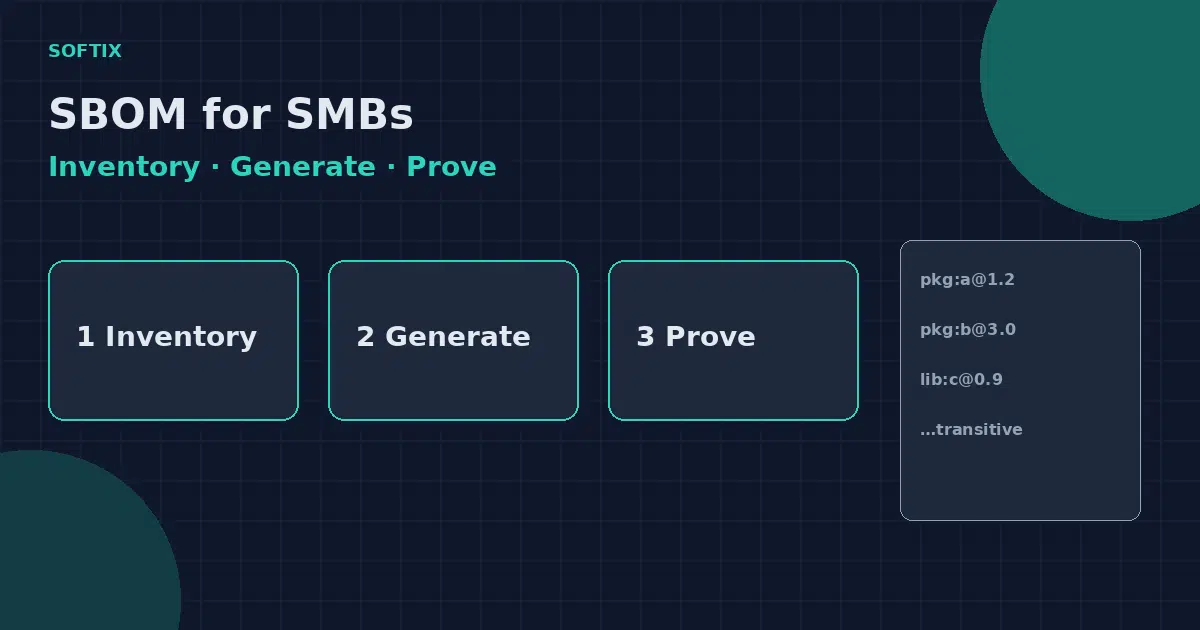
The Softix Inventory–Generate–Prove framework
Model launches and regulations outrun most SMB change calendars. Softix uses three gates so SBOM work becomes a release habit—not a PDF scramble before a security questionnaire.
Inventory — Know every artefact you place or procure
Before you pick a scanner:
- List shippable artefacts: web/SaaS builds, desktop/mobile installers, Docker/OCI images, CLIs, SDKs, firmware.
- Tag who owns generation: product eng vs vendor vs open-source package.
- Separate produce vs consume: what you ship vs what you buy (and must request SBOMs for).
- Map data classes: customer PII, payments, regulated workloads—procurement heat follows these.
If Inventory is vague, Generate will produce pretty files nobody trusts.
Generate — Emit 2026-baseline, machine-processable SBOMs
Generate means the pipeline produces an SBOM per release, not a one-off spreadsheet.
| Practice | Softix SMB expectation |
|---|---|
| Format | Prefer current SPDX or CycloneDX; accept both on intake |
| Depth | Include transitive components; do not stop at direct deps only |
| Metadata | Author, timestamp, tool name/version, SBOM version; follow CISA field list |
| Honesty | Mark unknown vs withheld explicitly—do not invent hashes or licenses |
| Trust | Plan for author/signature expectations in 2026 guidance |
| Timing | Generate post-build so hashes match what you actually shipped |
Pair Generate with Softix’s vibe-coding / secure SDLC habits (https://thesoftix.com/vibe-coding-enterprise-2026-security-governance-guide/): SAST/SCA and secret scanning still matter; an SBOM does not replace them.
Prove — Deliver, clarify, and operate on the data
Prove is what buyers test:
- Attach or link the SBOM to each customer-facing release (or authorized portal).
- Respond to clarification requests on redacted/withheld fields.
- Consume vendor SBOMs the same way—refuse PDF screenshots of dependency lists.
- Wire to incident response: when a CVE drops, Inventory + SBOM should answer “are we affected?” in hours—complementary to Softix CRA Scope–Report–Prove if you also ship into the EU.
Cannot Prove it? Do not claim “SBOM ready” on a sales slide.
Inventory–Generate–Prove at a glance
| Gate | Question | US SMB action |
|---|---|---|
| Inventory | Which artefacts and vendors are in scope? | Catalogue apps/images/SDKs; tag produce vs consume |
| Generate | Can CI emit SPDX/CycloneDX meeting 2026 fields? | Post-build generation; transitive depth; unknown marking |
| Prove | Can we deliver, clarify, and triage CVEs with it? | Release attachment + clarification SLA + vuln workflow |
A 30-day SMB plan
Days 1–10 — Inventory: freeze artefact list; pick one golden product; identify top third-party packages by risk; decide produce vs request.
Days 11–20 — Generate: enable SBOM export in CI for that product; validate against SPDX/CycloneDX tooling; fix missing licenses/hashes; document unknown fields honestly.
Days 21–30 — Prove: publish SBOM with a staging release; run a tabletop (“critical CVE in transitive lib X”); update vendor contract language to request 2026-baseline SBOMs; brief sales on what you will and will not claim.
Risks and limits
- Guidance is not statute. CISA’s minimum elements are authoritative practice for many US buyers; they are not Softix legal advice. Confirm with counsel for federal contracts.
- SaaS nuance. CISA notes AI and SaaS may need additional elements—start with the minimum, then extend.
- Tool marketing. Vendor one-click SBOM claims still need your Inventory truthfulness.
- EU CRA overlap. SBOM evidence helps CRA readiness but does not replace Article 14 reporting clocks.
- No fake completeness. Withheld fields without a clarification path destroy trust.
Is this the same as Softix’s EU CRA Article 14 post?
No. CRA Article 14 is EU reporting of actively exploited vulnerabilities and severe incidents. This article is the US CISA 2026 SBOM baseline for what a quality ingredients list contains.
Do pure SMBs need SBOMs if they are not federal contractors?
Often yes in practice: enterprise customers, insurers, and partners increasingly ask. CISA’s audience list includes SMBs for a reason.
Will Softix generate SBOMs for us?
Softix builds custom software (https://thesoftix.com/custom-software-development/) and SaaS (https://thesoftix.com/saas-development/) with release pipelines that can emit and consume SBOMs. We help you Inventory–Generate–Prove—not rubber-stamp a marketing PDF.
Softix CTA
If a customer just asked for a “2026 SBOM” and your team only has a dependency screenshot, Softix can wire Inventory–Generate–Prove into your CI and vendor process. Let’s talk: https://thesoftix.com/contact-us/
How Softix embeds SBOM into custom software delivery
When Softix builds or modernizes a product, Inventory–Generate–Prove is treated as part of the release Definition of Done—not a side quest for a security questionnaire week:
- Artefact inventory lives next to the architecture diagram (web, mobile, workers, containers).
- CI emits SPDX or CycloneDX for each tagged release candidate.
- Unknown fields are listed in a short README so sales does not invent completeness.
- Customer portal or release notes link the SBOM for enterprise buyers.
- Vuln response runbooks reference the same Inventory used for CRA-style reporting if EU distribution exists.
This is how Softix keeps E-E-A-T practical: we describe the operating system we actually install on engagements, without inventing customer names or pass rates.
Procurement questions worth answering once
Write answers now so every RFP does not restart the debate:
- Which products have 2026-baseline SBOMs today?
- Which formats do we emit (SPDX, CycloneDX, both)?
- How do buyers request clarification on withheld fields?
- How fast can we confirm exposure for a named CVE in a transitive dependency?
- Which third-party vendors still owe us SBOMs?
Pin those answers in a one-pager owned by product-ops and engineering together.
Share