
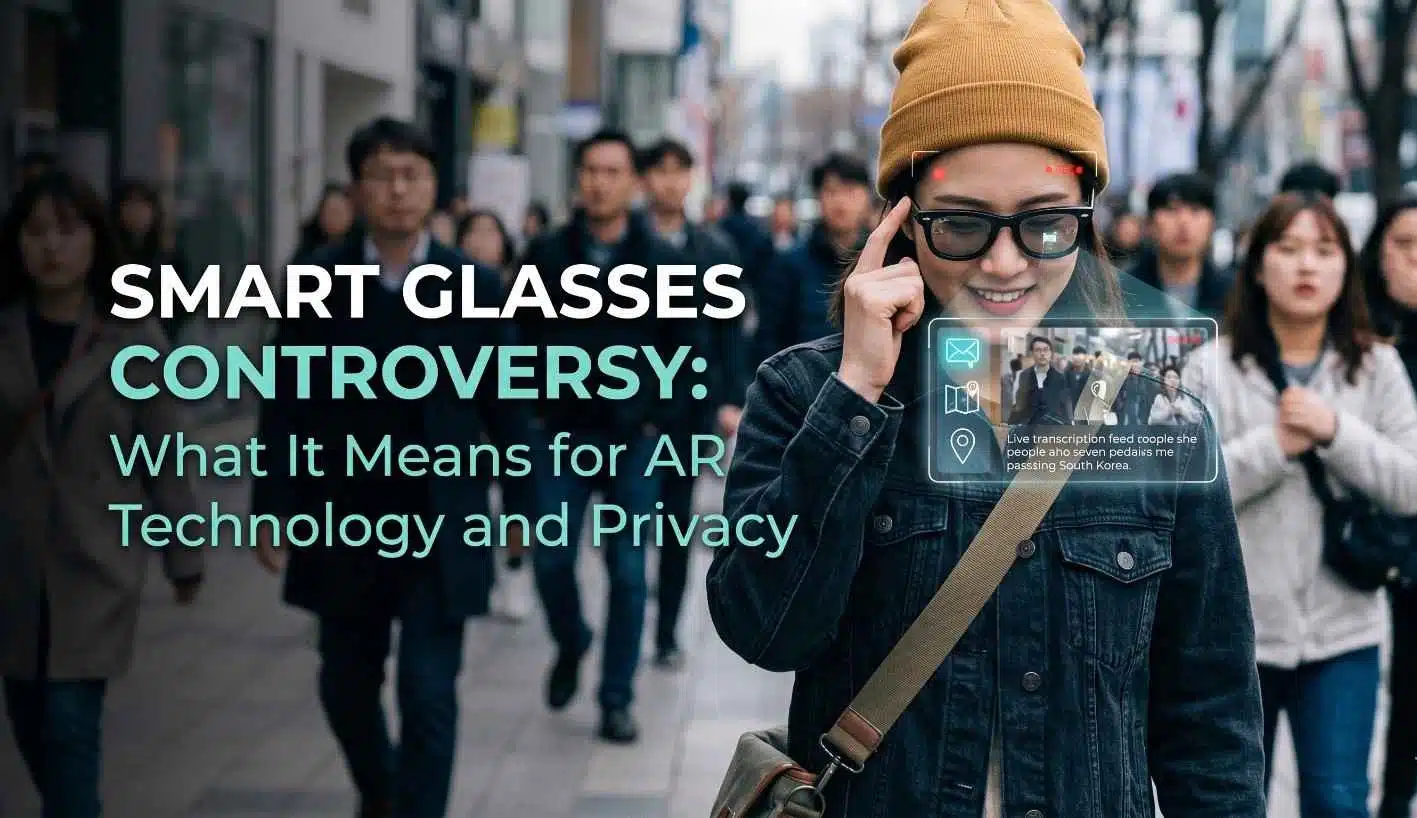
The landscape of personal electronics is shifting from the palm of our hands to the frames on our faces. As we move through 2026, the meteoric rise of “invisible” wearables has brought us to a cultural and technological crossroads. The ongoing Smart Glasses controversy is no longer a niche debate for Silicon Valley it has become a global conversation about the boundaries of digital surveillance, the evolution of AR technology, and the fundamental right to remain anonymous in a connected world.
The 2026 Surge: Innovation Meets Anxiety
For years, the tech industry struggled to make smart eyewear socially acceptable. The “Glasshole” era of the early 2010s was defined by clunky designs and obvious cameras that made bystanders uncomfortable. Fast forward to today, and the collaboration behind Meta Ray-Ban Meta AI has successfully cracked the code: style. By embedding high-performance sensors into iconic frames, the technology has become ubiquitous.
However, this success is exactly what fueled the modern Smart Glasses controversy. When technology becomes invisible, consent becomes impossible to verify. We are now living in an era where every person walking down the street could potentially be a live-streaming node, an AI-powered facial recognition scanner, or a data collection point for global tech giants.
The Technological Evolution of AR
To understand the friction, we must look at how far AR technology has come. Modern devices are no longer just cameras on hinges; they are sophisticated spatial computers.
- Real-Time Processing: Current chipsets allow for on-device AI that can translate foreign text in real-time or identify objects through neural networks.
- Spatial Anchors: These allow digital information to stay “pinned” to physical locations, turning the entire world into a clickable interface.
- Invisible Sensors: Micro-LEDs and hidden microphones ensure that the future of AR devices looks exactly like standard fashion, removing the visual cues that once signaled “tech is present.”
At TheSoftix, we have tracked these wearable technology trends 2026 closely. While the hardware is breathtaking, the software governing it is where the most significant privacy risks of smart glasses reside.
The Privacy Minefield: Data, Consent, and Clouds
The primary catalyst for the current Smart Glasses controversy involves how data is handled once it leaves the device. Investigations in early 2026 revealed that footage captured by users was being routed to third-party contractors in various regions for “AI model tuning.”
This practice has turned private interactions into training data. When a user wears these glasses into a private home, a doctor’s office, or a school, the device doesn’t just see the world; it records it. The augmented reality privacy debate is centered on three critical pillars:
1. The Deletion of Anonymity
In the past, walking through a city provided a level of “public anonymity.” You were just a face in the crowd. With the integration of Meta Ray-Ban Meta AI and third-party facial recognition plugins, that anonymity is dead. Recent “Name Tag” style features allow wearers to instantly link a stranger’s face to their Instagram, LinkedIn, or even private database entries.
2. Biometric Data Security
Smart glasses are moving toward tracking more than just what we see. New sensors track eye movement (gaze tracking), pupil dilation, and even heart rate through the temples. This biometric data security concern is paramount. If a company knows exactly what you look at and for how long they possess the ultimate tool for psychological profiling and hyper-targeted advertising.
3. The Failure of Physical Indicators
Meta and other manufacturers implemented a “capture LED” to signal when recording is active. However, the Smart Glasses controversy reached a fever pitch when “stealth mods” began appearing online, teaching users how to dim or cover these LEDs without triggering the device’s internal shut-off sensors. This has led to a surge in recorded interactions where the subject had no idea they were on camera.
Legal and Ethical Frameworks: The Global Response
As the Privacy risks of smart glasses become more apparent, regulators are stepping in. In Europe, the European Commission has launched inquiries into whether Meta’s data-handling practices violate GDPR, specifically regarding the “lawful processing” of third-party data.
In the United States, the focus has shifted toward wearable AI ethics. Advocacy groups like the ACLU have called for a total ban on facial recognition in consumer eyewear, arguing that the technology gives “predators and stalkers” unprecedented power. The debate is no longer about whether the technology is cool—it’s about whether it is safe for a civil society.
The Industry’s Defense: Why AR Needs Data
Manufacturers argue that these privacy-invasive features are the only way to realize the true potential of AR technology. For an AR assistant to be helpful, it must have “world-facing” awareness.
- It needs to see your stove to tell you it’s still on.
- It needs to see your friend’s face to remind you of their birthday.
- It needs to map your living room to place a virtual TV on the wall.
This is the “Privacy Paradox” of the future of AR devices. To provide maximum value, the device requires maximum access. Companies are now pivoting toward “Privacy by Design,” promising that more data will be processed on the device’s local chip rather than being sent to the cloud. Whether consumers trust these promises remains the billion-dollar question.
Impact on the Future of AR Devices
The Smart Glasses controversy will ultimately dictate the design of the next generation of hardware. We are likely to see:
- Hard-Wired Privacy Switches: Physical sliders that cut power to the camera, providing a visual “safe” mode for bystanders.
- Bystander Notifications: Technology that can ping nearby smartphones to alert people that a recording device is active in the vicinity.
- Restricted Zones: Geofencing software that automatically disables cameras in sensitive areas like hospitals or locker rooms.
For the readers of TheSoftix, staying informed on these biometric data security developments is crucial. We aren’t just choosing a gadget; we are participating in a massive social experiment regarding the “right to be forgotten.”
Conclusion: A New Social Contract
The Smart Glasses controversy isn’t going away. As AR technology continues to merge with our daily lives, we must establish a new social contract. We need to decide where the “digital world” ends and our “private world” begins.
Meta Ray-Ban Meta AI and similar devices offer a glimpse into a future of effortless information and enhanced human capability. However, that future cannot come at the cost of our fundamental augmented reality privacy. As we move forward, the “soft” side of tech policy, ethics, and consent will be just as important as the hardware itself.
The future of AR devices is bright, but only if we can ensure that the eyes of the world aren’t always watching, recording, and analyzing our every move.
Share